Used
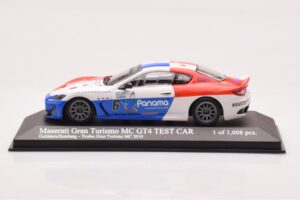
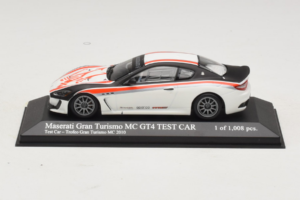
Maserati GranTurismo MC GT4 #6 Goldstein / Sumberg Trofeo GranTurismo 2010 Minichamps 1:43
Only 2 left
Price:
£32.00
Price shown excluding UK VAT. Import VAT and the courier's customs clearance fee are collected on delivery.
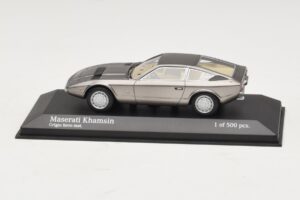
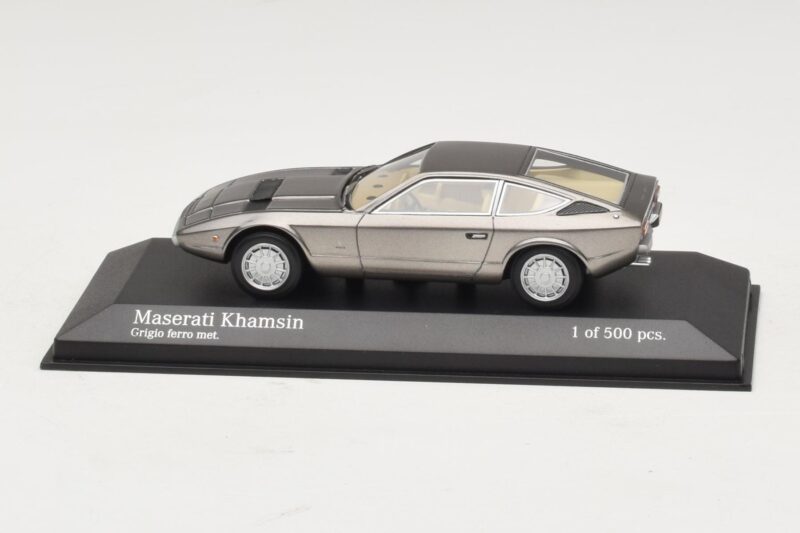
TL;DR: Minichamps' 1:43 Maserati Khamsin Grey Metallic reproduces Marcello Gandini's Bertone-designed grand tourer, built during Maserati's Citroën-owned era in the mid-1970s. The sealed diecast body captures the Kamm tail's glass rear panel and the coupé's flat, angular surfacing in a restrained grey that lets the design speak for itself. A mid-tier piece for serious Maserati collectors.
Marcello Gandini drew some of the most dramatic Italian cars of the 1970s, and the Khamsin's flat planes and glass-panelled tail were among his boldest work for Bertone. Minichamps' 1:43 diecast renders that design in grey metallic, a shade that suits the Khamsin's severity better than a louder colour might. Built during Maserati's years under Citroën ownership, the real car borrowed French hydraulics for its brakes and steering.
The Khamsin's most distinctive feature sits at the rear, where a full-width glass panel covers the tail lights and licence plate, a Gandini touch that gave the car a smooth, uninterrupted Kamm-tail profile unlike anything else in Maserati's range. Bertone built the body to carry that flat glass cleanly into the rear wings, a shape that depended on precise panel fit to avoid an awkward seam where glass met metal. Minichamps has to reproduce that transition convincingly in miniature, since any softness in the moulding there would undercut the whole design's point.
Maserati spent the late 1960s and early 1970s under Citroën's ownership, and the Khamsin absorbed some of that French engineering directly: hydraulic power steering and brakes borrowed from Citroën's system, along with hydraulically operated pop-up headlights hidden behind the front panel until needed. It is an unusual pairing, an Italian V8 grand tourer running on French hydraulics, and one that makes the Khamsin a genuine curiosity within Maserati's history rather than just another 1970s coupé. None of that hydraulic hardware is visible from outside, so the model's job is simpler: get the closed, headlight-concealing nose right, and the story behind it comes along for free. The result was a car that felt distinct to drive, and distinct to look at, wherever a design line runs.
Bertone's design leans on large, flat panels rather than heavy curves, a look that is unforgiving of any casting softness because there is so little surface detail to distract from a wavering line. Diecast's zinc alloy construction gives Minichamps the rigidity to hold those flat planes true, at the cost of the slightly wider tolerances metal casting allows compared with resin. On a car this angular, that trade favours the metal: a flat surface needs to stay flat, and a heavier, more dimensionally stable body helps guarantee it does. That stability also protects the sharp shoulder line running the length of the door, a feature that would round off quickly on a softer material.
The rear panel's glass effect is picked out with a tinted, glossy finish distinct from the surrounding grey bodywork, a detail that has to read correctly under a display lamp for the Kamm tail to make sense as a design. Because the body is sealed, with no boot or door that opens, that transition between glass-look and painted metal runs as a single uninterrupted line, exactly as Gandini intended it. The pop-up headlight covers, too, sit flush and closed, part of that same fixed casting rather than a separate moving piece.
Grey suits the Khamsin in a way a brighter Maserati red might not, because Gandini's design already carries plenty of visual drama in its shape alone. A quieter colour lets the flat bonnet, the sharp waistline and the glass tail panel do the talking without competing for attention, and under direct light the metallic flake sits at a convincing depth rather than reading flat or chalky. At 1:43, the Khamsin measures roughly ten centimetres from nose to tail, a compact size that still leaves enough surface for the design's key lines to register clearly on a cabinet shelf. Displayed next to a Ghibli or a Bora, the two other Maseratis of the period built to broadly similar briefs by different designers, the Khamsin's flat-planed grey stands out as the most severe, least ornamented shape of the three. Diecast holds that grey consistently across the bonnet and tail panel, with no visible seam where the casting's sections meet, a small but telling sign of careful assembly at this price point. For a collector who already owns the red version elsewhere in the range, the restrained tone offers a genuine alternative rather than a repeat.
Within Maserati's early-1970s range, the Khamsin occupied an odd middle ground: front-engined and V8-powered like the Ghibli it eventually replaced, but styled with the same Bertone severity that Gandini brought to some of the era's most talked-about supercars. It never sold in the numbers the Ghibli did, which makes a well-finished 1:43 replica a useful way to study a design most collectors will never see parked at a show. Minichamps' sealed diecast build keeps the focus exactly where the Khamsin earns it, on Gandini's surfacing and that glass-panelled tail, rather than on any moving feature the real car's hardware might tempt a builder to add. That difference is the strongest reason to seek this coupé out over a more common Maserati of the same decade.


Save £33.00


Save £14.00