Used

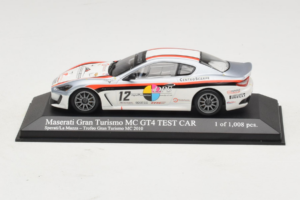
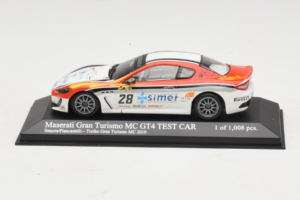
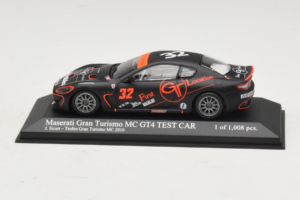
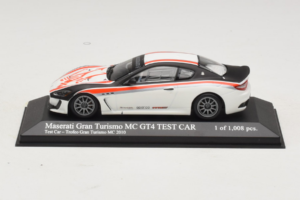
Maserati GranTurismo MC GT4 #6 Goldstein / Sumberg Trofeo GranTurismo 2010 Minichamps 1:43
Only 2 left
Price:
£32.00
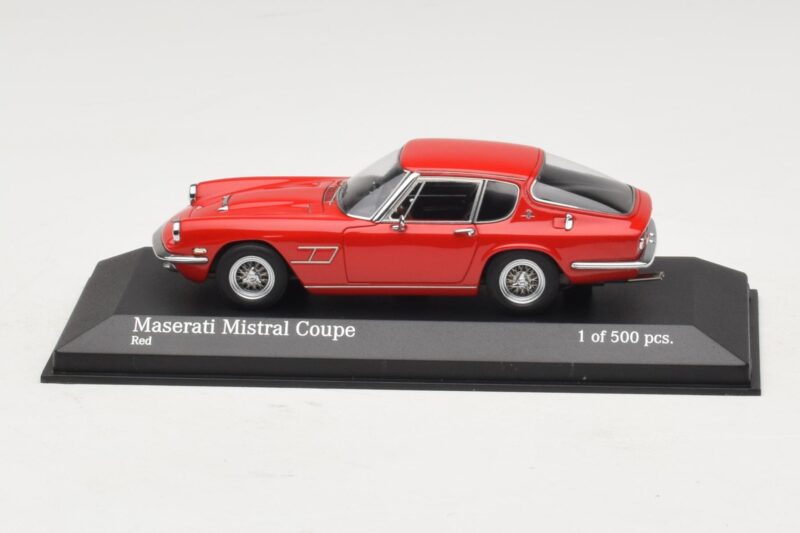
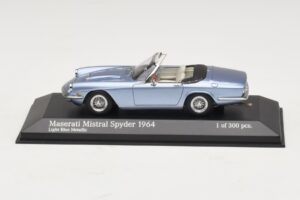
TL;DR: Minichamps' 1:43 Maserati Mistral Red reproduces Pietro Frua's 1963 grand tourer, one of Maserati's wind-named coupés and among the first production cars with a full glass hatchback. The sealed diecast body captures Frua's compact, six-cylinder-powered shape in a bold red finish. A mid-tier piece for collectors tracing Maserati's design lineage before the Ghibli.
Before the Ghibli made Maserati's name synonymous with dramatic Italian grand tourers, the Mistral quietly did something more unusual: it fitted a full glass hatchback over its luggage area, years before that idea became common. Minichamps' 1:43 rendering in red shows Pietro Frua's compact coupé shape, powered in period by one of the few straight-six engines Maserati ever built rather than the marque's usual V8.
The Mistral's rear glass hatch, hinged to lift as a single piece over the luggage compartment, was a genuinely novel idea when Frua introduced it in 1963, predating the hatchback layouts that would later become common across ordinary family cars. On the real Mistral, that glass panel curved down into the tail in a way that made the whole rear end look lighter and more open than a conventional boot lid could manage. Minichamps' casting holds that curve as a fixed, sealed shape, with the glass-effect panel picked out cleanly against the surrounding red bodywork rather than built to lift.
Where most of Maserati's grand tourers from this period ran V8 engines, the Mistral used a straight-six derived from the earlier 3500GT, a choice that made it lighter and, by most contemporary accounts, more agile through corners than its bigger-engined siblings. That mechanical distinction is invisible on a sealed diecast model, of course, but it shaped the Mistral's proportions: a shorter, narrower nose than the Khamsin or Indy that followed it, since a straight-six demands less width under the bonnet than a V8. Frua's body reflects that packaging directly in its compact, tapering front end. The name itself follows a tradition Maserati kept for years, naming grand tourers after Mediterranean winds rather than places or numbers.
The Mistral's shorter nose and tighter overall proportions, compared with later Maseratis, leave a diecast body less surface to work with but no less to get right; a smaller car shows a soft edge or an uneven panel just as readily as a larger one. Zinc alloy's weight gives this compact coupé a settled presence in the hand despite its modest 1:43 footprint, a density that a resin casting at the same size would not replicate.
Because the body is sealed, with no boot or door that opens, the glass hatch's curve runs as one continuous surface from the roofline into the tail, exactly the effect Frua's original design depended on. That fixed construction lets Minichamps hold a crisp, consistent edge where the glass-effect panel meets the painted metal around it, a transition that would be far harder to keep sharp on a hinged, opening version of the same part. Red paint sits with real depth against that darker glass panel, giving the tail a clear visual break without any loss of surface continuity. Wheel arches sit tight and close to the tyres, a proportion typical of Frua's more compact grand tourers and one Minichamps holds faithfully at this scale. That tightness is part of what makes the Mistral read as noticeably smaller than its Maserati siblings on the same shelf.
Red brings out the Mistral's tighter, more compact shape in a way a quieter colour might not, since the shorter nose and narrower cabin have less surface for a bold shade to spread across, concentrating the visual impact rather than diluting it. Under a display lamp the metallic finish reads with genuine depth, catching the curve of that glass hatch differently from the flatter door panels beside it. At roughly ten centimetres nose to tail in 1:43, the Mistral sits close in size to the later Khamsin, but its rounder, less angular surfacing gives the same red a softer, more classically Italian read than Gandini's flatter design would produce in the same colour. Set beside a Ghibli or an Indy from the same Maserati family, the Mistral's smaller proportions and rounder nose mark it as the more delicate design of the group, a distinction red only sharpens. Diecast holds that shade evenly across the compact body, with the glass hatch's darker finish providing a clean, deliberate contrast rather than an abrupt colour break. For a collector tracing Maserati's design lineage through the 1960s, this red Mistral marks an earlier, gentler chapter than the more aggressive shapes that followed it.
The Mistral occupies a specific, easily overlooked position in Maserati's history: the last of the marque's smaller, six-cylinder grand tourers before the V8-powered Ghibli redefined what a Maserati coupé should look and feel like. Minichamps' 1:43 diecast keeps that earlier chapter accessible, a mid-tier piece that rewards a collector willing to look past the more famous Ghibli and Bora for a genuinely distinctive design. The sealed body and glass hatch profile are the model's whole story, since there is no engine bay to open and no straight-six to admire directly, only the shape Frua gave it. Its rarity relative to the later cars only adds to that argument.



Save £14.00