Used

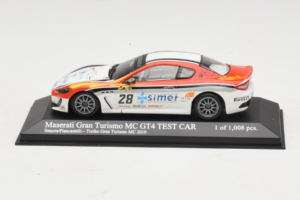
Maserati GranTurismo MC GT4 #6 Goldstein / Sumberg Trofeo GranTurismo 2010 Minichamps 1:43
Only 2 left
Price:
£32.00
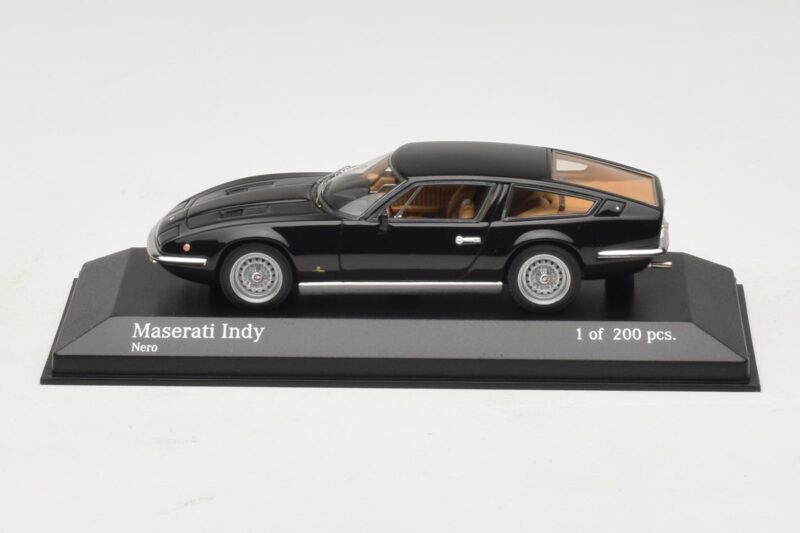
TL;DR: Minichamps' 1:43 Maserati Indy reproduces the 1969-1975 Vignale-styled grand tourer in gloss black diecast, cast as a sealed one-piece body with no opening panels. Named for Maserati's Indianapolis 500 wins, this coupe pairs a long bonnet and fastback roofline with crisp shut lines and deep, even paintwork.
Vignale's design studio gave the Indy a low, wide stance quite unlike the upright saloons Maserati is sometimes remembered for. Minichamps captures that stance at 1:43, and the black finish here does the shape few favours in the way metallic paint would, but it also hides nothing: every line has to earn its place, and the model's proportions carry the design without shortcuts.
The Indy's bonnet runs long and nearly flat from the grille to the windscreen, a shape that rewards a body with no seams to interrupt it. Minichamps casts this Maserati as a single fixed shell, and that decision keeps the roofline, the wing tops and the bonnet as one continuous surface rather than a set of separately hinged panels chasing consistent gaps. Nothing on this model opens, and that is by design rather than omission: zinc alloy diecast at 1:43 does its best work when the tooling can hold one uninterrupted line across a body this length, and the Indy's slab-sided profile is exactly the kind of shape that benefits.
Black is the least forgiving colour a diecast finisher can choose, because it shows every imperfection in a panel line and every inconsistency in gloss. Under a directed light, the Indy's flanks read as a single even sheet, with the paint holding consistent depth from the front wing to the tail. There is no chrome trim break to hide a seam here, so the quality of the black lacquer itself becomes the model's calling card. Held in the hand, the weight of zinc alloy construction is immediately obvious against lighter materials, and it is that mass, together with the paint's evenness, that gives this small-scale coupe real shelf presence.
Maserati named the Indy to commemorate its back-to-back Indianapolis 500 victories, wins that predated this car's 1969 launch by three decades but still carried weight for a marque that traded heavily on racing pedigree. The road car itself never competed at Indianapolis; the name was pure homage, applied to a grand tourer built to cover long distances at speed rather than to lap an oval. That contrast between a competition name and a comfort-focused brief runs through the whole car, and it is part of what makes the Indy an interesting subject for a coupe collection rather than a pure racing one.
Where many Italian GTs of the period seated two, the Indy was built as a genuine 2+2, with rear seats intended for adults rather than token space behind the front chairs. Maserati fitted its own V8, offered across the model's run in 4.2, 4.7 and 4.9-litre forms, the same engine family that powered the Ghibli and Quattroporte of the era. That combination of four real seats and a proper V8 made the Indy a rarer proposition than the two-seat Ghibli it shared showroom space with, a grand tourer built for owners who wanted usable space alongside genuine pace.
Vignale styled several Maserati road cars through the late 1960s, and the Indy sits alongside the Ghibli and Mexico as one of the studio's clearest statements from that period, aimed at a slightly different buyer than either two-seat rival. Lined up on a shelf, the differences in roofline and bonnet length show how Vignale adapted one design language across a two-seat coupe, a four-seat coupe and this longer 2+2. A 1:43 collection organised by coachbuilder rather than marque rewards that comparison, since the scale is compact enough to gather several Italian GTs from competing studios without needing a large cabinet.
At just over ten centimetres, the Indy's footprint suits a dense shelf arrangement far better than the same subject at 1:18 would. Minichamps has built its reputation on this smaller scale largely because it lets a collector cover more ground: a full decade of Italian grand tourers fits into the space a handful of larger models would occupy. The trade-off is resolution rather than accuracy. Fine cast-in details read smaller, but the panel geometry and stance that define a Vignale design remain legible from across a room, which is exactly what a coupe like this needs to communicate on a shelf.
This Indy fits most naturally into a themed run of late-1960s and early-1970s Italian grand tourers, where its longer cabin and 2+2 layout provide a useful contrast to the two-seat coupes that usually dominate such a display. Buyers assembling a Maserati timeline in 1:43 will find the black finish works as a neutral anchor colour, one that sits comfortably beside brighter liveries from the same era without competing for attention.
Against the alternative of chasing this subject at 1:18, the smaller scale keeps the acquisition modest without asking a collector to compromise on the shape that actually defines the Indy. It suits a buyer who wants Vignale's design language represented accurately rather than a showpiece that dominates a cabinet, and it pairs sensibly with other Minichamps Maserati coupes finished in different colours from the same production run.


Save £33.00




Save £14.00