Used
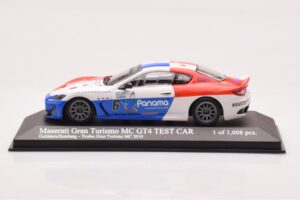
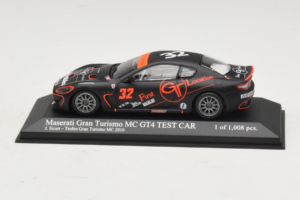
Maserati GranTurismo MC GT4 #6 Goldstein / Sumberg Trofeo GranTurismo 2010 Minichamps 1:43
Only 2 left
Price:
£32.00
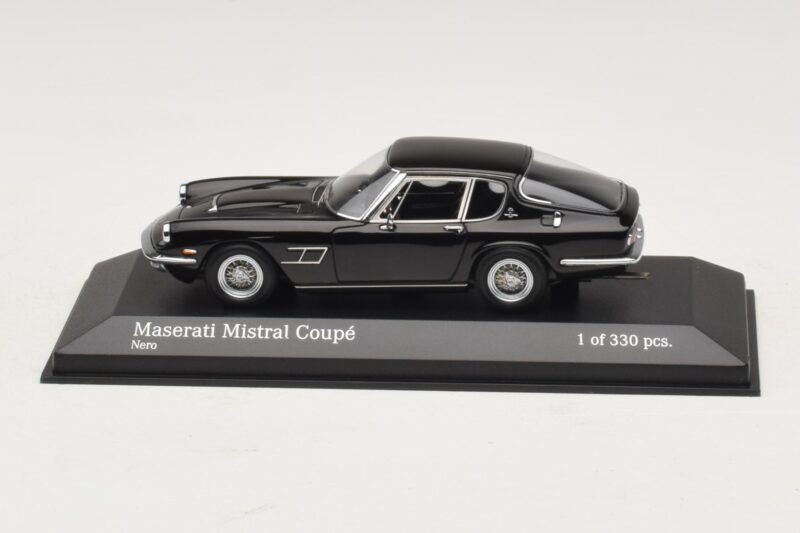
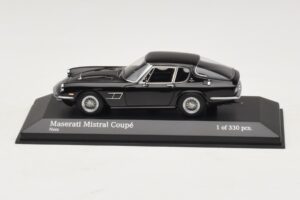
TL;DR: Minichamps' 1:43 Maserati Mistral Coupe reproduces Frua's closed-roof GT from 1963, the more common body style behind Maserati's last straight-six sports car. Cast as a sealed diecast body in black, it carries the fastback roofline that defined the original design before the rarer Spyder followed a year later.
Before Maserati offered an open version of the Mistral, there was only this shape: Pietro Frua's fastback coupe, launched in 1963 as the definitive closed-roof expression of the design. Minichamps casts that original body in black 1:43 diecast, a sealed shell that gives full weight to the roofline the Spyder would later trade away. Where the Spyder reads as the rarer variant, this coupe is the Mistral most buyers chose.
Pietro Frua's Mistral design debuted as a coupe in 1963, a year before the open Spyder followed, and the closed roofline is arguably the purer expression of what Frua was after: a long, tapering fastback that carried the greenhouse smoothly down into the tail rather than interrupting it with a folding top's mechanism and stowage space. The Mistral was Maserati's last GT built around the company's long-serving straight-six engine, arriving just before the V8-powered Ghibli took over as the marque's flagship, which gives the coupe a particular place in Maserati's history as the closing chapter of an engineering era rather than the opening of a new one. Because the coupe arrived first and remained in production throughout the model's run, it accounts for the larger share of surviving Mistrals today, making it the body style most collectors will encounter first when researching the car. That relative commonality does not make the coupe a lesser piece; if anything, it represents Frua's design intent most completely, since the fastback roofline was the element the Spyder's conversion had to compromise around. For a collector prioritising design purity over rarity, the coupe is the more faithful record of what Frua actually drew.
The coupe's fastback roofline is the single detail that most needs to convince on a casting like this, since it is the element that most clearly separates the closed car from the open Spyder built on the same underlying shape. Minichamps casts the body as a sealed, one-piece zinc alloy shell, and that construction suits a coupe far more naturally than it would an open car, because there is no cabin to leave visible and no compromise needed between a solid casting and an implied open top. The roofline should taper smoothly from the windscreen down to a near-vertical tail, following Frua's fastback profile rather than settling into a more generic notchback shape, and getting that taper right is what separates a genuinely well-tooled Mistral coupe from a passable but slightly wrong GT silhouette. Black paint over that shell shows panel lines with unusual clarity, since dark colours reveal any inconsistency in a shut line or surface transition far more readily than a lighter shade would, which makes black something of a stress test for a manufacturer's tooling quality. The zinc alloy body's weight gives the coupe real presence in the hand, a density that matters on a GT this size.
Black is a demanding colour for diecast, showing every seam and surface irregularity that a mid-tone or metallic finish would help disguise, and a well-executed black Mistral coupe should hold a deep, even gloss across the roof and bonnet without any cloudiness along the character line. The coupe's grille, the same understated narrow oval Frua used across the range, sits within a nose that carries slightly more formal presence in black than the same shape would in a brighter colour, suiting the car's role as a serious, grown-up GT rather than a flamboyant show car. Chrome window surrounds and door handles need to stand out crisply against the dark bodywork, since black offers little forgiveness for trim that sits even slightly proud or recessed compared with the surrounding panel. Wheel choice should carry a stance that keeps the car looking low and purposeful, consistent with the Mistral's genuine high-speed touring intent.
For a collector new to the Mistral, this black coupe is the sensible starting point: it represents the design in its original, most complete form, and its relative commonality against the Spyder means it typically sits at a more accessible price within Minichamps' range. Owning both eventually tells the fuller story, the coupe's unbroken roofline against the Spyder's rarer open cabin, but the coupe alone already captures Frua's design intent without needing that pairing to justify the purchase. Black gives this casting a formal, slightly serious character that suits the Mistral's position as the final expression of Maserati's straight-six era, a car built to close out a chapter rather than announce a new one. That quiet significance is easy to overlook next to flashier contemporary Italian GTs, which is exactly why it rewards a more considered collector.

Save £33.00

Save £14.00