Used

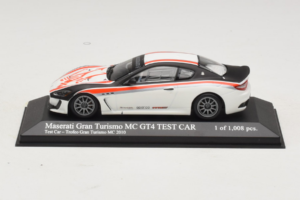
Maserati GranTurismo MC GT4 #6 Goldstein / Sumberg Trofeo GranTurismo 2010 Minichamps 1:43
Only 2 left
Price:
£32.00
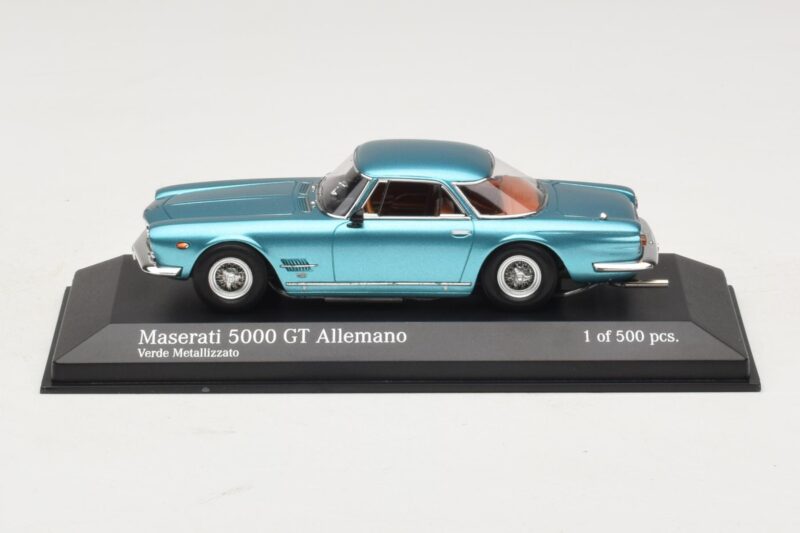
TL;DR: Minichamps' 1:43 Maserati 5000 GT reproduces Allemano's 1962 coachbuilt body in metallic green diecast, cast as a sealed one-piece shell with no opening panels. Built on the 3500GT chassis with a 5-litre V8 derived from the 450S racer, the 5000 GT was among Maserati's rarest and most exclusive post-war grand tourers.
Few Maserati road cars carry a backstory as unusual as the 5000 GT, a car originally built to satisfy the Shah of Iran's request for something faster than his 3500GT. Allemano's coachwork on this example is one of several interpretations the model wore across its short production run, and Minichamps renders that specific body in a deep metallic green that suits the car's understated, hand-finished character better than a brighter shade would.
The original 5000 GT was never a production car in any conventional sense; each coachbuilder essentially hand-formed its own interpretation over the 3500GT platform, and Allemano's version is generally considered the most numerous of the batch, though still built in tiny numbers. Minichamps casts this Allemano-bodied example as a single fixed diecast shell, with no doors, bonnet or boot that open. That construction choice suits a coachbuilt subject well: the original panels were shaped by hand rather than pressed on a production line, and a one-piece casting lets the model's surfaces read as continuously as the hand-formed original did, without hinge lines interrupting a shape that was never meant to have them.
Metallic green is a harder colour to get right in miniature than a solid shade, because the flake has to sit evenly across compound curves without breaking up or pooling in recesses. Under a spotlight, this example's paintwork should show a consistent depth from the long bonnet through to the sloping tail, with the metallic content reading as fine grain rather than coarse sparkle. Zinc alloy construction gives the body enough mass to feel substantial for its size, and that weight, paired with a well-applied metallic finish, is what separates a considered diecast reproduction from a toy-grade casting at the same scale.
The story that gave the 5000 GT its start involves Mohammad Reza Pahlavi, the Shah of Iran, who reportedly asked Maserati for something more potent than his existing 3500GT. Maserati's response was to fit the smaller car's chassis with a much larger engine and commission a series of coachbuilders to clothe it individually, rather than settling on one design for series production. That approach explains why 5000 GTs vary so much from one example to the next: Touring, Frua, Ghia, Bertone, Michelotti and Allemano all built bodies, and none of them built very many.
Under the skin, the 5000 GT carried a five-litre V8 derived from the 450S, the sports racer Maserati had campaigned at Le Mans and other endurance events earlier in the decade. Putting a competition-bred engine into a car intended for private, wealthy clients rather than a circuit was unusual even by the standards of the period, and it gave the 5000 GT genuine performance to match its exclusivity. That racing lineage is part of why the model still commands serious attention among Maserati specialists today, even though most enthusiasts will only ever encounter one in miniature rather than in the metal.
Original 5000 GTs rarely appear at auction, and when they do, the coachbuilder attached to a given chassis matters enormously to value and to how the car is discussed among specialists. For most collectors, a 1:43 diecast is the only practical way to study Allemano's specific take on the shape: the tighter tail treatment, the more restrained grille surround, and the slightly longer glasshouse that distinguish it from Frua's or Ghia's versions of the same underpinnings. Building a shelf around 5000 GT variants offers a rare chance to compare interpretations of one brief that most collectors of any Maserati generation will never see gathered in one room.
At 1:43, the model's footprint sits under eleven centimetres, small enough to keep several coachbuilt variants together without demanding a dedicated cabinet. That density matters for a subject this narrow: there is little value in owning just one 5000 GT interpretation when the entire appeal lies in comparing bodies, and the compact scale makes that comparison genuinely practical on a home shelf rather than a museum wall.
Set beside more conventional Maserati grand tourers like the Indy or the Mistral, this 5000 GT represents the specialist end of the same lineage: a car built in far smaller numbers, to individual commission, rather than to any standard specification. It works best as an anchor piece within a coachbuilder-focused display rather than as one entry among many volume-production Italian coupes.
Buyers drawn to Maserati's most exclusive history, rather than its most visible one, will find this model rewards closer study more than a quick glance. The metallic green, applied with the same care Minichamps brings to its other Italian subjects, gives the Allemano body a presence that a flatter colour would understate.



Save £33.00




Save £14.00