Used
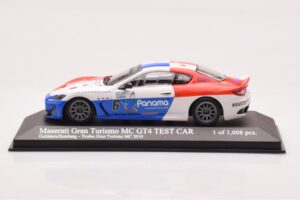
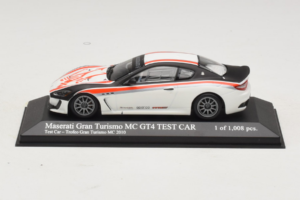
Maserati GranTurismo MC GT4 #6 Goldstein / Sumberg Trofeo GranTurismo 2010 Minichamps 1:43
Only 2 left
Price:
£32.00
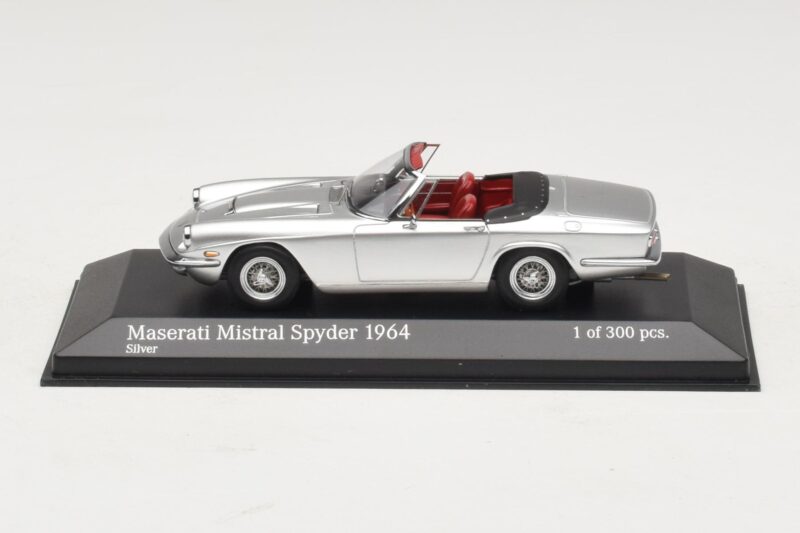
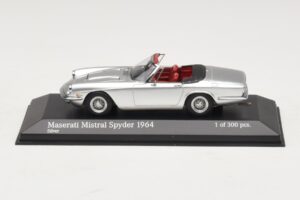
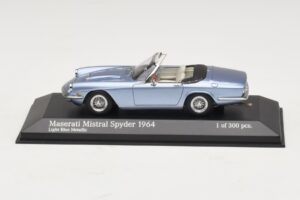
TL;DR: Minichamps' 1:43 Maserati Mistral Spyder reproduces Pietro Frua's 1964 open-top design in silver diecast, cast as a sealed one-piece body with no opening panels. The Mistral began Maserati's tradition of naming road cars after winds, a practice later continued with the Ghibli and Bora, and its twin-cam straight-six carried genuine racing pedigree.
Frua's design for the Mistral runs tauter and more restrained than the curvier Ghibli that followed it, and the Spyder version strips away the coupe's fastback roofline entirely, leaving a shape defined by its long bonnet and low scuttle. Minichamps finishes this example in silver, a colour that lets the surfacing do the work rather than relying on a bold hue to draw attention, and it suits a car whose appeal has always been about proportion rather than flamboyance.
An open-top car presents a particular challenge for a small-scale diecast, because there is no roofline to help disguise where panels might otherwise meet. Minichamps casts the Mistral Spyder as one fixed body, with no doors or boot that open, which keeps the beltline running as a single unbroken edge from the nose to the tail. That matters more here than on a closed coupe, because the absence of a roof means the eye travels the full length of the car in one uninterrupted sweep, and any visible seam along that sweep would be far more noticeable than it would be on a fastback.
Silver is an unforgiving colour on a compact scale, because it reveals surfacing flaws that a darker or more saturated shade would hide. Across the Mistral's long, gently curved bonnet, the finish needs to hold consistent depth without any patchiness where the casting's curvature changes, and under direct light a well-applied silver should show the fine, even grain that separates careful diecast finishing from a flatter, cheaper alternative. The zinc alloy body's weight helps here too, giving the small model a settled, substantial feel that a lighter material could not replicate at the same size.
Maserati's practice of naming road cars after winds started with the Mistral, a naming convention the company continued through the Ghibli, the Bora and the Khamsin across the following decade. That the tradition began here gives this particular model a small but genuine historical significance beyond its own styling. The name refers to the strong, cold wind that blows through southern France toward the Mediterranean, an image of speed and force that Maserati clearly intended to carry over to the car itself, one that later wind-named Maseratis would each interpret in their own way through the 1970s.
Under that Frua bodywork sat a twin-cam straight-six with direct roots in Maserati's earlier competition engines, a lineage that separated the Mistral from more ordinary grand tourers of its era. That racing-bred engineering, wrapped in road-going comfort, was very much the Maserati formula of the period: engines developed with circuit experience behind them, fitted into cars built for wealthy private buyers rather than professional drivers. The Mistral Spyder, in particular, let those buyers experience that pedigree with the roof down, a genuinely different proposition from the closed coupe built on the same mechanical base.
Frua built both a coupe and this open Spyder on the Mistral's platform, and the two variants reveal how much a roofline can change the emphasis of an otherwise identical design. The coupe's fastback tail gives it a more purposeful, sporting stance, while the Spyder trades that visual weight for a lighter, more elegant profile better suited to slow boulevard driving than outright speed. Collectors drawn to Frua's work specifically, rather than to Maserati as a marque, often want both variants precisely because the comparison says something real about how a single design brief can be read two different ways.
At 1:43, gathering both body styles takes up little extra shelf space, making a Mistral pairing a realistic ambition even for a collector without room for a dedicated Maserati cabinet. The Spyder's open cockpit also means the model rewards a slightly different viewing angle than the coupe does; looking down into the car reveals the dashboard and seating in a way a closed roofline simply hides, giving this variant a different kind of visual interest even at a scale this compact.
This Mistral Spyder works best as part of a design-led collection built around Pietro Frua's output for Maserati and other Italian marques, rather than as a standalone Maserati purchase. Its significance lies as much in what it started, that wind-naming tradition, as in what it is on its own terms.
Buyers already assembling later wind-named Maseratis, a Ghibli or a Bora, will find this Mistral a natural, historically grounded starting point for that theme, and the silver finish gives it enough visual restraint to sit comfortably beside brighter Italian coupes from the same broader era without clashing. It rewards a buyer who values provenance over showiness, which is exactly the kind of restraint the original Spyder itself was built around.


Save £33.00

Save £14.00