Used

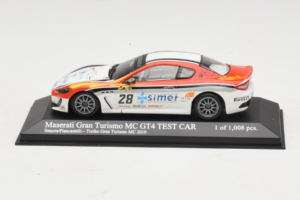
Maserati GranTurismo MC GT4 #6 Goldstein / Sumberg Trofeo GranTurismo 2010 Minichamps 1:43
Only 2 left
Price:
£32.00
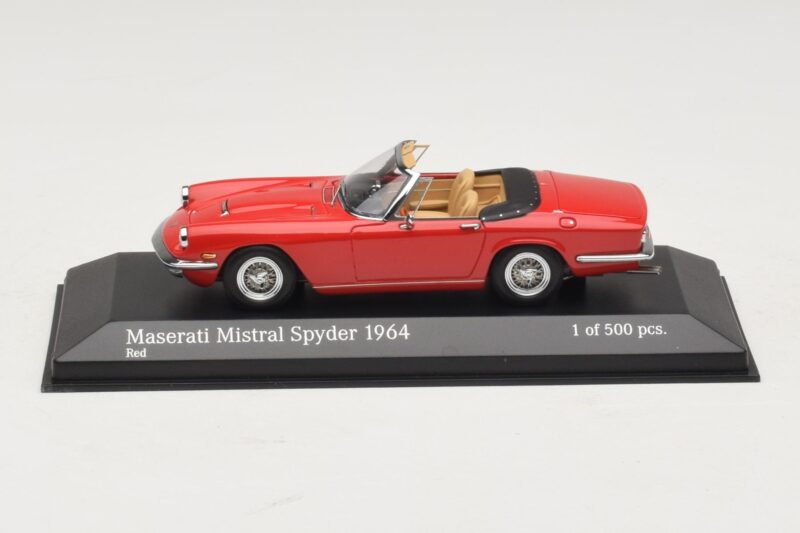
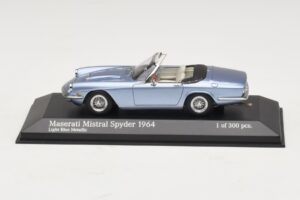
TL;DR: Minichamps' 1:43 Maserati Mistral Spyder Red reproduces Pietro Frua's open two-seater version of the 1960s Mistral coupé, one of Maserati's wind-named grand tourers. The sealed diecast body shows the folded-roof cabin cast as part of one piece, finished in a bold red. A mid-tier piece for pairing with the closed Mistral coupé.
Where the Mistral coupé hid its cabin behind a glass hatch and a fixed roof, the Spyder version stripped that roof away entirely, turning Frua's compact grand tourer into an open two-seater built for a different kind of driving. Minichamps' 1:43 rendering in red shows that open cabin exactly as the real car presents it, seats, dashboard and transmission tunnel all visible from above rather than hidden.
Pietro Frua developed the Spyder alongside the coupé, sharing the same compact proportions and straight-six mechanical layout but trading the coupé's glass hatch and fixed roof for a folding soft top and a shorter, more open rear deck. That change reshaped the car's whole rear-end treatment, removing the coupé's most distinctive feature in favour of a cleaner, simpler tail suited to an open body. Minichamps' casting reflects that difference directly, giving the Spyder a genuinely different rear profile from its closed sibling rather than a simple roof swap on an identical shell.
Fewer Spyders left Frua's workshop than coupés during the Mistral's production run through the 1960s, a rarity that makes the open version a genuinely distinct chapter in the Mistral's story rather than a simple variant. That scarcity carries through to collecting: a well-finished Spyder model represents a body style most enthusiasts will only ever encounter in miniature. Minichamps casting both versions lets a collector assemble the complete Mistral story, open and closed, in a way that finding both real cars side by side would be far harder to achieve. Its shorter production run also means the Spyder rarely appears at the same shows or auctions the coupé still turns up at with some regularity.
Because the Spyder's real body has no fixed roof, the cabin's visibility on this model is a feature of the design itself, not a moving part: the seats, dashboard and folded-top storage area are all cast as part of the same one-piece shell, finished to the same standard as the exterior bodywork. That open-cabin construction means there is nowhere for Minichamps to cut a corner, since the interior sits in plain view from every angle rather than glimpsed through a window.
The Spyder's shorter rear deck and open cabin leave slightly less structure than the coupé's fixed roof provides, making the diecast body's inherent rigidity more valuable here than on the closed car. Zinc alloy's weight keeps the model settled and stable despite the open top, a density that gives the compact two-seater real presence in the hand at 1:43. Red paint sits deep and even across the shortened rear deck, with the folded-top area's texture picked out distinctly from the surrounding painted metal. That texture, subtle but deliberate, is the detail that separates a considered open-top casting from one that simply omits a roof without replacing it with anything. Door tops and windscreen surround, exposed without a roof to frame them, carry the same crisp edge definition as the rest of the body.
Red works particularly well on an open body, since there is no roof colour to balance against and the eye takes in the full length of bonnet, cabin and rear deck as one continuous red surface. Under direct light the metallic finish reads with real depth across that unbroken run, catching the shortened rear deck differently from the coupé's longer, glass-topped tail. At roughly ten centimetres nose to tail in 1:43, the Spyder sits close in size to its coupé sibling but reads more compact and open on a shelf, the visible cabin adding a sense of occasion the closed car's glass hatch does not offer in the same way. Set beside the coupé, this Spyder becomes the more sociable, warm-weather half of the Mistral story, its open cabin inviting a closer look that a sealed roofline simply cannot match. Diecast holds the red evenly across the compact open body, with the seats and dashboard visible beneath finished to match the exterior's quality. For a collector already holding the closed Mistral, this red Spyder is less a duplicate than a genuinely different way of experiencing the same design.
The Mistral's story was always told in two bodies, and a collection built around only one version misses half of what Frua actually offered through the 1960s. Minichamps' 1:43 diecast makes assembling both halves realistic, keeping the Spyder accessible rather than pricing it as a rare halo piece despite its genuine scarcity relative to the coupé. The open cabin's visible seats and dashboard give this version a display appeal the sealed coupé cannot quite match, a small window into the real car's cockpit without any moving part required to show it. For anyone already collecting Maserati's wind-named grand tourers, this red Spyder is the piece that completes the Mistral chapter properly, and it does so with a shape found nowhere else in the range.


Save £33.00




Save £14.00