{"ajaxurl":"https:\/\/models118.co.uk\/wp-admin\/admin-ajax.php?lang=en_GB","nonce":"8688bd9d48","homeUrl":"https:\/\/models118.co.uk\/","shopUrl":"https:\/\/models118.co.uk\/shop\/","cartUrl":"https:\/\/models118.co.uk\/cart-en-gb\/","checkoutUrl":"https:\/\/models118.co.uk\/checkout\/","skipCart":true,"collectionLimit":12,"i18n":{"addedToCart":"Added to basket","addToWishlist":"Add to wishlist","addedToWishlist":"Added to wishlist","removeFromWishlist":"Remove from wishlist","removedFromWishlist":"Removed from wishlist","undo":"Undo","error":"Something went wrong","loading":"Loading...","outOfStock":"Out of stock","viewCart":"View basket","proceedToCheckout":"Proceed to checkout","addedToCollection":"Added to your collection","reserved":"Added to your collection","soldOut":"Sold out","invalidEmail":"Please enter a valid email address","connectionError":"Connection error. Please try again.","tocToggle":"On this page","close":"Close","inCartTooltip":"Already in your basket \u2013 open your basket to check out","loginToSave":"Sign in to save this model","waitlistNotify":"Notify me","waitlistOnList":"On the waiting list \u2713","waitlistJoined":"You're on the waiting list. We'll email you the moment this model is available again.","waitlistRemoved":"Done \u2014 you're off the waiting list for this model.","waitlistRateLimit":"Too many attempts \u2014 please try again shortly","waitlistTurnstile":"We couldn't complete the check \u2014 please try again","waitlistError":"Sorry, something went wrong. Please try again in a moment."},"wishlist":{"loggedIn":false,"loginUrl":"https:\/\/models118.co.uk\/my-account\/","addAction":"models118_wishlist_add","removeAction":"models118_wishlist_remove"},"waitlist":{"loggedIn":false,"subscribeAction":"models118_waitlist_subscribe","toggleAction":"models118_waitlist_toggle","stateAction":"models118_waitlist_state"},"stats":{"models":2418,"brands":213,"manufacturers":128,"collectors":10000},"product":{"id":1659311,"sku":"110130077","condition":"used","availability":"in_stock","name":"Lotus F1 Team E21 #7 K. Raikkonen Showcar 2013 Minichamps 1:18","brand":"Lotus","manufacturer":"Minichamps","scale":"1:18","material":"Diecast","price":161,"regularPrice":161,"isOnSale":false,"savingsAmount":0,"stockQty":2,"stockStatus":"very_low","isDiscontinued":false,"image":"https:\/\/models118.co.uk\/wp-content\/uploads\/2026\/08\/lotus-f1-team-e21-7-k-raikkonen-showcar-2013-minichamps-1-18-110130077-1-1-300x200.jpg","permalink":"https:\/\/models118.co.uk\/lotus-f1-team-e21-7-k-raikkonen-showcar-2013-minichamps-1-18-110130077\/"}}
Cookies on Models118
We use cookies to remember your preferences, understand how the shop is used and show you models and offers that suit your interests. What you allow is up to you, and you can change it at any time.
Always active
The technical storage or access is strictly necessary for the legitimate purpose of enabling the use of a specific service explicitly requested by the subscriber or user, or for the sole purpose of carrying out the transmission of a communication over an electronic communications network.
The technical storage or access is necessary for the legitimate purpose of storing preferences that are not requested by the subscriber or user.
The technical storage or access that is used exclusively for statistical purposes.
The technical storage or access is required to create user profiles to send advertising, or to track the user on a website or across several websites for similar marketing purposes.
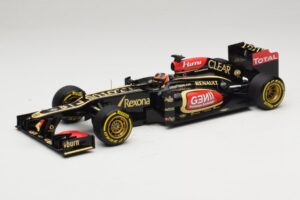
Lotus F1 Team E21 #7 K. Raikkonen Showcar 2013 Minichamps 1:18
1/7
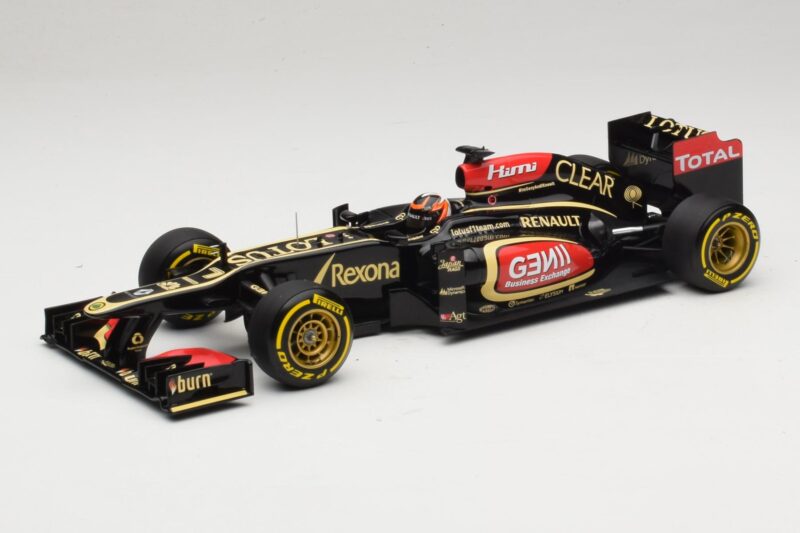
Minichamps' 1:18 diecast Lotus E21 reproduces the showcar version of Kimi Räikkönen's 2013 #7 entry, finished in Lotus F1's black, gold and red Total livery. Built as a sealed one-piece body, the model carries crisp aero surfaces, sponsor decal registration and cockpit sculpting without a single moving panel. Showcars differ from race-spec builds, made for demonstration and promotional appearances rather than competition, and this diecast captures that distinction alongside the E21's striking presentation.
About the Lotus F1 Team E21 #7 K. Raikkonen Showcar 2013 Minichamps 1:18
TL;DR: Minichamps' 1:18 diecast Lotus E21 reproduces Kimi Räikkönen's 2013 #7 showcar, finished in Lotus F1's Total-sponsored black, gold and red livery. The sealed one-piece body carries crisp aero surfaces and decal registration rather than opening panels, positioning it as a display-focused companion to the team's race-spec F1 diecast.
Räikkönen's return to Lotus for 2013 produced one of the team's strongest seasons, and Minichamps marks it with a showcar rather than a race-spec build. The distinction matters: showcars are prepared for demonstration runs, sponsor events and photo calls, not competition, and this 1:18 diecast reflects that purpose in its finish, its decal precision and its sealed, one-piece construction.
The E21 Showcar and What Sets It Apart
Presentation Builds vs Race-Spec Machinery
Formula 1 teams commission showcars for a specific job: touring sponsor hospitality suites, appearing at launch events, and standing in for the real chassis when the race car itself cannot travel. A showcar wears the correct livery and carries the visual language of the season, but it is built to be handled and displayed rather than driven in anger. Minichamps labels this Lotus E21 as exactly that, a showcar rather than a race-worn chassis, and the distinction is worth knowing before comparing it against a raced #7 model. The livery register is still precise, the decal placement still matches what appeared at circuits that year, but the model represents a different chapter of the car's working life than a grand prix Sunday.
Sculpted Cockpit Detail on a Sealed Body
An open-cockpit single-seater does not need opening doors or a lifting engine cover to show its detail, and Minichamps uses that to its advantage here. The seat, the steering wheel, the roll structure ahead of the cockpit opening and the sculpted bargeboards along the flanks are all cast into a single fixed body, so nothing needs to hinge or lift for the detail to read clearly. That sealed construction keeps every panel gap tight and consistent, with none of the tolerance stack-up that a moving cover would introduce around the airbox or sidepod intakes.
Kimi Räikkönen's 2013 Season and the #7 Livery
Räikkönen carried car number 7 through his second season back at Lotus after stepping away from Formula 1 for a run at rallying, and 2013 turned into the strongest year of that comeback. He won the season-opening Australian Grand Prix, converting a long first pit stop stint into a race-winning tyre advantage over faster qualifiers, and closed the year third in the drivers' championship behind Sebastian Vettel and Fernando Alonso. Teammate Romain Grosjean ran the sister car under number 8, and the pairing gave Lotus its most competitive season since the team's 2012 rebrand from Renault. The E21 itself carried one of the grid's more technically adventurous packages that year, including a passive ride-height system that drew scrutiny from rivals before the sport tightened its rules the following season. The livery on this showcar, black through the nose and sidepods with gold striping and red Total branding across the flanks, echoes the fuel partner's identity that carried through Lotus's entire E21 programme that year. Total had backed the team since its Renault days, and the gold accents against black bodywork drew deliberate comparison to Lotus's own John Player Special livery from the 1970s, a link the team's marketing leaned into throughout the E21's design. For a driver whose Lotus stint is remembered as a career-reviving high point, this livery is the one most associated with that comeback season.
Minichamps' Sealed-Body Diecast Craft on the E21
Zinc Alloy Weight and Sealed-Body Construction
Lift this E21 from its packaging and the zinc alloy density is the first thing that registers, a weight that plastic or resin alternatives at the same scale simply cannot replicate. Minichamps builds its Formula 1 diecast almost universally as sealed, one-piece bodies, and an open-cockpit single-seater is arguably the ideal subject for that approach: there is no bonnet or boot to omit, so the fixed construction reads as a natural fit rather than a simplification. What the sealed body does buy is consistency across the aerodynamic surfaces that define a modern F1 car's shape, the front wing endplates, the barge boards, the sculpted sidepod inlets, all cast without the seam lines a hinged panel would introduce nearby.
Tampo Printing Across a Dense Livery
The sponsor decals carry real production risk on a livery this dense, dozens of logos at scales where a millimetre of misregistration is visible to the naked eye, and Minichamps' tampo printing holds that registration tightly across the nose, sidepods and rear wing. Sitting a step below Minichamps' most exclusive limited-run pieces and well above entry-level toy-grade Formula 1 diecast, this showcar occupies a sensible mid-premium position: detailed enough to reward close inspection, priced for a collector building a season rather than chasing a single grail piece.
A Launch-Livery Companion to the Race Car
A showcar earns its place in a display precisely because it is not the raced version, and that difference is worth building into a themed shelf rather than treating it as a lesser substitute. Pair this E21 with a race-spec #7 Lotus from the same season and the two together tell a fuller story: one built for the circuit, one built for the paddock and the cameras. At roughly 20cm nose to rear wing, the 1:18 format keeps the E21's low, wide stance readable at a glance, and single-seaters photograph well from directly above where the cockpit sculpting and sidepod detail are most visible. Its sealed body also means the piece survives handling at model fairs and swapmeets far better than a build with delicate hinged covers. For collectors following Räikkönen's career through Sauber, McLaren, Ferrari and back to Lotus, this piece marks the comeback chapter, and its Total livery remains one of the more visually striking F1 schemes of the early 2010s grid.
Create a free account and claim 10% off your first order — from hundreds of collectible 1:18, 1:43 and 1:12 models by Porsche, Mercedes-Benz, BMW and more.
{"id":1659311,"name":"Lotus F1 Team E21 #7 K. Raikkonen Showcar 2013 Minichamps 1:18","price":"£<\/span>161.00<\/bdi><\/span>","image":"https:\/\/models118.co.uk\/wp-content\/uploads\/2026\/08\/lotus-f1-team-e21-7-k-raikkonen-showcar-2013-minichamps-1-18-110130077-1-1-400x400.jpg","permalink":"https:\/\/models118.co.uk\/lotus-f1-team-e21-7-k-raikkonen-showcar-2013-minichamps-1-18-110130077\/","brand":"Lotus"}