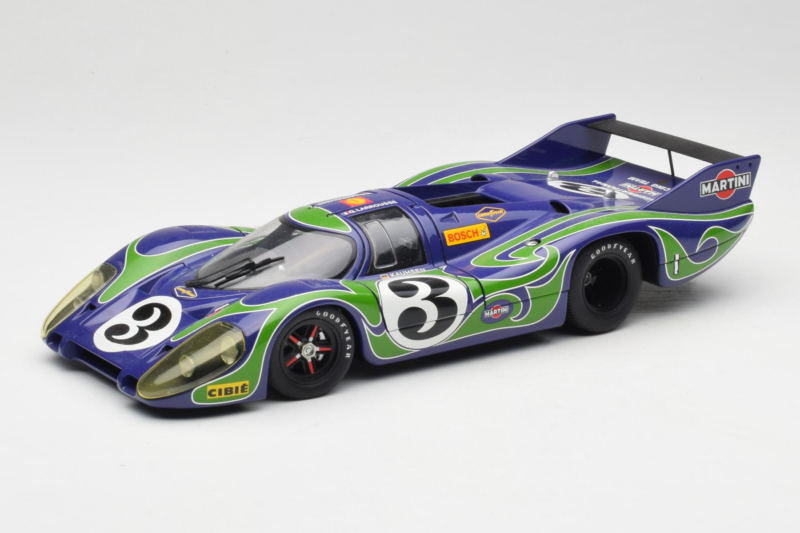
Porsche 917 LH #3 Hippie 2nd Place 24 Hours of Le Mans 1970 AUTOart 1:18
Sold out
1
/
8
AUTOart's 1:18 diecast Porsche 917 LH reproduces chassis entered by Willi Kauhsen Racing Team in its famous psychedelic Hippie livery, which finished second overall at the 1970 24 Hours of Le Mans. Diecast construction suits the 917's long, low tail-section bodywork, and the striking artwork makes this a standout anchor for any Le Mans prototype display or 1970s endurance racing collection.
1 / 8
[{"index":0,"id":"1306915","thumb":"https:\/\/models118.co.uk\/wp-content\/uploads\/2026\/06\/porsche-917-lh-n3-hippie-2nd-le-mans-1970-replacement-box-autoart-1-18-300x200.png","medium":"https:\/\/models118.co.uk\/wp-content\/uploads\/2026\/06\/porsche-917-lh-n3-hippie-2nd-le-mans-1970-replacement-box-autoart-1-18-800x533.png","full":"https:\/\/models118.co.uk\/wp-content\/uploads\/2026\/06\/porsche-917-lh-n3-hippie-2nd-le-mans-1970-replacement-box-autoart-1-18.png","srcset":"https:\/\/models118.co.uk\/wp-content\/uploads\/2026\/06\/porsche-917-lh-n3-hippie-2nd-le-mans-1970-replacement-box-autoart-1-18-800x533.png 800w, https:\/\/models118.co.uk\/wp-content\/uploads\/2026\/06\/porsche-917-lh-n3-hippie-2nd-le-mans-1970-replacement-box-autoart-1-18-64x43.png 64w, https:\/\/models118.co.uk\/wp-content\/uploads\/2026\/06\/porsche-917-lh-n3-hippie-2nd-le-mans-1970-replacement-box-autoart-1-18-300x200.png 300w, https:\/\/models118.co.uk\/wp-content\/uploads\/2026\/06\/porsche-917-lh-n3-hippie-2nd-le-mans-1970-replacement-box-autoart-1-18.png 1800w","sizes":"(max-width: 1023px) 400px, 640px","srcsetAvif":"https:\/\/models118.co.uk\/wp-content\/uploads\/2026\/06\/porsche-917-lh-n3-hippie-2nd-le-mans-1970-replacement-box-autoart-1-18-800x533.png.avif 800w, https:\/\/models118.co.uk\/wp-content\/uploads\/2026\/06\/porsche-917-lh-n3-hippie-2nd-le-mans-1970-replacement-box-autoart-1-18-64x43.png.avif 64w, https:\/\/models118.co.uk\/wp-content\/uploads\/2026\/06\/porsche-917-lh-n3-hippie-2nd-le-mans-1970-replacement-box-autoart-1-18-300x200.png.avif 300w, https:\/\/models118.co.uk\/wp-content\/uploads\/2026\/06\/porsche-917-lh-n3-hippie-2nd-le-mans-1970-replacement-box-autoart-1-18.png.avif 1800w","srcsetWebp":"https:\/\/models118.co.uk\/wp-content\/uploads\/2026\/06\/porsche-917-lh-n3-hippie-2nd-le-mans-1970-replacement-box-autoart-1-18-800x533.png.webp 800w, https:\/\/models118.co.uk\/wp-content\/uploads\/2026\/06\/porsche-917-lh-n3-hippie-2nd-le-mans-1970-replacement-box-autoart-1-18-64x43.png.webp 64w, https:\/\/models118.co.uk\/wp-content\/uploads\/2026\/06\/porsche-917-lh-n3-hippie-2nd-le-mans-1970-replacement-box-autoart-1-18-300x200.png.webp 300w, https:\/\/models118.co.uk\/wp-content\/uploads\/2026\/06\/porsche-917-lh-n3-hippie-2nd-le-mans-1970-replacement-box-autoart-1-18.png.webp 1800w","alt":"Porsche 917 LH #3 Hippie 2nd Place 24 Hours of Le Mans 1970 AUTOart 1:18 87075-R1 Diecast"},{"index":1,"id":1307061,"thumb":"https:\/\/models118.co.uk\/wp-content\/uploads\/2026\/06\/porsche-917-lh-n3-hippie-2nd-le-mans-1970-replacement-box-autoart-1-18-1-300x200.png","medium":"https:\/\/models118.co.uk\/wp-content\/uploads\/2026\/06\/porsche-917-lh-n3-hippie-2nd-le-mans-1970-replacement-box-autoart-1-18-1-800x533.png","full":"https:\/\/models118.co.uk\/wp-content\/uploads\/2026\/06\/porsche-917-lh-n3-hippie-2nd-le-mans-1970-replacement-box-autoart-1-18-1.png","srcset":"https:\/\/models118.co.uk\/wp-content\/uploads\/2026\/06\/porsche-917-lh-n3-hippie-2nd-le-mans-1970-replacement-box-autoart-1-18-1-800x533.png 800w, https:\/\/models118.co.uk\/wp-content\/uploads\/2026\/06\/porsche-917-lh-n3-hippie-2nd-le-mans-1970-replacement-box-autoart-1-18-1-64x43.png 64w, https:\/\/models118.co.uk\/wp-content\/uploads\/2026\/06\/porsche-917-lh-n3-hippie-2nd-le-mans-1970-replacement-box-autoart-1-18-1-300x200.png 300w, https:\/\/models118.co.uk\/wp-content\/uploads\/2026\/06\/porsche-917-lh-n3-hippie-2nd-le-mans-1970-replacement-box-autoart-1-18-1.png 1800w","sizes":"(max-width: 1023px) 400px, 640px","srcsetAvif":"https:\/\/models118.co.uk\/wp-content\/uploads\/2026\/06\/porsche-917-lh-n3-hippie-2nd-le-mans-1970-replacement-box-autoart-1-18-1-800x533.png.avif 800w, https:\/\/models118.co.uk\/wp-content\/uploads\/2026\/06\/porsche-917-lh-n3-hippie-2nd-le-mans-1970-replacement-box-autoart-1-18-1-64x43.png.avif 64w, https:\/\/models118.co.uk\/wp-content\/uploads\/2026\/06\/porsche-917-lh-n3-hippie-2nd-le-mans-1970-replacement-box-autoart-1-18-1-300x200.png.avif 300w, https:\/\/models118.co.uk\/wp-content\/uploads\/2026\/06\/porsche-917-lh-n3-hippie-2nd-le-mans-1970-replacement-box-autoart-1-18-1.png.avif 1800w","srcsetWebp":"https:\/\/models118.co.uk\/wp-content\/uploads\/2026\/06\/porsche-917-lh-n3-hippie-2nd-le-mans-1970-replacement-box-autoart-1-18-1-800x533.png.webp 800w, https:\/\/models118.co.uk\/wp-content\/uploads\/2026\/06\/porsche-917-lh-n3-hippie-2nd-le-mans-1970-replacement-box-autoart-1-18-1-64x43.png.webp 64w, https:\/\/models118.co.uk\/wp-content\/uploads\/2026\/06\/porsche-917-lh-n3-hippie-2nd-le-mans-1970-replacement-box-autoart-1-18-1-300x200.png.webp 300w, https:\/\/models118.co.uk\/wp-content\/uploads\/2026\/06\/porsche-917-lh-n3-hippie-2nd-le-mans-1970-replacement-box-autoart-1-18-1.png.webp 1800w","alt":"Porsche 917 LH #3 Hippie 2nd Place 24 Hours of Le Mans 1970 AUTOart 1:18 87075-R1 Diecast \u2014 photo 2 of 8"},{"index":2,"id":1307211,"thumb":"https:\/\/models118.co.uk\/wp-content\/uploads\/2026\/06\/porsche-917-lh-n3-hippie-2nd-le-mans-1970-replacement-box-autoart-1-18-2-300x200.png","medium":"https:\/\/models118.co.uk\/wp-content\/uploads\/2026\/06\/porsche-917-lh-n3-hippie-2nd-le-mans-1970-replacement-box-autoart-1-18-2-800x533.png","full":"https:\/\/models118.co.uk\/wp-content\/uploads\/2026\/06\/porsche-917-lh-n3-hippie-2nd-le-mans-1970-replacement-box-autoart-1-18-2.png","srcset":"https:\/\/models118.co.uk\/wp-content\/uploads\/2026\/06\/porsche-917-lh-n3-hippie-2nd-le-mans-1970-replacement-box-autoart-1-18-2-800x533.png 800w, https:\/\/models118.co.uk\/wp-content\/uploads\/2026\/06\/porsche-917-lh-n3-hippie-2nd-le-mans-1970-replacement-box-autoart-1-18-2-64x43.png 64w, https:\/\/models118.co.uk\/wp-content\/uploads\/2026\/06\/porsche-917-lh-n3-hippie-2nd-le-mans-1970-replacement-box-autoart-1-18-2-300x200.png 300w, https:\/\/models118.co.uk\/wp-content\/uploads\/2026\/06\/porsche-917-lh-n3-hippie-2nd-le-mans-1970-replacement-box-autoart-1-18-2.png 1800w","sizes":"(max-width: 1023px) 400px, 640px","srcsetAvif":"https:\/\/models118.co.uk\/wp-content\/uploads\/2026\/06\/porsche-917-lh-n3-hippie-2nd-le-mans-1970-replacement-box-autoart-1-18-2-800x533.png.avif 800w, https:\/\/models118.co.uk\/wp-content\/uploads\/2026\/06\/porsche-917-lh-n3-hippie-2nd-le-mans-1970-replacement-box-autoart-1-18-2-64x43.png.avif 64w, https:\/\/models118.co.uk\/wp-content\/uploads\/2026\/06\/porsche-917-lh-n3-hippie-2nd-le-mans-1970-replacement-box-autoart-1-18-2-300x200.png.avif 300w, https:\/\/models118.co.uk\/wp-content\/uploads\/2026\/06\/porsche-917-lh-n3-hippie-2nd-le-mans-1970-replacement-box-autoart-1-18-2.png.avif 1800w","srcsetWebp":"https:\/\/models118.co.uk\/wp-content\/uploads\/2026\/06\/porsche-917-lh-n3-hippie-2nd-le-mans-1970-replacement-box-autoart-1-18-2-800x533.png.webp 800w, https:\/\/models118.co.uk\/wp-content\/uploads\/2026\/06\/porsche-917-lh-n3-hippie-2nd-le-mans-1970-replacement-box-autoart-1-18-2-64x43.png.webp 64w, https:\/\/models118.co.uk\/wp-content\/uploads\/2026\/06\/porsche-917-lh-n3-hippie-2nd-le-mans-1970-replacement-box-autoart-1-18-2-300x200.png.webp 300w, https:\/\/models118.co.uk\/wp-content\/uploads\/2026\/06\/porsche-917-lh-n3-hippie-2nd-le-mans-1970-replacement-box-autoart-1-18-2.png.webp 1800w","alt":"Porsche 917 LH #3 Hippie 2nd Place 24 Hours of Le Mans 1970 AUTOart 1:18 87075-R1 Diecast \u2014 photo 3 of 8"},{"index":3,"id":1307349,"thumb":"https:\/\/models118.co.uk\/wp-content\/uploads\/2026\/06\/porsche-917-lh-n3-hippie-2nd-le-mans-1970-replacement-box-autoart-1-18-3-300x200.png","medium":"https:\/\/models118.co.uk\/wp-content\/uploads\/2026\/06\/porsche-917-lh-n3-hippie-2nd-le-mans-1970-replacement-box-autoart-1-18-3-800x533.png","full":"https:\/\/models118.co.uk\/wp-content\/uploads\/2026\/06\/porsche-917-lh-n3-hippie-2nd-le-mans-1970-replacement-box-autoart-1-18-3.png","srcset":"https:\/\/models118.co.uk\/wp-content\/uploads\/2026\/06\/porsche-917-lh-n3-hippie-2nd-le-mans-1970-replacement-box-autoart-1-18-3-800x533.png 800w, https:\/\/models118.co.uk\/wp-content\/uploads\/2026\/06\/porsche-917-lh-n3-hippie-2nd-le-mans-1970-replacement-box-autoart-1-18-3-64x43.png 64w, https:\/\/models118.co.uk\/wp-content\/uploads\/2026\/06\/porsche-917-lh-n3-hippie-2nd-le-mans-1970-replacement-box-autoart-1-18-3-300x200.png 300w, https:\/\/models118.co.uk\/wp-content\/uploads\/2026\/06\/porsche-917-lh-n3-hippie-2nd-le-mans-1970-replacement-box-autoart-1-18-3.png 1800w","sizes":"(max-width: 1023px) 400px, 640px","srcsetAvif":"https:\/\/models118.co.uk\/wp-content\/uploads\/2026\/06\/porsche-917-lh-n3-hippie-2nd-le-mans-1970-replacement-box-autoart-1-18-3-800x533.png.avif 800w, https:\/\/models118.co.uk\/wp-content\/uploads\/2026\/06\/porsche-917-lh-n3-hippie-2nd-le-mans-1970-replacement-box-autoart-1-18-3-64x43.png.avif 64w, https:\/\/models118.co.uk\/wp-content\/uploads\/2026\/06\/porsche-917-lh-n3-hippie-2nd-le-mans-1970-replacement-box-autoart-1-18-3-300x200.png.avif 300w, https:\/\/models118.co.uk\/wp-content\/uploads\/2026\/06\/porsche-917-lh-n3-hippie-2nd-le-mans-1970-replacement-box-autoart-1-18-3.png.avif 1800w","srcsetWebp":"https:\/\/models118.co.uk\/wp-content\/uploads\/2026\/06\/porsche-917-lh-n3-hippie-2nd-le-mans-1970-replacement-box-autoart-1-18-3-800x533.png.webp 800w, https:\/\/models118.co.uk\/wp-content\/uploads\/2026\/06\/porsche-917-lh-n3-hippie-2nd-le-mans-1970-replacement-box-autoart-1-18-3-64x43.png.webp 64w, https:\/\/models118.co.uk\/wp-content\/uploads\/2026\/06\/porsche-917-lh-n3-hippie-2nd-le-mans-1970-replacement-box-autoart-1-18-3-300x200.png.webp 300w, https:\/\/models118.co.uk\/wp-content\/uploads\/2026\/06\/porsche-917-lh-n3-hippie-2nd-le-mans-1970-replacement-box-autoart-1-18-3.png.webp 1800w","alt":"Porsche 917 LH #3 Hippie 2nd Place 24 Hours of Le Mans 1970 AUTOart 1:18 87075-R1 Diecast \u2014 photo 4 of 8"},{"index":4,"id":1307481,"thumb":"https:\/\/models118.co.uk\/wp-content\/uploads\/2026\/06\/porsche-917-lh-n3-hippie-2nd-le-mans-1970-replacement-box-autoart-1-18-4-300x200.png","medium":"https:\/\/models118.co.uk\/wp-content\/uploads\/2026\/06\/porsche-917-lh-n3-hippie-2nd-le-mans-1970-replacement-box-autoart-1-18-4-800x533.png","full":"https:\/\/models118.co.uk\/wp-content\/uploads\/2026\/06\/porsche-917-lh-n3-hippie-2nd-le-mans-1970-replacement-box-autoart-1-18-4.png","srcset":"https:\/\/models118.co.uk\/wp-content\/uploads\/2026\/06\/porsche-917-lh-n3-hippie-2nd-le-mans-1970-replacement-box-autoart-1-18-4-800x533.png 800w, https:\/\/models118.co.uk\/wp-content\/uploads\/2026\/06\/porsche-917-lh-n3-hippie-2nd-le-mans-1970-replacement-box-autoart-1-18-4-64x43.png 64w, https:\/\/models118.co.uk\/wp-content\/uploads\/2026\/06\/porsche-917-lh-n3-hippie-2nd-le-mans-1970-replacement-box-autoart-1-18-4-300x200.png 300w, https:\/\/models118.co.uk\/wp-content\/uploads\/2026\/06\/porsche-917-lh-n3-hippie-2nd-le-mans-1970-replacement-box-autoart-1-18-4.png 1800w","sizes":"(max-width: 1023px) 400px, 640px","srcsetAvif":"https:\/\/models118.co.uk\/wp-content\/uploads\/2026\/06\/porsche-917-lh-n3-hippie-2nd-le-mans-1970-replacement-box-autoart-1-18-4-800x533.png.avif 800w, https:\/\/models118.co.uk\/wp-content\/uploads\/2026\/06\/porsche-917-lh-n3-hippie-2nd-le-mans-1970-replacement-box-autoart-1-18-4-64x43.png.avif 64w, https:\/\/models118.co.uk\/wp-content\/uploads\/2026\/06\/porsche-917-lh-n3-hippie-2nd-le-mans-1970-replacement-box-autoart-1-18-4-300x200.png.avif 300w, https:\/\/models118.co.uk\/wp-content\/uploads\/2026\/06\/porsche-917-lh-n3-hippie-2nd-le-mans-1970-replacement-box-autoart-1-18-4.png.avif 1800w","srcsetWebp":"https:\/\/models118.co.uk\/wp-content\/uploads\/2026\/06\/porsche-917-lh-n3-hippie-2nd-le-mans-1970-replacement-box-autoart-1-18-4-800x533.png.webp 800w, https:\/\/models118.co.uk\/wp-content\/uploads\/2026\/06\/porsche-917-lh-n3-hippie-2nd-le-mans-1970-replacement-box-autoart-1-18-4-64x43.png.webp 64w, https:\/\/models118.co.uk\/wp-content\/uploads\/2026\/06\/porsche-917-lh-n3-hippie-2nd-le-mans-1970-replacement-box-autoart-1-18-4-300x200.png.webp 300w, https:\/\/models118.co.uk\/wp-content\/uploads\/2026\/06\/porsche-917-lh-n3-hippie-2nd-le-mans-1970-replacement-box-autoart-1-18-4.png.webp 1800w","alt":"Porsche 917 LH #3 Hippie 2nd Place 24 Hours of Le Mans 1970 AUTOart 1:18 87075-R1 Diecast \u2014 photo 5 of 8"},{"index":5,"id":1307622,"thumb":"https:\/\/models118.co.uk\/wp-content\/uploads\/2026\/06\/porsche-917-lh-n3-hippie-2nd-le-mans-1970-replacement-box-autoart-1-18-5-300x200.png","medium":"https:\/\/models118.co.uk\/wp-content\/uploads\/2026\/06\/porsche-917-lh-n3-hippie-2nd-le-mans-1970-replacement-box-autoart-1-18-5-800x533.png","full":"https:\/\/models118.co.uk\/wp-content\/uploads\/2026\/06\/porsche-917-lh-n3-hippie-2nd-le-mans-1970-replacement-box-autoart-1-18-5.png","srcset":"https:\/\/models118.co.uk\/wp-content\/uploads\/2026\/06\/porsche-917-lh-n3-hippie-2nd-le-mans-1970-replacement-box-autoart-1-18-5-800x533.png 800w, https:\/\/models118.co.uk\/wp-content\/uploads\/2026\/06\/porsche-917-lh-n3-hippie-2nd-le-mans-1970-replacement-box-autoart-1-18-5-64x43.png 64w, https:\/\/models118.co.uk\/wp-content\/uploads\/2026\/06\/porsche-917-lh-n3-hippie-2nd-le-mans-1970-replacement-box-autoart-1-18-5-300x200.png 300w, https:\/\/models118.co.uk\/wp-content\/uploads\/2026\/06\/porsche-917-lh-n3-hippie-2nd-le-mans-1970-replacement-box-autoart-1-18-5.png 1800w","sizes":"(max-width: 1023px) 400px, 640px","srcsetAvif":"https:\/\/models118.co.uk\/wp-content\/uploads\/2026\/06\/porsche-917-lh-n3-hippie-2nd-le-mans-1970-replacement-box-autoart-1-18-5-800x533.png.avif 800w, https:\/\/models118.co.uk\/wp-content\/uploads\/2026\/06\/porsche-917-lh-n3-hippie-2nd-le-mans-1970-replacement-box-autoart-1-18-5-64x43.png.avif 64w, https:\/\/models118.co.uk\/wp-content\/uploads\/2026\/06\/porsche-917-lh-n3-hippie-2nd-le-mans-1970-replacement-box-autoart-1-18-5-300x200.png.avif 300w, https:\/\/models118.co.uk\/wp-content\/uploads\/2026\/06\/porsche-917-lh-n3-hippie-2nd-le-mans-1970-replacement-box-autoart-1-18-5.png.avif 1800w","srcsetWebp":"https:\/\/models118.co.uk\/wp-content\/uploads\/2026\/06\/porsche-917-lh-n3-hippie-2nd-le-mans-1970-replacement-box-autoart-1-18-5-800x533.png.webp 800w, https:\/\/models118.co.uk\/wp-content\/uploads\/2026\/06\/porsche-917-lh-n3-hippie-2nd-le-mans-1970-replacement-box-autoart-1-18-5-64x43.png.webp 64w, https:\/\/models118.co.uk\/wp-content\/uploads\/2026\/06\/porsche-917-lh-n3-hippie-2nd-le-mans-1970-replacement-box-autoart-1-18-5-300x200.png.webp 300w, https:\/\/models118.co.uk\/wp-content\/uploads\/2026\/06\/porsche-917-lh-n3-hippie-2nd-le-mans-1970-replacement-box-autoart-1-18-5.png.webp 1800w","alt":"Porsche 917 LH #3 Hippie 2nd Place 24 Hours of Le Mans 1970 AUTOart 1:18 87075-R1 Diecast \u2014 photo 6 of 8"},{"index":6,"id":1307775,"thumb":"https:\/\/models118.co.uk\/wp-content\/uploads\/2026\/06\/porsche-917-lh-n3-hippie-2nd-le-mans-1970-replacement-box-autoart-1-18-6-300x200.png","medium":"https:\/\/models118.co.uk\/wp-content\/uploads\/2026\/06\/porsche-917-lh-n3-hippie-2nd-le-mans-1970-replacement-box-autoart-1-18-6-800x533.png","full":"https:\/\/models118.co.uk\/wp-content\/uploads\/2026\/06\/porsche-917-lh-n3-hippie-2nd-le-mans-1970-replacement-box-autoart-1-18-6.png","srcset":"https:\/\/models118.co.uk\/wp-content\/uploads\/2026\/06\/porsche-917-lh-n3-hippie-2nd-le-mans-1970-replacement-box-autoart-1-18-6-800x533.png 800w, https:\/\/models118.co.uk\/wp-content\/uploads\/2026\/06\/porsche-917-lh-n3-hippie-2nd-le-mans-1970-replacement-box-autoart-1-18-6-64x43.png 64w, https:\/\/models118.co.uk\/wp-content\/uploads\/2026\/06\/porsche-917-lh-n3-hippie-2nd-le-mans-1970-replacement-box-autoart-1-18-6-300x200.png 300w, https:\/\/models118.co.uk\/wp-content\/uploads\/2026\/06\/porsche-917-lh-n3-hippie-2nd-le-mans-1970-replacement-box-autoart-1-18-6.png 1800w","sizes":"(max-width: 1023px) 400px, 640px","srcsetAvif":"https:\/\/models118.co.uk\/wp-content\/uploads\/2026\/06\/porsche-917-lh-n3-hippie-2nd-le-mans-1970-replacement-box-autoart-1-18-6-800x533.png.avif 800w, https:\/\/models118.co.uk\/wp-content\/uploads\/2026\/06\/porsche-917-lh-n3-hippie-2nd-le-mans-1970-replacement-box-autoart-1-18-6-64x43.png.avif 64w, https:\/\/models118.co.uk\/wp-content\/uploads\/2026\/06\/porsche-917-lh-n3-hippie-2nd-le-mans-1970-replacement-box-autoart-1-18-6-300x200.png.avif 300w, https:\/\/models118.co.uk\/wp-content\/uploads\/2026\/06\/porsche-917-lh-n3-hippie-2nd-le-mans-1970-replacement-box-autoart-1-18-6.png.avif 1800w","srcsetWebp":"https:\/\/models118.co.uk\/wp-content\/uploads\/2026\/06\/porsche-917-lh-n3-hippie-2nd-le-mans-1970-replacement-box-autoart-1-18-6-800x533.png.webp 800w, https:\/\/models118.co.uk\/wp-content\/uploads\/2026\/06\/porsche-917-lh-n3-hippie-2nd-le-mans-1970-replacement-box-autoart-1-18-6-64x43.png.webp 64w, https:\/\/models118.co.uk\/wp-content\/uploads\/2026\/06\/porsche-917-lh-n3-hippie-2nd-le-mans-1970-replacement-box-autoart-1-18-6-300x200.png.webp 300w, https:\/\/models118.co.uk\/wp-content\/uploads\/2026\/06\/porsche-917-lh-n3-hippie-2nd-le-mans-1970-replacement-box-autoart-1-18-6.png.webp 1800w","alt":"Porsche 917 LH #3 Hippie 2nd Place 24 Hours of Le Mans 1970 AUTOart 1:18 87075-R1 Diecast \u2014 photo 7 of 8"},{"index":7,"id":1307936,"thumb":"https:\/\/models118.co.uk\/wp-content\/uploads\/2026\/06\/porsche-917-lh-n3-hippie-2nd-le-mans-1970-replacement-box-autoart-1-18-7-300x200.png","medium":"https:\/\/models118.co.uk\/wp-content\/uploads\/2026\/06\/porsche-917-lh-n3-hippie-2nd-le-mans-1970-replacement-box-autoart-1-18-7-800x533.png","full":"https:\/\/models118.co.uk\/wp-content\/uploads\/2026\/06\/porsche-917-lh-n3-hippie-2nd-le-mans-1970-replacement-box-autoart-1-18-7.png","srcset":"https:\/\/models118.co.uk\/wp-content\/uploads\/2026\/06\/porsche-917-lh-n3-hippie-2nd-le-mans-1970-replacement-box-autoart-1-18-7-800x533.png 800w, https:\/\/models118.co.uk\/wp-content\/uploads\/2026\/06\/porsche-917-lh-n3-hippie-2nd-le-mans-1970-replacement-box-autoart-1-18-7-64x43.png 64w, https:\/\/models118.co.uk\/wp-content\/uploads\/2026\/06\/porsche-917-lh-n3-hippie-2nd-le-mans-1970-replacement-box-autoart-1-18-7-300x200.png 300w, https:\/\/models118.co.uk\/wp-content\/uploads\/2026\/06\/porsche-917-lh-n3-hippie-2nd-le-mans-1970-replacement-box-autoart-1-18-7.png 1800w","sizes":"(max-width: 1023px) 400px, 640px","srcsetAvif":"https:\/\/models118.co.uk\/wp-content\/uploads\/2026\/06\/porsche-917-lh-n3-hippie-2nd-le-mans-1970-replacement-box-autoart-1-18-7-800x533.png.avif 800w, https:\/\/models118.co.uk\/wp-content\/uploads\/2026\/06\/porsche-917-lh-n3-hippie-2nd-le-mans-1970-replacement-box-autoart-1-18-7-64x43.png.avif 64w, https:\/\/models118.co.uk\/wp-content\/uploads\/2026\/06\/porsche-917-lh-n3-hippie-2nd-le-mans-1970-replacement-box-autoart-1-18-7-300x200.png.avif 300w, https:\/\/models118.co.uk\/wp-content\/uploads\/2026\/06\/porsche-917-lh-n3-hippie-2nd-le-mans-1970-replacement-box-autoart-1-18-7.png.avif 1800w","srcsetWebp":"https:\/\/models118.co.uk\/wp-content\/uploads\/2026\/06\/porsche-917-lh-n3-hippie-2nd-le-mans-1970-replacement-box-autoart-1-18-7-800x533.png.webp 800w, https:\/\/models118.co.uk\/wp-content\/uploads\/2026\/06\/porsche-917-lh-n3-hippie-2nd-le-mans-1970-replacement-box-autoart-1-18-7-64x43.png.webp 64w, https:\/\/models118.co.uk\/wp-content\/uploads\/2026\/06\/porsche-917-lh-n3-hippie-2nd-le-mans-1970-replacement-box-autoart-1-18-7-300x200.png.webp 300w, https:\/\/models118.co.uk\/wp-content\/uploads\/2026\/06\/porsche-917-lh-n3-hippie-2nd-le-mans-1970-replacement-box-autoart-1-18-7.png.webp 1800w","alt":"Porsche 917 LH #3 Hippie 2nd Place 24 Hours of Le Mans 1970 AUTOart 1:18 87075-R1 Diecast \u2014 photo 8 of 8"}]
Porsche 917 LH #3 Hippie 2nd Place 24 Hours of Le Mans 1970 AUTOart 1:18
Current price:
£167.50
Out of production
This model is currently sold out. Enter your email and we'll let you know when it's back in stock.
Specifications
- Car Brand
- Porsche
- Model Manufacturer
- AUTOart
- Scale
- 1:18
- Material
- Diecast
- Model Condition
- Used Model
- SKU
- 87075-R1
- Year
- 1970
- Era
- 1970s
- Body Type
- Prototype Models
- Vehicle Class
- Le Mans Prototypes
- Openable Parts
- Yes
- Packaging Condition
- Traces of Storage
- Model Type
- Race Models
- EAN / GTIN
- —
Genuine articles
5-layer carton
Foam-filled interior
Hassle-free returns
14-day no-quibble returns
Secure payment
Bank-level encryption
About the Porsche 917 LH #3 Hippie 2nd Place 24 Hours of Le Mans 1970 AUTOart 1:18
TL;DR: AUTOart's 1:18 diecast Porsche 917 LH reproduces the psychedelic Hippie livery entered by Willi Kauhsen Racing Team, which finished second overall at the 1970 24 Hours of Le Mans. Diecast construction suits the 917's long tail; a strong anchor piece for a Le Mans prototype shelf.
Few liveries in endurance racing history stand out the way this one does. Painted in swirling psychedelic colours by art students rather than a factory design team, the Hippie 917 turned heads at Le Mans and backed up the spectacle with a genuine podium finish.
AUTOart's Diecast Take on the 917's Long-Tail Bodywork
The 917 Langheck, or long-tail, was Porsche's answer to the need for outright top speed down the Mulsanne Straight, and AUTOart's diecast build gives that stretched, low bodywork the weight and stability a resin casting cannot always match. Zinc alloy construction means the model settles with real heft in the hand, a useful trait for a car whose original engineering obsession was aerodynamic stability at speed rather than outright cornering grip. AUTOart has long built its reputation on racing subjects, and the panel lines around the 917's distinctive tail and flanks hold up well under close inspection, tracing the surfacing that made this shape so effective in period wind-tunnel testing. The psychedelic paintwork itself is the real test of any reproduction: broad swirls of colour that have to sit correctly across compound curves rather than a single flat panel. Getting that right, without the pattern drifting or misaligning at the shut lines, is where a diecast specialist's tooling experience shows.
The Hippie Car's Second-Place Finish and Le Mans Legacy
Willi Kauhsen Racing Team entered this 917 LH at the 1970 24 Hours of Le Mans, and the artwork alone made it one of the most photographed cars of the race weekend. What matters just as much to collectors is that the result backed up the spectacle: the car finished second overall, a genuine podium result against a field packed with factory Porsche and Ferrari entries in one of the most competitive Le Mans grids of the era. That combination, striking looks and a real result, is exactly why this particular 917 keeps getting reproduced in scale rather than fading into the background of 1970s prototype racing. For a collector building a Le Mans-themed shelf, it sits naturally alongside other podium finishers from the same period, and its bright livery gives an otherwise silver-and-red-dominated display genuine visual contrast.
Frequently Asked Questions About the AUTOart Porsche 917 LH Hippie
How large is the AUTOart 1:18 Porsche 917 LH?
At 1:18 scale, the model measures roughly 24 to 25 centimetres in length, matching the real 917's long-tail proportions. It needs a slightly deeper shelf space than a standard road car casting of the same scale.
Does the model reproduce the full Hippie livery accurately?
AUTOart's tooling wraps the swirling psychedelic pattern across the doors, tail and nose without visible misalignment at the panel gaps, which is the hardest part of reproducing this particular livery in miniature.
Is diecast the right material for a Le Mans prototype like this?
Yes. Diecast's weight and durability suit a competition subject meant for regular handling and display, though it trades some of the ultra-sharp shut lines a sealed resin casting can achieve on complex curves.
Same marque, same scale
Last one
Used
Last one
Used
Porsche 956L Spirit of America #8 G. Follmer / J. Morton / K. Miller 24 Hours of Le Mans 1986 Minichamps 1:18
Only 1 left
Price:
£101.00
Used
Porsche 956K Warsteiner #1 B. Wollek / S. Johansson DRM Zolder Winner 1983 Minichamps 1:18
Only 2 left
Price:
£77.00
Last one
Used
Porsche 911 991.2 GT2 RS Light Green With Black Magnesium Wheels Minichamps 1:18
Only 1 left
Price:
£137.00
Last one
Used
Porsche 911 991.2 GT3 R #69 Team Iron Force Racing Ring Police L. Luhr / M. Holzer ADAC GT Masters 2019 Minichamps 1:18
Only 1 left
Price:
£96.00
Collectors also bought
Browse all 1:18
Last one
Dodge Viper SRT-10 Silver AUTOart 1:43
Price:
£23.00
Last one
Used

Last one
Used
Last one
Used
Last one
Used
Last one
Used
Last one
Used

Porsche 911 996 GT3 RS #290 N. Bartels / H. Jacksties / F. Lorenzo Yokohama 24 Hours of Nurburgring 2003 AUTOart 1:18
Only 1 left
Price:
£161.00
Recently viewed
{"id":1393003,"name":"Porsche 917 LH #3 Hippie 2nd Place 24 Hours of Le Mans 1970 AUTOart 1:18","price":"£<\/span>167.50<\/bdi><\/span>","image":"https:\/\/models118.co.uk\/wp-content\/uploads\/2026\/06\/porsche-917-lh-n3-hippie-2nd-le-mans-1970-replacement-box-autoart-1-18-400x400.png","permalink":"https:\/\/models118.co.uk\/porsche-917-lh-3-hippie-2nd-place-24-hours-of-le-mans-1970-autoart-1-18-87075-r1\/","brand":"Porsche"}