New arrival

Touring Modelcars gathers 1:18 diecast BMW executive saloons from the 1980s, an era of upright lines, slim pillars and large glasshouses that suits the bigger scale well. It rewards collectors who prefer a focused, single-marque shelf, and the guide below covers judging finish, placing the models and planning a run.

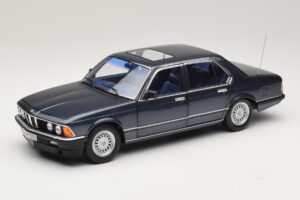

TL;DR: Touring Modelcars is a manufacturer collection centred on BMW executive saloons from the 1980s, made as 1:18 diecast. At roughly a quarter of a metre long, each model shows panel fit, paint depth and interior finish clearly. The range suits focused single-marque shelves; whether a given model's panels open is stated on each product card.
Touring Modelcars BMW 1:18 diecast models give a clear, narrow focus: executive saloons from the 1980s, a decade when the marque's four-door cars were defined by crisp, upright lines rather than the rounder shapes that followed. Focus makes a shelf read as a deliberate collection. This page explains how to judge the finish, how the scale behaves on a shelf, and how to build a run that holds together.
Touring Modelcars is treated here as a manufacturer collection, and what it holds in this catalogue is clear: BMW executive saloons from the 1980s, in 1:18 diecast. That narrow band is the collection's centre of gravity, which makes the page a sensible starting point for anyone who wants one marque, one decade and one scale on the same shelf.
A note on scope. This describes what is present here, not the manufacturer's complete output, so avoid assuming other marques, scales or materials and rely on each product card for specifics. British collectors tend to research carefully before buying, and per-model facts serve that habit far better than brand-level generalisations.
What the focus gives you is comparability. Two saloons from the same decade, in the same scale and the same material, can sit side by side and be judged on identical terms: paint, glass, grille, wheels, stance. Differences between them are then genuine differences in execution, not artefacts of mixed scales. That consistency is the quiet appeal of a single-marque category, and it often makes a short run on the shelf look more resolved than a larger, mixed one.
An unfamiliar manufacturer is best placed by what the model shows, not by reputation. Five signals do most of the work:
Tier follows from how many of these hold up at arm's length and under a close lamp. Entry-level work tends to relax several at once. Mid-tier work holds most of them. Premium and investment-grade pieces hold nearly all and add finer separate parts. None of this hands a verdict to any particular manufacturer; it is a method, and it works the same on any shelf. Where two saloons are close, paint and shut lines usually decide it, because those are the two things the eye reads first from across a room.
Executive saloons of the 1980s present a particular challenge and a particular pleasure for a model. The shapes are upright and rectilinear, with slim roof pillars, large glasshouses and flat flanks, so there is little curvature to hide behind. Every uneven gap or wavering window line shows. That is why the era rewards the larger scale: at 1:18 the glass area, thin pillars and flat panels read clearly.
Trim finishes matter. Many cars of the decade mixed bright metal with black plastic around windows, bumpers and grille, and a good replica separates those finishes cleanly rather than blending them. Check the window surrounds, the way colour meets black trim, and the lines of the bonnet, boot and doors. Interior colours of the period also repay a comparison with photographs of the real car, since tan, grey and black schemes can look convincing or flat depending on execution.
A 1980s run also documents a transitional stretch in executive motoring, sitting before the rounder styling that arrived in the 1990s. That context gives a BMW saloon diecast shelf a clear narrative without any need to stretch beyond the collection.
Zinc-alloy diecast brings mass. Lift a 1:18 saloon from its foam insert and the weight is the first thing you register, followed by the cool, dense feel of cast metal. Paint sits well on a hard metal shell, so gloss tends to read deep and even under a display lamp. The body also tolerates handling and ages steadily on a shelf.
The trade-off is tolerance. Casting allows slightly wider shut lines and marginally softer edges than cast resin can hold, which is why resin is often preferred for razor-sharp panel detail, though it is lighter and more brittle. Neither material is a quality ranking; they suit different priorities. A diecast saloon suits a collector who values heft and robustness.
Scale sets the footprint. A 1980s executive saloon at 1:18 lands at roughly 25 to 26 centimetres in length and just under 10 centimetres in width, so detail such as door handles, wipers and badge lettering has room to register. At 1:43 the same car shrinks to a matchbox footprint where those details compress. Whether a particular model's bonnet, boot or doors open varies from piece to piece, so read it from the product card rather than assuming it from the material.
At this size a model is an object on show for years, and the display decides how it ages. Allow around 4 centimetres between cars so each reads as an individual, which puts about three on a metre-wide shelf. A glass-fronted display case keeps dust off, a real advantage with fine grille bars and wheel spokes that are awkward to clean.
Light cuts both ways. A small lamp from above and slightly forward shows paint depth and exposes flaws, which is exactly what a collector wants when comparing two saloons. Direct sunlight is the enemy: it fades paint and yellows clear parts faster than any other hazard. Position the case away from windows.
Handle by the underside or base rather than the roof or bumpers, and use a soft brush for dust instead of a cloth that can catch wing mirrors and wipers. Keep original boxes and inserts. British collectors place real value on packaging, paperwork and completeness, and a boxed model is easier to store, move and pass on. Store away from damp, which can corrode metal parts and warp card.
A narrow category supports a focused scope, not a full landscape, and that is a strength when planned. Pick a thread before buying. One option is colour: a shelf of saloons in a controlled palette looks deliberate from across the room. Another is body shape, grouping similar proportions so subtle differences stand out. A third is sequence, arranging cars in the order the real models appeared so the shelf reads as a timeline.
Keep to one scale. Mixing 1:18 with smaller scales breaks the sightlines, whereas a uniform run lets stance and proportion compare directly. Collectors who want broader coverage often add that breadth elsewhere in the hobby, leaving this shelf as the examination-grade display.
Record provenance as you go: boxes, inserts and any paperwork, noting edition details only where the product card gives them. Compare two examples of a similar car before committing, using the five signals above. That habit turns a purchase into a decision and a handful of saloons into a collection with a clear reason to exist.
This collection centres on 1:18 scale in diecast, which means roughly a quarter of a metre of length per saloon and the weight of cast metal in the hand. Each product card lists the details for that model, so check it for specifics.
Compare paint depth, shut lines, glazing, grille and badge crispness, and wheel offset under the same light. Stance matters too: a model sitting too high or too low looks wrong from across the room. The one that holds more of these together is the better execution.
It adds a clean, upright counterpoint to rounder, later cars. Flat flanks and large glass areas make build quality easy to read, and the car documents a distinct period in executive motoring, giving a mixed display a clear chapter of its own.
Begin with a single saloon in a colour you would genuinely enjoy looking at daily, and judge it against the checks above. Once you know what good paint and tight shut lines look like at 1:18, adding a second car for comparison is far easier.