Last one
Used
This model is currently sold out. Enter your email and we'll let you know when it's back in stock.
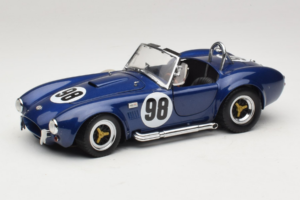
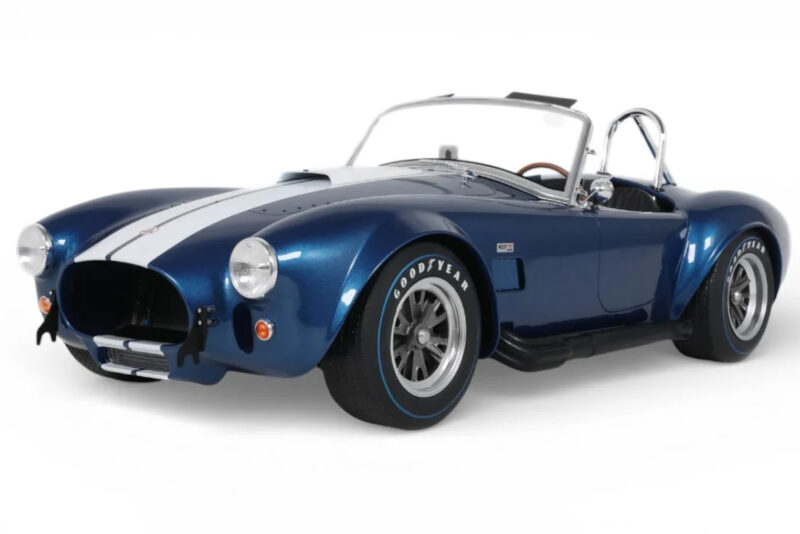
TL;DR: GT Spirit's 1:8 resin Shelby Cobra 427 S/C reproduces Carroll Shelby's big-block roadster, one of the most powerful production sports cars of the 1960s. The sealed resin body holds the wide arches and flared bodywork the 427 needed to fit its engine. A genuinely hero-scale piece reserved for a subject that earns it.
Most Cobras get a shelf slot alongside a dozen other 1960s sports cars. This one asks for its own space, a 1:8 casting large enough that the 427's menace actually reads at a glance rather than needing explanation.
Carroll Shelby's original small-block Cobra had already earned a reputation for being more car than most drivers could handle, and the 427 raised the stakes considerably by fitting a genuine big-block V8 into essentially the same lightweight chassis. The S/C designation, standing for semi-competition, marked cars built with racing-derived specification but sold as road-legal machines, complete with the flared, wide-hipped bodywork needed to clear the fatter tyres a car with this much power actually required. It remains one of the more genuinely intimidating production sports cars to come out of the 1960s, and its reputation has never really softened.
Not every subject earns 1:8, a scale reserved by most manufacturers for cars whose presence and detail genuinely reward the extra size. The 427 S/C, with its aggressive flared arches and purposeful stance, is exactly the kind of car that benefits from a scale large enough to let those proportions breathe.
This Cobra is cast as a sealed resin body with no opening doors or bonnet, and at 1:8 that construction choice lets the flared wheel arches and the roadster's low, curved bodywork hold a crispness that a hinge-accommodating body simply could not manage across a surface this large. Resin's advantage over diecast in holding compound curves becomes even more pronounced at hero scale, where any softness in the casting would be immediately visible rather than hidden by small size.
A casting at this size still carries real substance in the hand despite being resin rather than diecast, and the paint depth over such a large, unbroken bonnet and rear deck shows off metallic flake and gloss in a way a smaller scale simply cannot. Shut lines along the doors run as single continuous grooves, and at this size that precision is genuinely visible from normal viewing distance rather than requiring a close inspection.
The Cobra sits at the aggressive end of 1960s American sports car history, built in far smaller numbers than contemporary Mustangs or Corvettes and priced accordingly both then and now among collectors of the real cars. That rarity and reputation translate directly into the model market, where a genuine 427 S/C casting, especially at this larger scale, sits well above the mainstream diecast Cobras most collections already contain.
At 1:8, this Cobra measures a genuinely substantial length, likely exceeding fifty centimetres given the real car's already long-hooded roadster proportions, so it needs a dedicated shelf or a cabinet built with that footprint in mind rather than a shared row. Displayed alone or as the clear centrepiece of an American sports car collection, this 427 S/C earns its scale through sheer physical presence, exactly as the real car earned its reputation through sheer physical intimidation.