Last one
Save £4.00
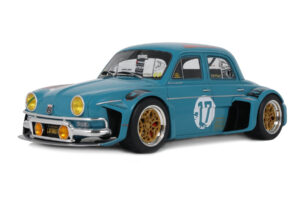
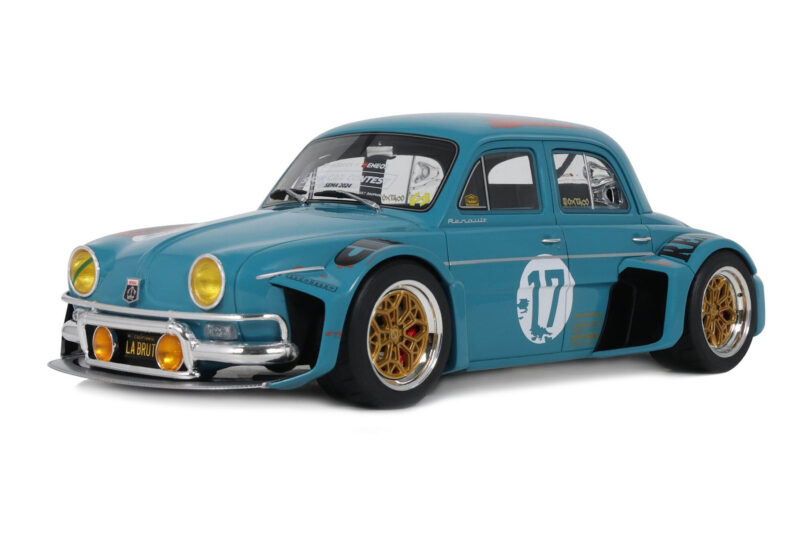
TL;DR: Otto's 1:18 Renault Dauphine La Brute reproduces the SEMA-honoured restomod build of Renault's 1950s rear-engined economy sedan, cast as a sealed resin shell in weathered green patina. A lowered, aggressive stance sits over the Dauphine's originally modest proportions, with the whole build read entirely from its exterior finish.
Renault built the Dauphine from 1956 through 1967, and for a brief period in the late 1950s it was genuinely one of the best-selling imported cars in the United States, its light, rear-engined layout appealing to buyers looking beyond Detroit's larger offerings. La Brute takes that unassuming shape and turns it into something far more aggressive, a hot rod restomod finished with deliberate patina rather than fresh paint.
The Dauphine followed Renault's earlier 4CV with a slightly larger body and the same rear-engine, rear-drive layout, a configuration that gave it decent interior space relative to its footprint and reasonably light steering for the era. It sold well across Europe, but its most remarkable chapter came in America, where import buyers briefly made it one of the most popular small foreign cars on sale, years before Volkswagen's Beetle came to dominate that same niche. Reliability and rust problems eventually caught up with its reputation there, but for a few years the Dauphine proved a genuinely small, simple car could find real success outside its home market.
Building a hot rod from a Dauphine is an unusual choice precisely because the car was never engineered with performance in mind; its light weight and simple structure are really the only qualities that make it viable as a restomod base at all. La Brute leans into that light weight rather than fighting it, pairing an aggressive, lowered stance with a patina finish that deliberately looks unrestored rather than freshly painted. That combination, visible weathering over a genuinely reworked chassis, is a specific aesthetic within the custom car world, one that values honesty about a build's history over a showroom-fresh finish.
Reproducing a patina finish convincingly is one of the harder tasks in miniature, because it asks a casting to look aged and imperfect on purpose while still being precisely applied. Otto builds this Dauphine as a single sealed resin body, with no bonnet or door built to open, which gives the painters a continuous, unbroken canvas to work the weathered green finish across without a hinge line interrupting the effect. The result reads as one aged surface rather than a series of separately treated panels, which is exactly what a convincing patina build needs to achieve.
Underneath the deliberate wear, the base green carries real depth, visible where the patina effect is lightest across the roof and bonnet, giving the finish a sense of history rather than a flat, uniform distress pattern. Resin holds that layered effect well, letting subtle colour variation show through the weathering convincingly under direct light. It is a considerably harder finish to execute than a simple gloss repaint, because any inconsistency in how the patina is applied would immediately look artificial rather than aged.
A patina-finished restomod invites a different kind of scrutiny than a factory-original replica, because the finish itself is meant to suggest history that never actually happened to this particular build. The fair questions are whether the weathering looks convincingly random rather than mechanically repeated, whether the stance reads as purposeful rather than simply distressed for effect, and whether the underlying shape still carries enough of the original Dauphine's character to make the transformation meaningful. On this casting, the answer holds up: the weathering varies naturally across panels, and the Dauphine's distinctive rounded roofline and modest greenhouse remain clearly visible beneath the lowered stance. A SEMA Best of Show recognition, the kind of accolade awarded at one of the automotive world's most competitive custom car showcases, signals that the full-size build succeeded at exactly this balancing act, and the model's job is to carry that same balance into 1:18.
This Dauphine sits most naturally within a display built around custom and restomod culture rather than one organised by manufacturer or decade, since its appeal has little to do with period-correct Renault history and everything to do with what a skilled builder did to reinterpret it. The sealed body and layered patina finish make it a genuinely distinctive shelf piece, one that rewards close inspection rather than a passing glance. At this tier, resin construction gives the weathered finish more subtlety than a die-cast equivalent would manage. For a collector already gathering award-recognised custom builds, this Dauphine earns its place through sheer distinctiveness.

Save £49.00