{"ajaxurl":"https:\/\/models118.co.uk\/wp-admin\/admin-ajax.php?lang=en_GB","nonce":"df31c18213","homeUrl":"https:\/\/models118.co.uk\/","shopUrl":"https:\/\/models118.co.uk\/shop\/","cartUrl":"https:\/\/models118.co.uk\/cart-en-gb\/","checkoutUrl":"https:\/\/models118.co.uk\/checkout\/","skipCart":true,"collectionLimit":12,"i18n":{"addedToCart":"Added to basket","addToWishlist":"Add to wishlist","addedToWishlist":"Added to wishlist","removeFromWishlist":"Remove from wishlist","removedFromWishlist":"Removed from wishlist","undo":"Undo","error":"Something went wrong","loading":"Loading...","outOfStock":"Out of stock","viewCart":"View basket","proceedToCheckout":"Proceed to checkout","addedToCollection":"Added to your collection","reserved":"Reserved!","soldOut":"Sold out","invalidEmail":"Please enter a valid email address","connectionError":"Connection error. Please try again.","loginToSave":"Sign in to save this model","waitlistNotify":"Notify me","waitlistOnList":"On the waiting list \u2713","waitlistJoined":"You're on the waiting list. We'll email you the moment this model is available again.","waitlistRemoved":"Done \u2014 you're off the waiting list for this model.","waitlistRateLimit":"Too many attempts \u2014 please try again shortly","waitlistTurnstile":"We couldn't complete the check \u2014 please try again","waitlistError":"Sorry, something went wrong. Please try again in a moment."},"wishlist":{"loggedIn":false,"loginUrl":"https:\/\/models118.co.uk\/my-account\/","addAction":"models118_wishlist_add","removeAction":"models118_wishlist_remove"},"waitlist":{"loggedIn":false,"subscribeAction":"models118_waitlist_subscribe","toggleAction":"models118_waitlist_toggle","stateAction":"models118_waitlist_state"},"stats":{"models":2148,"brands":205,"manufacturers":127,"collectors":10000},"product":{"id":303190,"sku":"08964BL","condition":"new","name":"Morris Mini Minor Blue Kyosho 1:18","brand":"Morris","manufacturer":"Kyosho","scale":"1:18","material":"Diecast","price":147,"regularPrice":147,"isOnSale":false,"savingsAmount":0,"stockQty":0,"stockStatus":"out_of_stock","isDiscontinued":true,"image":"https:\/\/models118.co.uk\/wp-content\/uploads\/2026\/03\/morris-mini-minor-blue-kyosho-1-18-300x200.jpg","permalink":"https:\/\/models118.co.uk\/morris-mini-minor-blue-kyosho-1-18-08964bl\/"}}
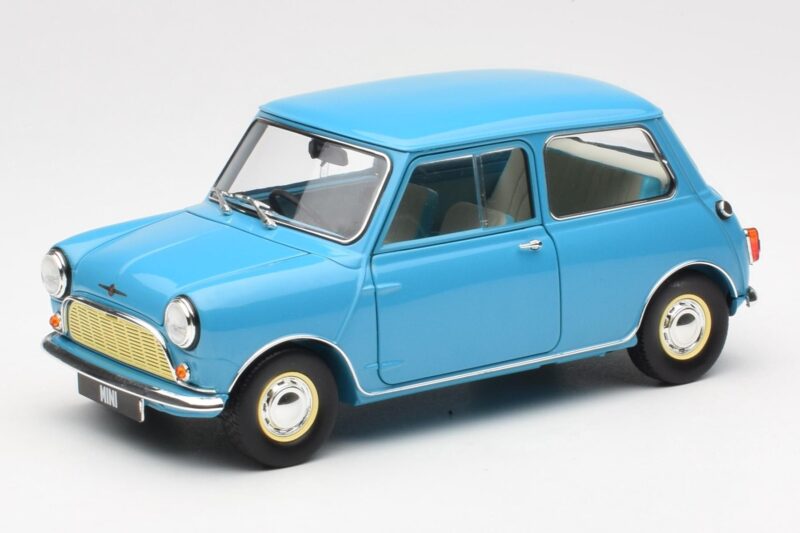
Kyosho's 1:18 diecast Morris Mini Minor in blue reproduces the 1964 BMC original, with opening doors, bonnet and boot over a zinc alloy body true to Issigonis's compact packaging. Tight panel fit and correctly sized 10-inch wheels hold up under close inspection, making this a solid foundation piece for a British classic or retro city shelf at an accessible mid-tier price. A dependable starting point for collectors building a themed Mini colour run.
1 / 8
[{"index":0,"id":"277839","thumb":"https:\/\/models118.co.uk\/wp-content\/uploads\/2026\/03\/morris-mini-minor-blue-kyosho-1-18-300x200.jpg","medium":"https:\/\/models118.co.uk\/wp-content\/uploads\/2026\/03\/morris-mini-minor-blue-kyosho-1-18-800x533.jpg","full":"https:\/\/models118.co.uk\/wp-content\/uploads\/2026\/03\/morris-mini-minor-blue-kyosho-1-18.jpg","srcset":"https:\/\/models118.co.uk\/wp-content\/uploads\/2026\/03\/morris-mini-minor-blue-kyosho-1-18-800x533.jpg 800w, https:\/\/models118.co.uk\/wp-content\/uploads\/2026\/03\/morris-mini-minor-blue-kyosho-1-18-64x43.jpg 64w, https:\/\/models118.co.uk\/wp-content\/uploads\/2026\/03\/morris-mini-minor-blue-kyosho-1-18-300x200.jpg 300w, https:\/\/models118.co.uk\/wp-content\/uploads\/2026\/03\/morris-mini-minor-blue-kyosho-1-18.jpg 1800w","sizes":"(max-width: 1023px) 400px, 640px","srcsetAvif":"https:\/\/models118.co.uk\/wp-content\/uploads\/2026\/03\/morris-mini-minor-blue-kyosho-1-18-800x533.jpg.avif 800w, https:\/\/models118.co.uk\/wp-content\/uploads\/2026\/03\/morris-mini-minor-blue-kyosho-1-18-64x43.jpg.avif 64w, https:\/\/models118.co.uk\/wp-content\/uploads\/2026\/03\/morris-mini-minor-blue-kyosho-1-18-300x200.jpg.avif 300w, https:\/\/models118.co.uk\/wp-content\/uploads\/2026\/03\/morris-mini-minor-blue-kyosho-1-18.jpg.avif 1800w","srcsetWebp":"https:\/\/models118.co.uk\/wp-content\/uploads\/2026\/03\/morris-mini-minor-blue-kyosho-1-18-800x533.jpg.webp 800w, https:\/\/models118.co.uk\/wp-content\/uploads\/2026\/03\/morris-mini-minor-blue-kyosho-1-18-64x43.jpg.webp 64w, https:\/\/models118.co.uk\/wp-content\/uploads\/2026\/03\/morris-mini-minor-blue-kyosho-1-18-300x200.jpg.webp 300w, https:\/\/models118.co.uk\/wp-content\/uploads\/2026\/03\/morris-mini-minor-blue-kyosho-1-18.jpg.webp 1800w","alt":"Morris Mini Minor Blue Kyosho 1:18 08964BL Diecast"},{"index":1,"id":277866,"thumb":"https:\/\/models118.co.uk\/wp-content\/uploads\/2026\/03\/morris-mini-minor-blue-kyosho-1-18-1-300x200.jpg","medium":"https:\/\/models118.co.uk\/wp-content\/uploads\/2026\/03\/morris-mini-minor-blue-kyosho-1-18-1-800x533.jpg","full":"https:\/\/models118.co.uk\/wp-content\/uploads\/2026\/03\/morris-mini-minor-blue-kyosho-1-18-1.jpg","srcset":"https:\/\/models118.co.uk\/wp-content\/uploads\/2026\/03\/morris-mini-minor-blue-kyosho-1-18-1-800x533.jpg 800w, https:\/\/models118.co.uk\/wp-content\/uploads\/2026\/03\/morris-mini-minor-blue-kyosho-1-18-1-64x43.jpg 64w, https:\/\/models118.co.uk\/wp-content\/uploads\/2026\/03\/morris-mini-minor-blue-kyosho-1-18-1-300x200.jpg 300w, https:\/\/models118.co.uk\/wp-content\/uploads\/2026\/03\/morris-mini-minor-blue-kyosho-1-18-1.jpg 1800w","sizes":"(max-width: 1023px) 400px, 640px","srcsetAvif":"https:\/\/models118.co.uk\/wp-content\/uploads\/2026\/03\/morris-mini-minor-blue-kyosho-1-18-1-800x533.jpg.avif 800w, https:\/\/models118.co.uk\/wp-content\/uploads\/2026\/03\/morris-mini-minor-blue-kyosho-1-18-1-64x43.jpg.avif 64w, https:\/\/models118.co.uk\/wp-content\/uploads\/2026\/03\/morris-mini-minor-blue-kyosho-1-18-1-300x200.jpg.avif 300w, https:\/\/models118.co.uk\/wp-content\/uploads\/2026\/03\/morris-mini-minor-blue-kyosho-1-18-1.jpg.avif 1800w","srcsetWebp":"https:\/\/models118.co.uk\/wp-content\/uploads\/2026\/03\/morris-mini-minor-blue-kyosho-1-18-1-800x533.jpg.webp 800w, https:\/\/models118.co.uk\/wp-content\/uploads\/2026\/03\/morris-mini-minor-blue-kyosho-1-18-1-64x43.jpg.webp 64w, https:\/\/models118.co.uk\/wp-content\/uploads\/2026\/03\/morris-mini-minor-blue-kyosho-1-18-1-300x200.jpg.webp 300w, https:\/\/models118.co.uk\/wp-content\/uploads\/2026\/03\/morris-mini-minor-blue-kyosho-1-18-1.jpg.webp 1800w","alt":"Morris Mini Minor Blue Kyosho 1:18 08964BL Diecast \u2014 photo 2 of 8"},{"index":2,"id":277893,"thumb":"https:\/\/models118.co.uk\/wp-content\/uploads\/2026\/03\/morris-mini-minor-blue-kyosho-1-18-2-300x200.jpg","medium":"https:\/\/models118.co.uk\/wp-content\/uploads\/2026\/03\/morris-mini-minor-blue-kyosho-1-18-2-800x533.jpg","full":"https:\/\/models118.co.uk\/wp-content\/uploads\/2026\/03\/morris-mini-minor-blue-kyosho-1-18-2.jpg","srcset":"https:\/\/models118.co.uk\/wp-content\/uploads\/2026\/03\/morris-mini-minor-blue-kyosho-1-18-2-800x533.jpg 800w, https:\/\/models118.co.uk\/wp-content\/uploads\/2026\/03\/morris-mini-minor-blue-kyosho-1-18-2-64x43.jpg 64w, https:\/\/models118.co.uk\/wp-content\/uploads\/2026\/03\/morris-mini-minor-blue-kyosho-1-18-2-300x200.jpg 300w, https:\/\/models118.co.uk\/wp-content\/uploads\/2026\/03\/morris-mini-minor-blue-kyosho-1-18-2.jpg 1800w","sizes":"(max-width: 1023px) 400px, 640px","srcsetAvif":"https:\/\/models118.co.uk\/wp-content\/uploads\/2026\/03\/morris-mini-minor-blue-kyosho-1-18-2-800x533.jpg.avif 800w, https:\/\/models118.co.uk\/wp-content\/uploads\/2026\/03\/morris-mini-minor-blue-kyosho-1-18-2-64x43.jpg.avif 64w, https:\/\/models118.co.uk\/wp-content\/uploads\/2026\/03\/morris-mini-minor-blue-kyosho-1-18-2-300x200.jpg.avif 300w, https:\/\/models118.co.uk\/wp-content\/uploads\/2026\/03\/morris-mini-minor-blue-kyosho-1-18-2.jpg.avif 1800w","srcsetWebp":"https:\/\/models118.co.uk\/wp-content\/uploads\/2026\/03\/morris-mini-minor-blue-kyosho-1-18-2-800x533.jpg.webp 800w, https:\/\/models118.co.uk\/wp-content\/uploads\/2026\/03\/morris-mini-minor-blue-kyosho-1-18-2-64x43.jpg.webp 64w, https:\/\/models118.co.uk\/wp-content\/uploads\/2026\/03\/morris-mini-minor-blue-kyosho-1-18-2-300x200.jpg.webp 300w, https:\/\/models118.co.uk\/wp-content\/uploads\/2026\/03\/morris-mini-minor-blue-kyosho-1-18-2.jpg.webp 1800w","alt":"Morris Mini Minor Blue Kyosho 1:18 08964BL Diecast \u2014 photo 3 of 8"},{"index":3,"id":277920,"thumb":"https:\/\/models118.co.uk\/wp-content\/uploads\/2026\/03\/morris-mini-minor-blue-kyosho-1-18-3-300x200.jpg","medium":"https:\/\/models118.co.uk\/wp-content\/uploads\/2026\/03\/morris-mini-minor-blue-kyosho-1-18-3-800x533.jpg","full":"https:\/\/models118.co.uk\/wp-content\/uploads\/2026\/03\/morris-mini-minor-blue-kyosho-1-18-3.jpg","srcset":"https:\/\/models118.co.uk\/wp-content\/uploads\/2026\/03\/morris-mini-minor-blue-kyosho-1-18-3-800x533.jpg 800w, https:\/\/models118.co.uk\/wp-content\/uploads\/2026\/03\/morris-mini-minor-blue-kyosho-1-18-3-64x43.jpg 64w, https:\/\/models118.co.uk\/wp-content\/uploads\/2026\/03\/morris-mini-minor-blue-kyosho-1-18-3-300x200.jpg 300w, https:\/\/models118.co.uk\/wp-content\/uploads\/2026\/03\/morris-mini-minor-blue-kyosho-1-18-3.jpg 1800w","sizes":"(max-width: 1023px) 400px, 640px","srcsetAvif":"https:\/\/models118.co.uk\/wp-content\/uploads\/2026\/03\/morris-mini-minor-blue-kyosho-1-18-3-800x533.jpg.avif 800w, https:\/\/models118.co.uk\/wp-content\/uploads\/2026\/03\/morris-mini-minor-blue-kyosho-1-18-3-64x43.jpg.avif 64w, https:\/\/models118.co.uk\/wp-content\/uploads\/2026\/03\/morris-mini-minor-blue-kyosho-1-18-3-300x200.jpg.avif 300w, https:\/\/models118.co.uk\/wp-content\/uploads\/2026\/03\/morris-mini-minor-blue-kyosho-1-18-3.jpg.avif 1800w","srcsetWebp":"https:\/\/models118.co.uk\/wp-content\/uploads\/2026\/03\/morris-mini-minor-blue-kyosho-1-18-3-800x533.jpg.webp 800w, https:\/\/models118.co.uk\/wp-content\/uploads\/2026\/03\/morris-mini-minor-blue-kyosho-1-18-3-64x43.jpg.webp 64w, https:\/\/models118.co.uk\/wp-content\/uploads\/2026\/03\/morris-mini-minor-blue-kyosho-1-18-3-300x200.jpg.webp 300w, https:\/\/models118.co.uk\/wp-content\/uploads\/2026\/03\/morris-mini-minor-blue-kyosho-1-18-3.jpg.webp 1800w","alt":"Morris Mini Minor Blue Kyosho 1:18 08964BL Diecast \u2014 photo 4 of 8"},{"index":4,"id":277947,"thumb":"https:\/\/models118.co.uk\/wp-content\/uploads\/2026\/03\/morris-mini-minor-blue-kyosho-1-18-4-300x200.jpg","medium":"https:\/\/models118.co.uk\/wp-content\/uploads\/2026\/03\/morris-mini-minor-blue-kyosho-1-18-4-800x533.jpg","full":"https:\/\/models118.co.uk\/wp-content\/uploads\/2026\/03\/morris-mini-minor-blue-kyosho-1-18-4.jpg","srcset":"https:\/\/models118.co.uk\/wp-content\/uploads\/2026\/03\/morris-mini-minor-blue-kyosho-1-18-4-800x533.jpg 800w, https:\/\/models118.co.uk\/wp-content\/uploads\/2026\/03\/morris-mini-minor-blue-kyosho-1-18-4-64x43.jpg 64w, https:\/\/models118.co.uk\/wp-content\/uploads\/2026\/03\/morris-mini-minor-blue-kyosho-1-18-4-300x200.jpg 300w, https:\/\/models118.co.uk\/wp-content\/uploads\/2026\/03\/morris-mini-minor-blue-kyosho-1-18-4.jpg 1800w","sizes":"(max-width: 1023px) 400px, 640px","srcsetAvif":"https:\/\/models118.co.uk\/wp-content\/uploads\/2026\/03\/morris-mini-minor-blue-kyosho-1-18-4-800x533.jpg.avif 800w, https:\/\/models118.co.uk\/wp-content\/uploads\/2026\/03\/morris-mini-minor-blue-kyosho-1-18-4-64x43.jpg.avif 64w, https:\/\/models118.co.uk\/wp-content\/uploads\/2026\/03\/morris-mini-minor-blue-kyosho-1-18-4-300x200.jpg.avif 300w, https:\/\/models118.co.uk\/wp-content\/uploads\/2026\/03\/morris-mini-minor-blue-kyosho-1-18-4.jpg.avif 1800w","srcsetWebp":"https:\/\/models118.co.uk\/wp-content\/uploads\/2026\/03\/morris-mini-minor-blue-kyosho-1-18-4-800x533.jpg.webp 800w, https:\/\/models118.co.uk\/wp-content\/uploads\/2026\/03\/morris-mini-minor-blue-kyosho-1-18-4-64x43.jpg.webp 64w, https:\/\/models118.co.uk\/wp-content\/uploads\/2026\/03\/morris-mini-minor-blue-kyosho-1-18-4-300x200.jpg.webp 300w, https:\/\/models118.co.uk\/wp-content\/uploads\/2026\/03\/morris-mini-minor-blue-kyosho-1-18-4.jpg.webp 1800w","alt":"Morris Mini Minor Blue Kyosho 1:18 08964BL Diecast \u2014 photo 5 of 8"},{"index":5,"id":277974,"thumb":"https:\/\/models118.co.uk\/wp-content\/uploads\/2026\/03\/morris-mini-minor-blue-kyosho-1-18-5-300x200.jpg","medium":"https:\/\/models118.co.uk\/wp-content\/uploads\/2026\/03\/morris-mini-minor-blue-kyosho-1-18-5-800x533.jpg","full":"https:\/\/models118.co.uk\/wp-content\/uploads\/2026\/03\/morris-mini-minor-blue-kyosho-1-18-5.jpg","srcset":"https:\/\/models118.co.uk\/wp-content\/uploads\/2026\/03\/morris-mini-minor-blue-kyosho-1-18-5-800x533.jpg 800w, https:\/\/models118.co.uk\/wp-content\/uploads\/2026\/03\/morris-mini-minor-blue-kyosho-1-18-5-64x43.jpg 64w, https:\/\/models118.co.uk\/wp-content\/uploads\/2026\/03\/morris-mini-minor-blue-kyosho-1-18-5-300x200.jpg 300w, https:\/\/models118.co.uk\/wp-content\/uploads\/2026\/03\/morris-mini-minor-blue-kyosho-1-18-5.jpg 1800w","sizes":"(max-width: 1023px) 400px, 640px","srcsetAvif":"https:\/\/models118.co.uk\/wp-content\/uploads\/2026\/03\/morris-mini-minor-blue-kyosho-1-18-5-800x533.jpg.avif 800w, https:\/\/models118.co.uk\/wp-content\/uploads\/2026\/03\/morris-mini-minor-blue-kyosho-1-18-5-64x43.jpg.avif 64w, https:\/\/models118.co.uk\/wp-content\/uploads\/2026\/03\/morris-mini-minor-blue-kyosho-1-18-5-300x200.jpg.avif 300w, https:\/\/models118.co.uk\/wp-content\/uploads\/2026\/03\/morris-mini-minor-blue-kyosho-1-18-5.jpg.avif 1800w","srcsetWebp":"https:\/\/models118.co.uk\/wp-content\/uploads\/2026\/03\/morris-mini-minor-blue-kyosho-1-18-5-800x533.jpg.webp 800w, https:\/\/models118.co.uk\/wp-content\/uploads\/2026\/03\/morris-mini-minor-blue-kyosho-1-18-5-64x43.jpg.webp 64w, https:\/\/models118.co.uk\/wp-content\/uploads\/2026\/03\/morris-mini-minor-blue-kyosho-1-18-5-300x200.jpg.webp 300w, https:\/\/models118.co.uk\/wp-content\/uploads\/2026\/03\/morris-mini-minor-blue-kyosho-1-18-5.jpg.webp 1800w","alt":"Morris Mini Minor Blue Kyosho 1:18 08964BL Diecast \u2014 photo 6 of 8"},{"index":6,"id":278001,"thumb":"https:\/\/models118.co.uk\/wp-content\/uploads\/2026\/03\/morris-mini-minor-blue-kyosho-1-18-6-300x200.jpg","medium":"https:\/\/models118.co.uk\/wp-content\/uploads\/2026\/03\/morris-mini-minor-blue-kyosho-1-18-6-800x533.jpg","full":"https:\/\/models118.co.uk\/wp-content\/uploads\/2026\/03\/morris-mini-minor-blue-kyosho-1-18-6.jpg","srcset":"https:\/\/models118.co.uk\/wp-content\/uploads\/2026\/03\/morris-mini-minor-blue-kyosho-1-18-6-800x533.jpg 800w, https:\/\/models118.co.uk\/wp-content\/uploads\/2026\/03\/morris-mini-minor-blue-kyosho-1-18-6-64x43.jpg 64w, https:\/\/models118.co.uk\/wp-content\/uploads\/2026\/03\/morris-mini-minor-blue-kyosho-1-18-6-300x200.jpg 300w, https:\/\/models118.co.uk\/wp-content\/uploads\/2026\/03\/morris-mini-minor-blue-kyosho-1-18-6.jpg 1800w","sizes":"(max-width: 1023px) 400px, 640px","srcsetAvif":"https:\/\/models118.co.uk\/wp-content\/uploads\/2026\/03\/morris-mini-minor-blue-kyosho-1-18-6-800x533.jpg.avif 800w, https:\/\/models118.co.uk\/wp-content\/uploads\/2026\/03\/morris-mini-minor-blue-kyosho-1-18-6-64x43.jpg.avif 64w, https:\/\/models118.co.uk\/wp-content\/uploads\/2026\/03\/morris-mini-minor-blue-kyosho-1-18-6-300x200.jpg.avif 300w, https:\/\/models118.co.uk\/wp-content\/uploads\/2026\/03\/morris-mini-minor-blue-kyosho-1-18-6.jpg.avif 1800w","srcsetWebp":"https:\/\/models118.co.uk\/wp-content\/uploads\/2026\/03\/morris-mini-minor-blue-kyosho-1-18-6-800x533.jpg.webp 800w, https:\/\/models118.co.uk\/wp-content\/uploads\/2026\/03\/morris-mini-minor-blue-kyosho-1-18-6-64x43.jpg.webp 64w, https:\/\/models118.co.uk\/wp-content\/uploads\/2026\/03\/morris-mini-minor-blue-kyosho-1-18-6-300x200.jpg.webp 300w, https:\/\/models118.co.uk\/wp-content\/uploads\/2026\/03\/morris-mini-minor-blue-kyosho-1-18-6.jpg.webp 1800w","alt":"Morris Mini Minor Blue Kyosho 1:18 08964BL Diecast \u2014 photo 7 of 8"},{"index":7,"id":278028,"thumb":"https:\/\/models118.co.uk\/wp-content\/uploads\/2026\/03\/morris-mini-minor-blue-kyosho-1-18-7-300x200.jpg","medium":"https:\/\/models118.co.uk\/wp-content\/uploads\/2026\/03\/morris-mini-minor-blue-kyosho-1-18-7-800x533.jpg","full":"https:\/\/models118.co.uk\/wp-content\/uploads\/2026\/03\/morris-mini-minor-blue-kyosho-1-18-7.jpg","srcset":"https:\/\/models118.co.uk\/wp-content\/uploads\/2026\/03\/morris-mini-minor-blue-kyosho-1-18-7-800x533.jpg 800w, https:\/\/models118.co.uk\/wp-content\/uploads\/2026\/03\/morris-mini-minor-blue-kyosho-1-18-7-64x43.jpg 64w, https:\/\/models118.co.uk\/wp-content\/uploads\/2026\/03\/morris-mini-minor-blue-kyosho-1-18-7-300x200.jpg 300w, https:\/\/models118.co.uk\/wp-content\/uploads\/2026\/03\/morris-mini-minor-blue-kyosho-1-18-7.jpg 1800w","sizes":"(max-width: 1023px) 400px, 640px","srcsetAvif":"https:\/\/models118.co.uk\/wp-content\/uploads\/2026\/03\/morris-mini-minor-blue-kyosho-1-18-7-800x533.jpg.avif 800w, https:\/\/models118.co.uk\/wp-content\/uploads\/2026\/03\/morris-mini-minor-blue-kyosho-1-18-7-64x43.jpg.avif 64w, https:\/\/models118.co.uk\/wp-content\/uploads\/2026\/03\/morris-mini-minor-blue-kyosho-1-18-7-300x200.jpg.avif 300w, https:\/\/models118.co.uk\/wp-content\/uploads\/2026\/03\/morris-mini-minor-blue-kyosho-1-18-7.jpg.avif 1800w","srcsetWebp":"https:\/\/models118.co.uk\/wp-content\/uploads\/2026\/03\/morris-mini-minor-blue-kyosho-1-18-7-800x533.jpg.webp 800w, https:\/\/models118.co.uk\/wp-content\/uploads\/2026\/03\/morris-mini-minor-blue-kyosho-1-18-7-64x43.jpg.webp 64w, https:\/\/models118.co.uk\/wp-content\/uploads\/2026\/03\/morris-mini-minor-blue-kyosho-1-18-7-300x200.jpg.webp 300w, https:\/\/models118.co.uk\/wp-content\/uploads\/2026\/03\/morris-mini-minor-blue-kyosho-1-18-7.jpg.webp 1800w","alt":"Morris Mini Minor Blue Kyosho 1:18 08964BL Diecast \u2014 photo 8 of 8"}]
Morris Mini Minor Blue Kyosho 1:18
Current price:£147.00
Out of production
This model is currently sold out.Enter your email and we'll let you know when it's back in stock.
TL;DR: Kyosho's 1:18 diecast Morris Mini Minor in blue reproduces the 1964 BMC classic, with opening doors, bonnet and boot over a zinc alloy body true to Issigonis's original proportions. A compact British icon for collectors building a retro city or home-grown classic shelf.
The Mini did more to reshape small-car design than almost any British product of its era, and this Morris-badged version carries that engineering story in a package that fits comfortably on a single shelf. Alec Issigonis packed a transverse engine and front-wheel drive into a footprint smaller than most rivals dared attempt.
Morris Mini Minor 1964 in 1:18 Diecast Blue
Issigonis's Packaging Miracle at Scale
Alec Issigonis's brief was brutal: fit four adults and their luggage into a footprint barely three metres long, and he solved it by turning the engine sideways and driving the front wheels, a layout that most of the industry eventually copied. Kyosho's 1:18 model keeps that compact footprint honest, at a size that still leaves the proportions looking right rather than stretched to fill the scale. The upright glasshouse, the tiny 10-inch wheels tucked into their arches and the short bonnet and boot overhangs are all present, and on a car this small, getting those relationships wrong would be obvious immediately. Badged as a Morris rather than an Austin, this version carries BMC's original dual-badge strategy from the car's earliest years on the market.
Blue Paint and Panel Fit on a Compact Body
The blue finish sits close to the period Morris palette, applied evenly across the bonnet and roof without the patchiness that can show on a smaller casting where every panel is visible at once. Shut lines around the opening doors, bonnet and boot stay tight, a genuine achievement given how little surface area a Mini offers to disguise a wandering gap. Chrome trim around the headlamps, bumpers and door handles is picked out cleanly, and the small wheels sit correctly within the arches, filling them properly rather than looking lost. It is a finish built to survive close inspection, which matters on a car whose whole appeal is compactness examined at arm's length.
Diecast Weight and BMC Heritage Context
Zinc Alloy Construction and Opening Panels
Lifted from its box, the model's weight signals zinc alloy construction straight away, a density that gives the Mini a satisfying solidity that belies its toy-like size. Doors, bonnet and boot all open on metal hinges, revealing a simplified engine bay and a cabin trimmed with the upright dashboard and bench-style seating the original used to maximise interior space. That opening boot is worth checking specifically, since it is the panel most likely to show play on a lesser diecast at this scale. Set against a sealed resin alternative, the trade-off favours interaction here: a Mini's charm is partly mechanical, and being able to open it up suits that character.
The Mini's Reputation Beyond the Showroom
BMC's Mini built its reputation well beyond ordinary road use, taking outright wins at the Monte Carlo Rally during the 1960s and proving that a small, cheap car could embarrass far larger machinery on a stage rally. This Morris Mini Minor is the everyday version rather than a rally-liveried Cooper S, but it carries the same underlying engineering that made those wins possible, and that context is worth knowing even on a standard-specification model. Owning the road car version alongside a competition variant is a common way collectors build out a fuller Mini story.
A Foundation Piece for a British Classic Shelf
This Mini Minor works as a foundation piece for any home-grown British classic display, small enough to sit three or four to a shelf without crowding, and significant enough in engineering terms to anchor a theme built around design innovation rather than horsepower. Pair it with other 1960s BMC products or with contemporary European city cars to show how differently manufacturers solved the same small-car problem. At a fair mid-tier price for the scale, it is an easy piece to justify even for collectors who do not usually favour British subjects.
Create a free account and claim 10% off your first order — from hundreds of collectible 1:18, 1:43 and 1:12 models by Porsche, Mercedes-Benz, BMW and more.
{"id":303190,"name":"Morris Mini Minor Blue Kyosho 1:18","price":"£<\/span>147.00<\/bdi><\/span>","image":"https:\/\/models118.co.uk\/wp-content\/uploads\/2026\/03\/morris-mini-minor-blue-kyosho-1-18-400x400.jpg","permalink":"https:\/\/models118.co.uk\/morris-mini-minor-blue-kyosho-1-18-08964bl\/","brand":"Morris"}
Cookies on Models118
We use cookies to remember your preferences, understand how the shop is used and show you models and offers that suit your interests. What you allow is up to you, and you can change it at any time.
Functional
Always active
The technical storage or access is strictly necessary for the legitimate purpose of enabling the use of a specific service explicitly requested by the subscriber or user, or for the sole purpose of carrying out the transmission of a communication over an electronic communications network.
Preferences
The technical storage or access is necessary for the legitimate purpose of storing preferences that are not requested by the subscriber or user.
Statistics
The technical storage or access that is used exclusively for statistical purposes.The technical storage or access that is used exclusively for anonymous statistical purposes. Without a subpoena, voluntary compliance on the part of your Internet Service Provider, or additional records from a third party, information stored or retrieved for this purpose alone cannot usually be used to identify you.
Marketing
The technical storage or access is required to create user profiles to send advertising, or to track the user on a website or across several websites for similar marketing purposes.
We use cookies to remember your preferences, understand how the shop is used and show you models and offers that suit your interests. What you allow is up to you, and you can change it at any time.
Functional
Always active
The technical storage or access is strictly necessary for the legitimate purpose of enabling the use of a specific service explicitly requested by the subscriber or user, or for the sole purpose of carrying out the transmission of a communication over an electronic communications network.
Preferences
The technical storage or access is necessary for the legitimate purpose of storing preferences that are not requested by the subscriber or user.
Statistics
The technical storage or access that is used exclusively for statistical purposes.The technical storage or access that is used exclusively for anonymous statistical purposes. Without a subpoena, voluntary compliance on the part of your Internet Service Provider, or additional records from a third party, information stored or retrieved for this purpose alone cannot usually be used to identify you.
Marketing
The technical storage or access is required to create user profiles to send advertising, or to track the user on a website or across several websites for similar marketing purposes.