Last one
Used
This model is currently sold out. Enter your email and we'll let you know when it's back in stock.
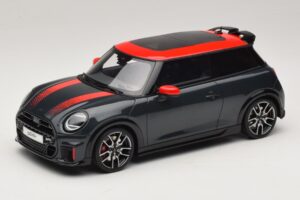
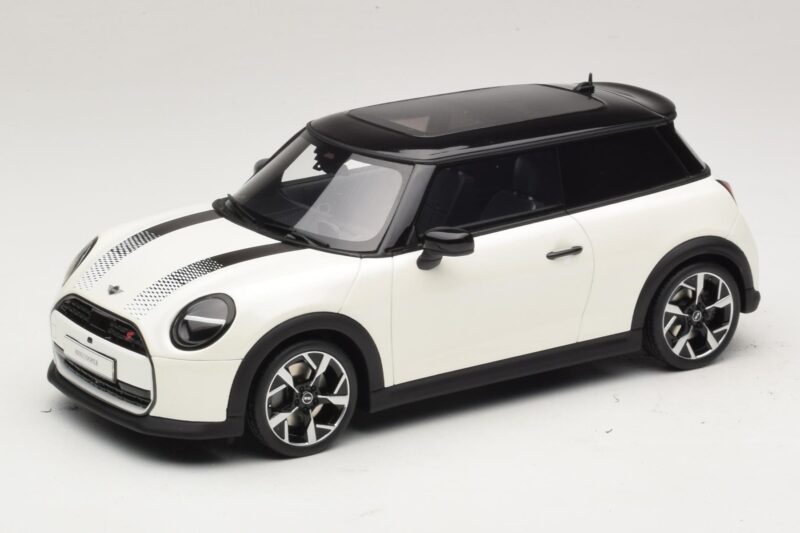
TL;DR: Otto's 1:18 resin Mini Cooper S F66 reproduces the 2025 fourth-generation hot hatch in Nanuq White Metallic. Cast as a sealed one-piece body, it holds tight, continuous shut lines rather than moving panels, a resin specialist's take on a car mainstream diecast manufacturers rarely commit to producing in this detail.
The Mini Cooper S hatchback enters its fourth generation for 2025, trading the outgoing car's toggle switches for a circular OLED display that echoes Mini's classic central speedometer. Otto's 1:18 resin replica arrives in Nanuq White Metallic, a shade that shows off the new body's softer, more rounded surfacing better than a darker finish would.
Mini's fourth-generation hatchback moves the design further from retro pastiche toward a cleaner, more sculpted silhouette. The circular theme survives, most visibly in a large OLED display set into the dashboard where earlier generations mounted a chrome-ringed speedometer, but the surfacing around it grew simpler and the trim fewer. Bumpers lost some of the outgoing car's brightwork, the headlight graphic turned rounder, and the roofline kept the short overhangs that have marked every Mini since the 2001 relaunch. Cooper S trim sits above the base Cooper, carrying the turbocharged four-cylinder and the firmer chassis tuning that has defined the S badge for two decades.
BMW's modern Mini line has moved through three prior hatchback generations since 2001, each carrying its own internal code: R50 and R56 through 2013, then F56 from 2014 to 2023. F66 marks the current car, and the jump in numbering reflects a genuinely new platform rather than a mid-life refresh. For a manufacturer choosing which Mini to reproduce, a first-year new-generation car carries its own appeal. It captures the design before running changes and trim shuffles blur the launch specification, the version most collectors picture first when they hear "the new Mini." First-year specification also tends to hold appeal longer than a car muddied by mid-cycle options and colour deletions, a pattern collectors watch for well beyond the Mini range.
Resin casting suits the F66's rounder surfacing better than a pressed metal die would. Cast rather than stamped, resin holds tighter tolerances through compound curves, so the wheel arches and the tapered glasshouse keep a crispness that a wider-tolerance process can soften. Otto builds this Mini as a one-piece body: no doors, bonnet or boot lift, and every panel line on the model is a painted seam rather than a working hinge. That decision buys consistency. Run a fingertip along the door line and it tracks a single unbroken groove rather than a gap that widens or narrows depending on how carefully a hinge was set at the factory.
Otto Mobile built its name on resin replicas of cars that mainstream diecast manufacturers rarely commit tooling to: hot hatches, homologation specials and performance models that sell in smaller numbers than a Golf GTI or a 911. A brand-new Mini Cooper S generation fits that pattern before the larger diecast houses catch up with their own tooling budgets. The trade-off is the one every resin buyer accepts: no opening panels, a lighter body in the hand than an equivalent zinc alloy casting, and a price that reflects hand finishing rather than mass production. What comes back is the surface quality resin was chosen for in the first place.
Nanuq White Metallic is one of the new generation's launch colours, a cooler, faintly pearlescent white next to the warmer solid whites Mini has offered in the past. Metallic paint behaves differently on a sealed resin body than on a diecast one: with no panel gaps to interrupt the flake pattern, the finish reads as a single continuous field of light rather than several panels catching it at slightly different angles. Under a directed shelf light the flake carries a faint cool shimmer rather than the warmer cast some metallic whites show, and it suits a car whose bumpers and grille surround stay body-colour rather than contrasting black.
At 1:18, a hatchback the F66's size comes out to roughly 21 to 22 centimetres long, a compact footprint next to larger saloons and estates sharing the same shelf. That size works in the Mini's favour: the short overhangs and stubby proportions read correctly at scale in a way a longer, lower sports car sometimes does not. Glazing stays clear enough to pick out the dashboard's circular display, and the wheel design is worth checking against launch photos, since wheel choice, the grille surround and the LED lighting signature are among the fastest tells of a rushed reproduction.
Resin construction places this Otto Mini above mass-market diecast hot hatches on price, and the gap shows in the finish rather than just the material. Where a die-cast Cooper S from a volume manufacturer tolerates wider seams to hold down tooling costs, this one-piece resin body keeps tighter lines throughout, at the cost of any opening panel and a lighter feel in the hand than a comparable zinc casting. For a collector building a Mini lineage from R56 through F56 to this F66, a first-year new-generation piece is the obvious starting point for the current chapter. It also works as a standalone contrast piece: a practical, everyday hot hatch on a shelf otherwise dominated by exotica, proof that resin specialists commit real attention to ordinary performance cars as well as homologation rarities. Displayed next to a classic R56 GP or a JCW variant, it marks a clean generational break worth owning in its own right, not just a placeholder until later trims arrive.