{"ajaxurl":"https:\/\/models118.co.uk\/wp-admin\/admin-ajax.php?lang=en_GB","nonce":"2bd8ec74fc","homeUrl":"https:\/\/models118.co.uk\/","shopUrl":"https:\/\/models118.co.uk\/shop\/","cartUrl":"https:\/\/models118.co.uk\/cart-en-gb\/","checkoutUrl":"https:\/\/models118.co.uk\/checkout\/","skipCart":true,"collectionLimit":12,"i18n":{"addedToCart":"Added to basket","addToWishlist":"Add to wishlist","addedToWishlist":"Added to wishlist","removeFromWishlist":"Remove from wishlist","removedFromWishlist":"Removed from wishlist","undo":"Undo","error":"Something went wrong","loading":"Loading...","outOfStock":"Out of stock","viewCart":"View basket","proceedToCheckout":"Proceed to checkout","addedToCollection":"Added to your collection","reserved":"Added to your collection","soldOut":"Sold out","invalidEmail":"Please enter a valid email address","connectionError":"Connection error. Please try again.","tocToggle":"On this page","close":"Close","inCartTooltip":"Already in your basket \u2013 open your basket to check out","loginToSave":"Sign in to save this model","waitlistNotify":"Notify me","waitlistOnList":"On the waiting list \u2713","waitlistJoined":"You're on the waiting list. We'll email you the moment this model is available again.","waitlistRemoved":"Done \u2014 you're off the waiting list for this model.","waitlistRateLimit":"Too many attempts \u2014 please try again shortly","waitlistTurnstile":"We couldn't complete the check \u2014 please try again","waitlistError":"Sorry, something went wrong. Please try again in a moment."},"wishlist":{"loggedIn":false,"loginUrl":"https:\/\/models118.co.uk\/my-account\/","addAction":"models118_wishlist_add","removeAction":"models118_wishlist_remove"},"waitlist":{"loggedIn":false,"subscribeAction":"models118_waitlist_subscribe","toggleAction":"models118_waitlist_toggle","stateAction":"models118_waitlist_state"},"stats":{"models":2615,"brands":213,"manufacturers":128,"collectors":10000},"product":{"id":1679366,"sku":"499034720","condition":"new","availability":"in_stock","name":"Mercedes L315 Pritschenzug Gustav Mauler Minichamps 1:43","brand":"Mercedes","manufacturer":"Minichamps","scale":"1:43","material":"Diecast","price":139,"regularPrice":139,"isOnSale":false,"savingsAmount":0,"stockQty":1,"stockStatus":"very_low","isDiscontinued":false,"image":"https:\/\/models118.co.uk\/wp-content\/uploads\/2026\/09\/mercedes-l315-pritschenzug-gustav-mauler-minichamps-1-43-499034720-1-1-300x200.jpg","permalink":"https:\/\/models118.co.uk\/mercedes-l315-pritschenzug-gustav-mauler-minichamps-1-43-499034720\/"}}
Cookies on Models118
We use cookies to remember your preferences, understand how the shop is used and show you models and offers that suit your interests. What you allow is up to you, and you can change it at any time.
Always active
The technical storage or access is strictly necessary for the legitimate purpose of enabling the use of a specific service explicitly requested by the subscriber or user, or for the sole purpose of carrying out the transmission of a communication over an electronic communications network.
The technical storage or access is necessary for the legitimate purpose of storing preferences that are not requested by the subscriber or user.
The technical storage or access that is used exclusively for statistical purposes.
The technical storage or access is required to create user profiles to send advertising, or to track the user on a website or across several websites for similar marketing purposes.
Mercedes L315 Pritschenzug Gustav Mauler Minichamps 1:43
New arrival
1/6
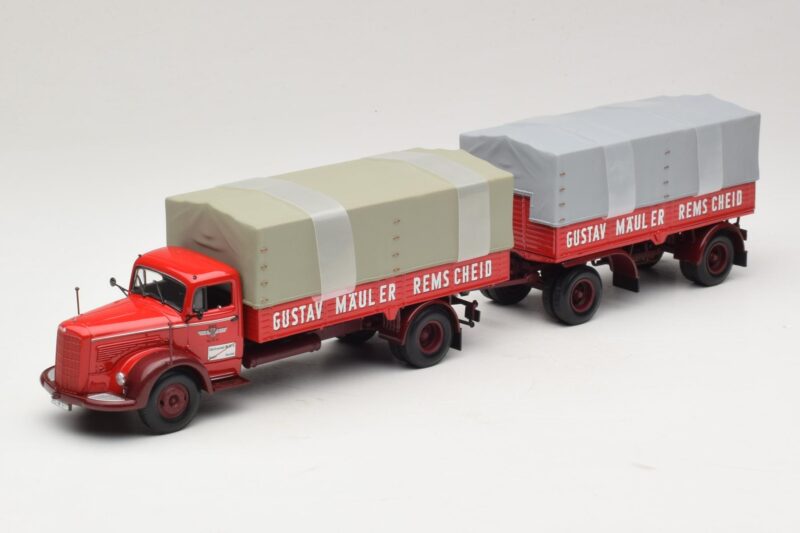
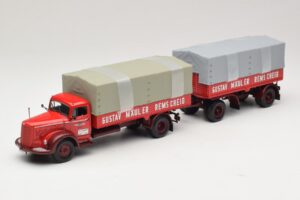
Minichamps' 1:43 diecast Mercedes L315 Pritschenzug couples the round-nosed 1954 cab to a drawbar flatbed trailer in Gustav Mauler livery, doubling load capacity over the solo flatbed version. Both units share matching wooden-plank texture and tampo-printed branding, a natural companion piece for collectors already holding the rigid L315.
About the Mercedes L315 Pritschenzug Gustav Mauler Minichamps 1:43
TL;DR: Minichamps' 1:43 diecast Mercedes L315 Pritschenzug pairs the round-nosed 1954 cab with a drawbar flatbed trailer in Gustav Mauler haulage livery, its sealed body reproducing the articulated rig that solo flatbed L315 castings do not offer. It is a companion configuration for anyone already holding the rigid version of this same cab.
Two lorries in this range share the same round-nosed L315 cab, but only one of them tows a second load behind it on the road. This Pritschenzug pairs the cab with a drawbar-coupled flatbed trailer, turning a single rigid truck into a proper doubled-up articulated combination.
The L315 Pritschenzug: An Articulated Rig on the Round-Nose Cab
What Pritschenzug Means for Load Capacity
Pritschenzug is the German term for a flatbed combination, a tractor unit coupled to a separate drawbar trailer rather than a single rigid chassis carrying its own load bed, and this casting reproduces exactly that arrangement on Mercedes-Benz's round-nosed L315 cab. Where a solo L315 flatbed carries its cargo directly over its own chassis, this version tows a second flatbed unit behind it on a drawbar coupling, doubling load capacity without lengthening the tractor itself, a practical solution period operators used before articulated fifth-wheel semi-trailers became widespread.
Gustav Mauler Livery and Drawbar Geometry
The cab wears the same bonneted, rounded styling found on other early-1950s Mercedes lorries, complete with the split windscreen and curved wings that marked the marque's commercial vehicles before flat-fronted cabs took over later in the decade. This particular example carries Gustav Mauler livery, a period haulage operator's branding applied across the cab doors and the trailing flatbed's side panels, giving the rig an identity beyond a plain factory colour scheme. The drawbar coupling itself is moulded as a fixed, rigid link between the two units, but the geometry is set correctly so the combination sits level rather than nose-up or sagging at the hitch.
Tractor-and-Trailer Coupling and Gustav Mauler Livery
Matching Load-Bed Texture Across Two Units
Judging a two-part rig like this means checking both halves independently before assuming the whole combination holds up. The tractor's own flatbed section carries the same wooden-plank texture and raised side rail detail as the solo version, and the drawbar trailer behind it repeats that treatment closely enough that the two units read as a matched pair rather than mismatched leftovers pressed together. The Gustav Mauler lettering is tampo-printed rather than applied as a transfer, sitting flat against the body surface with clean edges, and the livery continues onto the trailer's side rails so the branding reads as one continuous scheme.
Sealed Castings and Combined Weight
Both the tractor and the trailer are sealed, one-piece castings with no opening panels, so the entire account of build quality plays out in the shut lines around the cab doors, the crispness of the wooden-plank load bed texture, and the flush fit of the split windscreen glazing. Zinc alloy diecast gives the combination genuine weight once coupled, noticeably more substantial in the hand than the solo flatbed version simply because there is more metal involved, and that heft is a fair reflection of what a loaded drawbar rig actually represented on the road.
Rigid or Articulated: Two Ways to Collect the L315
Collectors deciding between the rigid L315 flatbed and this Pritschenzug version are really choosing between two different period stories told on the same cab tooling: one lorry working alone, one lorry doubling its capacity with a trailer behind it. Owning both side by side is the more complete answer, since it shows the same cab handling two distinct operational roles rather than treating either configuration as the definitive one. At 1:43, the coupled rig takes up noticeably more shelf length than the solo version, so it is worth measuring cabinet space before committing to a full fleet of drawbar combinations. For a haulage collection organised around load configuration rather than livery alone, this Pritschenzug is a sensible second purchase to sit alongside the rigid flatbed.
Create a free account and claim 10% off your first order — from hundreds of collectible 1:18, 1:43 and 1:12 models by Porsche, Mercedes-Benz, BMW and more.