{"ajaxurl":"https:\/\/models118.co.uk\/wp-admin\/admin-ajax.php?lang=en_GB","nonce":"1c48fa7922","homeUrl":"https:\/\/models118.co.uk\/","shopUrl":"https:\/\/models118.co.uk\/shop\/","cartUrl":"https:\/\/models118.co.uk\/cart-en-gb\/","checkoutUrl":"https:\/\/models118.co.uk\/checkout\/","skipCart":true,"collectionLimit":12,"i18n":{"addedToCart":"Added to basket","addToWishlist":"Add to wishlist","addedToWishlist":"Added to wishlist","removeFromWishlist":"Remove from wishlist","removedFromWishlist":"Removed from wishlist","undo":"Undo","error":"Something went wrong","loading":"Loading...","outOfStock":"Out of stock","viewCart":"View basket","proceedToCheckout":"Proceed to checkout","addedToCollection":"Added to your collection","reserved":"Added to your collection","soldOut":"Sold out","invalidEmail":"Please enter a valid email address","connectionError":"Connection error. Please try again.","tocToggle":"On this page","close":"Close","inCartTooltip":"Already in your basket \u2013 open your basket to check out","loginToSave":"Sign in to save this model","waitlistNotify":"Notify me","waitlistOnList":"On the waiting list \u2713","waitlistJoined":"You're on the waiting list. We'll email you the moment this model is available again.","waitlistRemoved":"Done \u2014 you're off the waiting list for this model.","waitlistRateLimit":"Too many attempts \u2014 please try again shortly","waitlistTurnstile":"We couldn't complete the check \u2014 please try again","waitlistError":"Sorry, something went wrong. Please try again in a moment."},"wishlist":{"loggedIn":false,"loginUrl":"https:\/\/models118.co.uk\/my-account\/","addAction":"models118_wishlist_add","removeAction":"models118_wishlist_remove"},"waitlist":{"loggedIn":false,"subscribeAction":"models118_waitlist_subscribe","toggleAction":"models118_waitlist_toggle","stateAction":"models118_waitlist_state"},"stats":{"models":2281,"brands":213,"manufacturers":128,"collectors":10000},"product":{"id":1390430,"sku":"37800-M5","condition":"used","availability":"out_of_stock","name":"Mercedes A-Class W168 Light Blue Maisto 1:18","brand":"Mercedes","manufacturer":"Maisto","scale":"1:18","material":"Diecast","price":48,"regularPrice":48,"isOnSale":false,"savingsAmount":0,"stockQty":0,"stockStatus":"out_of_stock","isDiscontinued":true,"image":"https:\/\/models118.co.uk\/wp-content\/uploads\/2026\/06\/mercedes-a-class-w168-light-blue-maisto-1-18-300x200.jpg","permalink":"https:\/\/models118.co.uk\/mercedes-a-class-w168-light-blue-maisto-1-18-37800-m5\/"}}
Cookies on Models118
We use cookies to remember your preferences, understand how the shop is used and show you models and offers that suit your interests. What you allow is up to you, and you can change it at any time.
Always active
The technical storage or access is strictly necessary for the legitimate purpose of enabling the use of a specific service explicitly requested by the subscriber or user, or for the sole purpose of carrying out the transmission of a communication over an electronic communications network.
The technical storage or access is necessary for the legitimate purpose of storing preferences that are not requested by the subscriber or user.
The technical storage or access that is used exclusively for statistical purposes.
The technical storage or access is required to create user profiles to send advertising, or to track the user on a website or across several websites for similar marketing purposes.
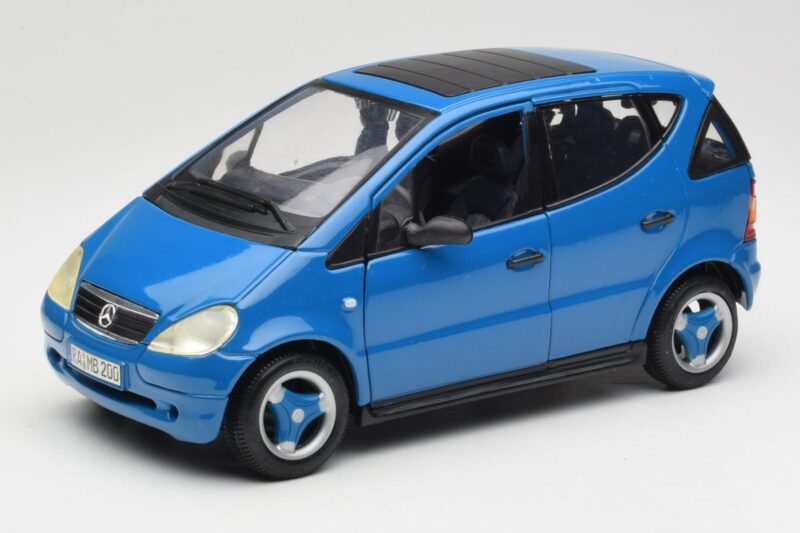
Maisto's 1:18 diecast Mercedes A-Class W168 reproduces the 1997 premium hatchback in light blue, the compact Mercedes that made headlines for a rollover test and led to standard-fit ESP. An entry-tier build with the W168's tall, upright cabin, a discovery piece for a 1990s display.
About the Mercedes A-Class W168 Light Blue Maisto 1:18
TL;DR: Maisto's 1:18 diecast Mercedes A-Class W168 recreates the 1997 premium hatchback in light blue, the compact Mercedes that failed a Swedish rollover test and pushed the marque to fit ESP as standard across its range. Entry-tier construction captures the car's tall, boxy stance for a 1990s themed shelf.
The A-Class is an unlikely hero for a display shelf, a small hatchback rather than a sports car, but its story explains why Mercedes went to such lengths to fix it fast.
Maisto's Diecast Take on Mercedes' Smallest 1990s Model
The body is zinc alloy diecast in light blue, with the boot or a door opening on simple hinges typical of Maisto's entry range, and panel gaps that run wider than mid-tier work. The cabin is simplified, using a moulded dashboard rather than mapped switchgear detail. Where the model earns attention is proportion: the W168's unusually tall, narrow body and short bonnet, a shape built to maximise interior space rather than to look conventionally sporty. That upright stance is what made the car both practical and, initially, unstable at speed, and Maisto's silhouette captures it faithfully.
The Elk Test That Changed the A-Class
In 1997 a Swedish motoring journalist rolled a pre-production A-Class during an emergency lane-change test, an incident that became widely known as the elk test. Mercedes halted deliveries, reworked the suspension, and fitted electronic stability control as standard, a move that helped push ESP toward becoming an industry norm rather than a luxury option. That episode gives an otherwise modest hatchback genuine significance in the story of car safety, and it is exactly the kind of context that turns a small Mercedes into a worthwhile addition to a 1990s shelf.
Placed beside larger Mercedes models of the same decade, the A-Class tells a very different story: not performance, but a car that changed how safety was engineered.
Create a free account and claim 10% off your first order — from hundreds of collectible 1:18, 1:43 and 1:12 models by Porsche, Mercedes-Benz, BMW and more.
{"id":1390430,"name":"Mercedes A-Class W168 Light Blue Maisto 1:18","price":"£<\/span>48.00<\/bdi><\/span>","image":"https:\/\/models118.co.uk\/wp-content\/uploads\/2026\/06\/mercedes-a-class-w168-light-blue-maisto-1-18-400x400.jpg","permalink":"https:\/\/models118.co.uk\/mercedes-a-class-w168-light-blue-maisto-1-18-37800-m5\/","brand":"Mercedes"}