{"ajaxurl":"https:\/\/models118.co.uk\/wp-admin\/admin-ajax.php?lang=en_GB","nonce":"a2e6fbeffa","homeUrl":"https:\/\/models118.co.uk\/","shopUrl":"https:\/\/models118.co.uk\/shop\/","cartUrl":"https:\/\/models118.co.uk\/cart-en-gb\/","checkoutUrl":"https:\/\/models118.co.uk\/checkout\/","skipCart":true,"collectionLimit":12,"i18n":{"addedToCart":"Added to basket","addToWishlist":"Add to wishlist","addedToWishlist":"Added to wishlist","removeFromWishlist":"Remove from wishlist","removedFromWishlist":"Removed from wishlist","undo":"Undo","error":"Something went wrong","loading":"Loading...","outOfStock":"Out of stock","viewCart":"View basket","proceedToCheckout":"Proceed to checkout","addedToCollection":"Added to your collection","reserved":"Added to your collection","soldOut":"Sold out","invalidEmail":"Please enter a valid email address","connectionError":"Connection error. Please try again.","tocToggle":"On this page","close":"Close","inCartTooltip":"Already in your basket \u2013 open your basket to check out","loginToSave":"Sign in to save this model","waitlistNotify":"Notify me","waitlistOnList":"On the waiting list \u2713","waitlistJoined":"You're on the waiting list. We'll email you the moment this model is available again.","waitlistRemoved":"Done \u2014 you're off the waiting list for this model.","waitlistRateLimit":"Too many attempts \u2014 please try again shortly","waitlistTurnstile":"We couldn't complete the check \u2014 please try again","waitlistError":"Sorry, something went wrong. Please try again in a moment."},"wishlist":{"loggedIn":false,"loginUrl":"https:\/\/models118.co.uk\/my-account\/","addAction":"models118_wishlist_add","removeAction":"models118_wishlist_remove"},"waitlist":{"loggedIn":false,"subscribeAction":"models118_waitlist_subscribe","toggleAction":"models118_waitlist_toggle","stateAction":"models118_waitlist_state"},"stats":{"models":2369,"brands":214,"manufacturers":129,"collectors":10000},"product":{"id":19027,"sku":"183777","condition":"new","availability":"out_of_stock","name":"Mercedes 200 W115 Norev 1:18","brand":"Mercedes","manufacturer":"Norev","scale":"1:18","material":"Diecast","price":84,"regularPrice":84,"isOnSale":false,"savingsAmount":0,"stockQty":0,"stockStatus":"out_of_stock","isDiscontinued":true,"image":"https:\/\/models118.co.uk\/wp-content\/uploads\/2026\/03\/mercedes-200-w115-norev-1-18-300x200.jpg","permalink":"https:\/\/models118.co.uk\/mercedes-200-w115-norev-1-18-183777\/"}}
Cookies on Models118
We use cookies to remember your preferences, understand how the shop is used and show you models and offers that suit your interests. What you allow is up to you, and you can change it at any time.
Always active
The technical storage or access is strictly necessary for the legitimate purpose of enabling the use of a specific service explicitly requested by the subscriber or user, or for the sole purpose of carrying out the transmission of a communication over an electronic communications network.
The technical storage or access is necessary for the legitimate purpose of storing preferences that are not requested by the subscriber or user.
The technical storage or access that is used exclusively for statistical purposes.
The technical storage or access is required to create user profiles to send advertising, or to track the user on a website or across several websites for similar marketing purposes.
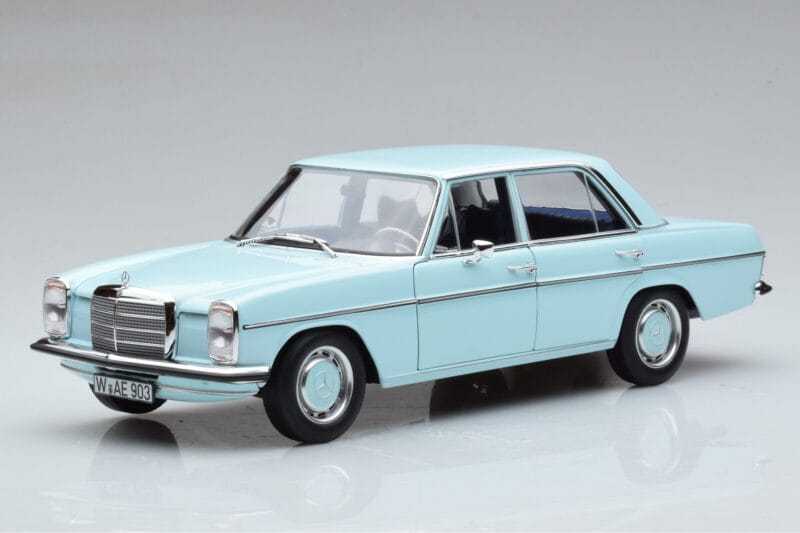
Norev's 1:18 diecast Mercedes 200 W115 recreates the 1968 "Stroke Eight" saloon that replaced the Fintail generation. Doors, bonnet and boot all open, showing off cabin and engine bay detail on a zinc alloy body with genuine weight in the hand. A dependable mid-century Mercedes for anyone building a saloon chronology or a broader German classic shelf.
TL;DR: Norev's 1:18 diecast Mercedes 200 W115 recreates the 1968 "Stroke Eight" saloon, the model that replaced the Fintail generation. Doors, bonnet and boot all open on this zinc alloy build, revealing cabin and engine bay detail. A solid mid-century entry for a Mercedes saloon chronology.
Mercedes-Benz called it the "Stroke Eight" for the year it launched, and the W115 quietly became one of the most consequential saloons the marque ever built, setting a template for build quality that outlasted its own production run. Norev's 1:18 diecast puts that unglamorous but enduring shape on a shelf, opening panels included.
The W115: Replacing the Fintail Generation
A Cleaner Shape After the Fintail
When the W115 arrived in 1968 it replaced the W110/W111 Fintail cars, dropping the tailfins for a squarer, more restrained silhouette that Mercedes would refine across the following two generations. The 200 sat toward the entry end of the range, powered by a four-cylinder engine rather than the sixes offered further up the lineup, but it shared its body, its safety engineering, and its build quality with pricier stablemates.
Safety Engineering Ahead of Its Time
Mercedes used the W115 generation to introduce crumple-zone thinking to a mainstream saloon, work that traced back to engineer Béla Barényi's pioneering safety research. That focus on passive safety, unusual for a mid-sized family saloon of the period, is a large part of why the W115 earned a reputation for durability that keeps surviving examples running today, and it gives this otherwise modest model genuine engineering significance behind its plain three-box shape.
Norev's Diecast Build and Opening Features
Doors, Bonnet and Boot That Move
This casting opens at all the expected points: doors swing to reveal upholstered seats and a period dashboard, the bonnet lifts over a scaled four-cylinder engine bay, and the boot opens onto luggage space that mirrors the real saloon's generous trunk. That articulation lets a buyer show the W115's cabin, which was notably plain but well finished for its era, without needing to imagine the details from the outside alone.
Zinc Alloy Construction and Paint Depth
Diecast at 1:18 uses zinc alloy, and the weight difference from a resin equivalent is immediate once the model is in hand. That mass brings real durability across years of handling, at the cost of slightly wider panel tolerances than a cast resin shell could achieve. The paint on Norev's saloon body sits with a deep, even gloss, appropriate for a period Mercedes finish where restraint rather than flash was the point.
A Saloon That Rewards a Chronology
The W115 makes more sense on a shelf next to its neighbours than on its own. Placed ahead of the W123 that succeeded it in 1976, the lineage of Mercedes mid-size saloons through the 1970s and 1980s becomes visible in a way a single model cannot convey. Placed behind a Fintail W110, the shift toward a squarer, more modern silhouette is equally obvious. Diecast at this scale is the practical way to build that kind of run, since a full chronology assembled entirely from hand-built resin quickly becomes an expensive undertaking, while Norev's mid-tier diecast lets a collector cover several generations without every piece demanding investment-grade pricing. The 200 badge specifically represents the accessible end of the W115 range, useful for anyone who wants the shape and the era without needing to track down a rarer six-cylinder variant.
Where the 200 W115 Sits on a Shelf
At 1:18 a saloon of the W115's dimensions comes out close to 26 centimetres, a size that anchors a shelf row rather than disappearing into it. Its restrained three-box shape and muted colour options mean it works as a calm counterpoint to flashier sports or supercar pieces, giving a mixed display some visual variety. For a collector focused on Mercedes-Benz saloon history specifically, this is a foundational entry: unglamorous, well engineered, and honestly priced for what it represents.
Create a free account and claim 5% off your first order — from hundreds of collectible 1:18, 1:43 and 1:12 models by Porsche, Mercedes-Benz, BMW and more.