{"ajaxurl":"https:\/\/models118.co.uk\/wp-admin\/admin-ajax.php?lang=en_GB","nonce":"6a890636e0","homeUrl":"https:\/\/models118.co.uk\/","shopUrl":"https:\/\/models118.co.uk\/shop\/","cartUrl":"https:\/\/models118.co.uk\/cart-en-gb\/","checkoutUrl":"https:\/\/models118.co.uk\/checkout\/","skipCart":true,"collectionLimit":12,"i18n":{"addedToCart":"Added to basket","addToWishlist":"Add to wishlist","addedToWishlist":"Added to wishlist","removeFromWishlist":"Remove from wishlist","removedFromWishlist":"Removed from wishlist","undo":"Undo","error":"Something went wrong","loading":"Loading...","outOfStock":"Out of stock","viewCart":"View basket","proceedToCheckout":"Proceed to checkout","addedToCollection":"Added to your collection","reserved":"Added to your collection","soldOut":"Sold out","invalidEmail":"Please enter a valid email address","connectionError":"Connection error. Please try again.","tocToggle":"On this page","close":"Close","inCartTooltip":"Already in your basket \u2013 open your basket to check out","loginToSave":"Sign in to save this model","waitlistNotify":"Notify me","waitlistOnList":"On the waiting list \u2713","waitlistJoined":"You're on the waiting list. We'll email you the moment this model is available again.","waitlistRemoved":"Done \u2014 you're off the waiting list for this model.","waitlistRateLimit":"Too many attempts \u2014 please try again shortly","waitlistTurnstile":"We couldn't complete the check \u2014 please try again","waitlistError":"Sorry, something went wrong. Please try again in a moment."},"wishlist":{"loggedIn":false,"loginUrl":"https:\/\/models118.co.uk\/my-account\/","addAction":"models118_wishlist_add","removeAction":"models118_wishlist_remove"},"waitlist":{"loggedIn":false,"subscribeAction":"models118_waitlist_subscribe","toggleAction":"models118_waitlist_toggle","stateAction":"models118_waitlist_state"},"stats":{"models":2160,"brands":217,"manufacturers":131,"collectors":10000},"product":{"id":1711875,"metaRid":"1711732","sku":"183832","condition":"new","availability":"in_stock","name":"Mercedes 190E W201 2.3-16 A. Senna Race of Champions 1984 Norev 1:18","brand":"Mercedes","manufacturer":"Norev","scale":"1:18","material":"Diecast","price":84,"regularPrice":84,"isOnSale":false,"savingsAmount":0,"stockQty":11,"stockStatus":"in_stock","isDiscontinued":false,"image":"https:\/\/models118.co.uk\/wp-content\/uploads\/2026\/11\/mercedes-190e-w201-2-3-16-a-senna-race-of-champions-1984-norev-1-18-183832-3-300x200.jpg","permalink":"https:\/\/models118.co.uk\/mercedes-190e-w201-2-3-16-a-senna-race-of-champions-1984-norev-1-18-183832\/"},"capture":{"p14":true,"codes":{"save_cart":"p17","heart":"p11","price_link":"p11","popup":"p14"},"beaconUrl":"https:\/\/models118.co.uk\/?m118_cap=1","cssUrl":"https:\/\/models118.co.uk\/wp-content\/themes\/models118-starter\/assets\/dist\/css\/capture.css?ver=2.0.0.1794842618","controlEnd":{"p14":"2027-01-08","p17":"2027-01-09"},"mailRule":"sesja","sitekey":"0x4AAAAAAC-YGorIpFXObqmM","i18n":{"title":"A weekly email for collectors","text":"Each email covers one topic: new arrivals, pre-orders, models back in stock and more.","label":"Email address","placeholder":"Enter your email address","button":"Sign up","fine":"One email a week about the models in our shop. Unsubscribe at any time with one click.","success":"You're signed up. Our next weekly email will be your first.","error":"Something went wrong. Please try again.","invalid":"That doesn't look like a valid email address.","verify":"Verification failed. Please try again.","rate":"Too many attempts. Please try again later.","close":"Close"},"p11":true,"priceLink":true,"priceLinkLabel":"Get a price-drop alert","heartI18n":{"title":"Saved to your wishlist","label":"Email address","placeholder":"Enter your email address","button":"Keep me posted","promise_price":"Add your email and we'll let you know if the price drops.","promise_stock":"Add your email and we'll let you know if it comes back in stock.","promise_news":"Add your email address to receive our weekly email for collectors, with one topic each week.","first5":"Create an account for a one-off 5% discount (code FIRST5).","fine":"Alerts for your list where they apply, plus one email a week about the models in our shop. Unsubscribe at any time with one click.","success":"You're signed up. Your list is now linked to your email.","list_note":"Your list is saved on this device only. Add your email and we'll alert you to price drops and restocks where they apply."},"p17":true}}
Cookies on Models118
We use cookies to remember your preferences, understand how the shop is used and show you models and offers that suit your interests. What you allow is up to you, and you can change it at any time.
Always active
The technical storage or access is strictly necessary for the legitimate purpose of enabling the use of a specific service explicitly requested by the subscriber or user, or for the sole purpose of carrying out the transmission of a communication over an electronic communications network.
The technical storage or access is necessary for the legitimate purpose of storing preferences that are not requested by the subscriber or user.
The technical storage or access that is used exclusively for statistical purposes.
The technical storage or access is required to create user profiles to send advertising, or to track the user on a website or across several websites for similar marketing purposes.
Mercedes 190E W201 2.3-16 A. Senna Race of Champions 1984 Norev 1:18
New arrival
1/8
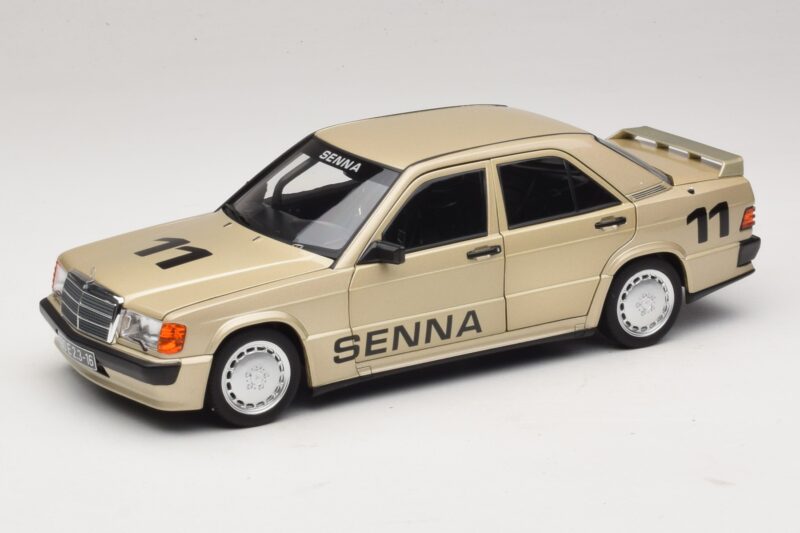
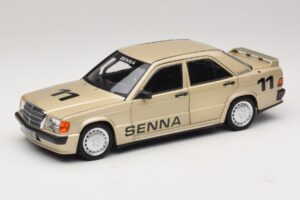
Norev's 1:18 diecast Mercedes 190E W201 2.3-16 carries the Senna Race of Champions 1984 identity, recalling the one-make match that opened the new Nürburgring grand prix circuit. Cast in zinc alloy with a body that articulates, it gives British Formula 1 fans a hands-on way to own a famous touring car moment. A mid-tier diecast with genuine shelf weight.
About the Mercedes 190E W201 2.3-16 A. Senna Race of Champions 1984 Norev 1:18
TL;DR: The Norev Mercedes 190E 2.3-16 Senna 1:18 is a diecast replica of the W201 raced in the 1984 Race of Champions, the one-make event that opened the new Nürburgring grand prix circuit. Zinc alloy construction, a body with opening parts and a mid-tier finish suit Formula 1 and 1980s touring car collectors.
Few touring car races have a field like this one. In May 1984 Mercedes-Benz lined up identically prepared 190E 2.3-16 saloons for a grid of Formula 1 drivers, and a young Ayrton Senna beat the established names. The Norev Mercedes 190E 2.3-16 Senna turns that afternoon into a 1:18 diecast for the shelf, with the weight and moving parts that format allows.
Mercedes 190E Senna Race of Champions: The 1984 Nürburgring Story
A Saloon Built for a Grand Prix Opening
The occasion was the inauguration of the redesigned Nürburgring grand prix circuit, and Mercedes-Benz chose to mark it with a one-make race rather than a parade. The 190E 2.3-16 was a natural choice. The sporting 190 had been developed with Cosworth, whose 16-valve cylinder head turned a compact executive saloon into a genuine performance car, and the company wanted the world to notice. Giving every driver an identical car meant the result would show talent rather than budget.
Senna, Britain and the Formula 1 Thread
For British readers the connection runs deep. Senna came to Britain to race in the junior categories and won the British Formula 3 title in 1983, then stepped into grand prix racing with Toleman in 1984. Winning the Race of Champions against a field that included Formula 1 world champions, in the very season he began his grand prix career, made the event a milestone in his story. That is why this model attracts Formula 1 collectors as much as Mercedes owners, and why its markings earn a place beside single-seaters on a themed shelf. British motorsport nostalgia has always made room for the drivers who made their names on home circuits.
Norev's 1:18 Diecast Treatment of the 190E
Norev casts the W201 in zinc alloy, so the model carries the density of metal in the hand, with the dimensional stability and robust paint adhesion that diecast offers over decades. The product data confirms that the body has opening parts, and for a saloon of this shape that matters. The boxy, upright W201 profile is hard to flatter at 1:18, so being able to handle and inspect the car adds interest that a sealed casting cannot.
Opening mechanisms inevitably widen the shut lines compared with a one-piece resin shell, and the model should be judged on that basis. A clean, consistent gap is a better sign than a razor-thin one that binds. The W201 was famously compact and square, with a deep, slab-sided body and a short boot, and those proportions are where a casting succeeds or fails. Look at the glasshouse: the window pillars should look slim and the glazing should sit flush with the roofline. Then look at the wheels, because stance matters most on a touring car, and a ride height pitched slightly too high makes any saloon look toy-like.
Race Markings and Display Space
A one-make race car lives on its markings, and tampo printing and decal work are where a diecast model of it succeeds or fails. Check that lettering is sharp, that number panels have clean edges and that graphics run continuously across panel lines rather than stepping or smearing. Compare the model with period photographs of the Race of Champions grid, since the W201 shape is simple enough that errors in colour or placement stand out at once.
At 1:18 the 190E measures roughly 24 centimetres, compact by saloon standards and an easy fit for a standard display case. The format carries far more detail than 1:43 can physically hold, from wheel design to the texture of lower-body trim, though it asks for more shelf depth. Norev's diecast sits at the mid tier: finished with care, but not assembled from hundreds of separate metal parts like the hand-built pieces that cost considerably more. Display it away from direct sunlight, which fades printed graphics over the years, and use a soft brush rather than a cloth on badges and mirror housings. A raised plinth lets a low touring car sit at eye level, where its stance reads best.
Pairing the 190E With Grand Prix and Touring Car Shelves
A Senna-linked 190E bridges two shelves, and Formula 1 collectors and saloon enthusiasts both lay claim to it. Set beside a 1980s grand prix car it records the same season from a different angle: the moment a rookie outraced champions in identical machinery. Beside the 190E's later touring car career in German racing, it becomes the starting point of a progression, the road-based sports saloon before the specialised racer.
British collectors who value provenance will want to keep the packaging and paperwork intact, since completeness matters when swapping or reselling. This is a model for buyers who care about the story behind a livery as much as the surface finish, and who want a diecast with real weight and moving parts at a sensible mid-tier level. If the Senna connection is the reason you collect, it is a straightforward model to shop for and an easy one to place.
From 28.11 to 29.11.2026, pre-owned models and new models from 12 brands up to 20% off, other new models up to 10% off. Prices already include the discount.
{"id":1711875,"name":"Mercedes 190E W201 2.3-16 A. Senna Race of Champions 1984 Norev 1:18","price":"£<\/span>84.00<\/bdi><\/span>","image":"https:\/\/models118.co.uk\/wp-content\/uploads\/2026\/11\/mercedes-190e-w201-2-3-16-a-senna-race-of-champions-1984-norev-1-18-183832-3-400x400.jpg","permalink":"https:\/\/models118.co.uk\/mercedes-190e-w201-2-3-16-a-senna-race-of-champions-1984-norev-1-18-183832\/","brand":"Mercedes"}