Last one
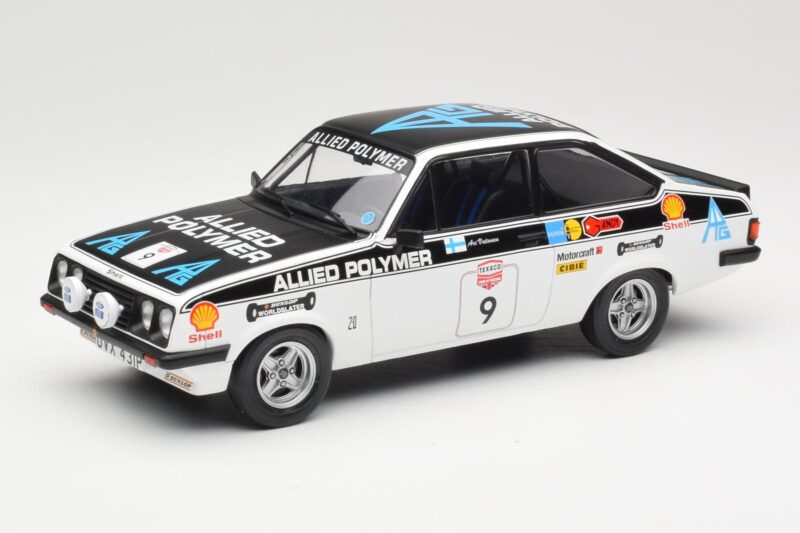
TL;DR: MCG's 1:18 diecast reproduces the Ford Escort Mk2 RS2000 #9, driven by Ari Vatanen and Peter Bryant on the 1977 RAC Rally, from Ford's dominant works rally era. The body is a sealed one-piece casting, so shut lines, arches, and livery detail carry the presentation on a 1970s rally-themed shelf.
Few shapes define 1970s international rallying like the Ford Escort Mk2, and Ford's works Boreham operation ran it to remarkable effect across Europe's toughest events. This MCG 1:18 diecast picks a specific moment from that campaign: car #9 on the 1977 RAC Rally, crewed by a young Ari Vatanen and Peter Bryant, years before Vatanen's Escort exploits made him a household name in the sport.
Ford's works rally programme built its reputation on the Escort Mk2 shape, run from the Boreham competition department in Essex through the second half of the 1970s. The Mk1 Escort had already proven the recipe on the international stage through the late 1960s and early 1970s, and the Mk2 simply sharpened it with a wider track and a stiffer shell. The road-going RS2000 supplied the aerodynamic nose and homologation base, while the works cars leaned on the RS1800's twin-cam BDA engine for genuine pace against Fiat, Lancia, and Peugeot. Roger Clark, Björn Waldegård, and Hannu Mikkola all campaigned Escorts through this period, helping take Ford to the 1979 World Rally Championship manufacturers' title.
On home gravel and forest stages, the RAC Rally became something close to a Ford benchmark event, run each November in punishing British winter conditions that tested cars and crews over several days and thousands of competitive miles. The Escort's short wheelbase and light weight made it forgiving on loose surfaces where longer, heavier rivals struggled, and that agility turned a modest production saloon into rallying's dominant shape for the better part of a decade. Ford's factory colours varied season to season as sponsors changed, which is part of why crew, car number and event together identify a specific entry rather than a generic livery.
Ari Vatanen's name became inseparable from the Ford Escort across the following decade, but in 1977 that story was still being written. The young Finn had begun making a name for himself on domestic and international events, and drives like this RAC Rally entry, partnered by Peter Bryant in the co-driver's seat, were part of the apprenticeship that led to full works status. The RAC Rally itself, run on closed forest stages across Britain each November, was among the most physically demanding events on the calendar, and simply finishing it with car and crew intact said as much about potential as any single result.
Vatanen would go on to win the RAC Rally outright in 1980 and take the World Rally Championship drivers' title in 1981, both achievements built on the same Escort platform this model reproduces. Reading a 1977 entry against that later career gives it a different weight: not a headline result in itself, but a documented step in a career that would define the marque's rally identity into the next decade. For collectors who follow a specific driver's career rather than only chasing outright wins, an early-career entry like this one carries its own significance, marking a point on the map rather than the destination. It is that specific, documented moment that MCG has chosen to recreate in diecast rather than a generic works tribute.
MCG casts this Escort Mk2 in zinc alloy diecast, and the weight is the first thing that registers when it clears the packaging: a density resin cannot match at this scale, giving a rally car's flared arches and roll-cage silhouette real presence on a shelf. The body is a sealed one-piece shell, with no doors, bonnet or boot lid built to open. This is a deliberate construction choice, and it pays off in the shut lines: with no hinge tolerances to plan around, the panel gaps around the arches and sills stay tight and consistent, and the roofline runs as one unbroken curve from screen to tail. Everything a collector needs to judge accuracy against reference photographs sits on the outside: the number 9 door graphics, sponsor decals, auxiliary lighting pods mounted ahead of the grille, and the raised ride height and chunky rally tyres that separate a competition Escort from a road RS2000. Paint depth under direct light shows whether decal edges sit clean, and on a model built around a documented livery rather than a generic rally scheme, crisp registration matters more than usual. At this price segment, buyers should expect exactly this: honest diecast weight, tight panel gaps, and exterior detail carried through tampo work and moulded trim rather than opening panels or engine-bay access.
At 1:18 scale, this Escort Mk2 comes in at roughly 24 to 25 centimetres nose to tail, close enough to standard hot-hatch dimensions that it sits comfortably in a 30-centimetre cabinet shelf alongside other 1970s rally diecast. It pairs naturally with other Boreham-era Escorts, Group 4 rivals from Lancia or Fiat, or a broader Vatanen career shelf running from this early RAC entry through to his 1981 championship-winning Escort. MCG's diecast sits in the accessible-to-mid segment of 1:18 rallying, below the fully detailed engine bays and opening panels of top-tier resin builds, but well ahead of basic toy-grade castings in stance, decal accuracy, and paint finish. For a collector assembling a Ford Escort Mk2 WRC diecast replica collection on a budget that still rewards close inspection, buying this specific driver-and-event pairing beats a generic works-liveried casting, because the number, crew, and event together anchor it to a real day on the RAC Rally rather than an approximation of one.