{"ajaxurl":"https:\/\/models118.co.uk\/wp-admin\/admin-ajax.php?lang=en_GB","nonce":"afc60de70b","homeUrl":"https:\/\/models118.co.uk\/","shopUrl":"https:\/\/models118.co.uk\/shop\/","cartUrl":"https:\/\/models118.co.uk\/cart-en-gb\/","checkoutUrl":"https:\/\/models118.co.uk\/checkout\/","skipCart":true,"collectionLimit":12,"i18n":{"addedToCart":"Added to basket","addToWishlist":"Add to wishlist","addedToWishlist":"Added to wishlist","removeFromWishlist":"Remove from wishlist","removedFromWishlist":"Removed from wishlist","undo":"Undo","error":"Something went wrong","loading":"Loading...","outOfStock":"Out of stock","viewCart":"View basket","proceedToCheckout":"Proceed to checkout","addedToCollection":"Added to your collection","reserved":"Added to your collection","soldOut":"Sold out","invalidEmail":"Please enter a valid email address","connectionError":"Connection error. Please try again.","tocToggle":"On this page","close":"Close","inCartTooltip":"Already in your basket \u2013 open your basket to check out","loginToSave":"Sign in to save this model","waitlistNotify":"Notify me","waitlistOnList":"On the waiting list \u2713","waitlistJoined":"You're on the waiting list. We'll email you the moment this model is available again.","waitlistRemoved":"Done \u2014 you're off the waiting list for this model.","waitlistRateLimit":"Too many attempts \u2014 please try again shortly","waitlistTurnstile":"We couldn't complete the check \u2014 please try again","waitlistError":"Sorry, something went wrong. Please try again in a moment."},"wishlist":{"loggedIn":false,"loginUrl":"https:\/\/models118.co.uk\/my-account\/","addAction":"models118_wishlist_add","removeAction":"models118_wishlist_remove"},"waitlist":{"loggedIn":false,"subscribeAction":"models118_waitlist_subscribe","toggleAction":"models118_waitlist_toggle","stateAction":"models118_waitlist_state"},"stats":{"models":2383,"brands":213,"manufacturers":128,"collectors":10000},"product":{"id":614081,"sku":"107116160","condition":"used","availability":"out_of_stock","name":"Delahaye Type 135-M Cabriolet Mullin Museum Minichamps 1:18","brand":"Delahaye","manufacturer":"Minichamps","scale":"1:18","material":"Diecast","price":235,"regularPrice":235,"isOnSale":false,"savingsAmount":0,"stockQty":0,"stockStatus":"out_of_stock","isDiscontinued":true,"image":"https:\/\/models118.co.uk\/wp-content\/uploads\/2026\/06\/delahaye-type-135-m-cabriolet-mullin-museum-minichamps-1-18-300x200.jpg","permalink":"https:\/\/models118.co.uk\/delahaye-type-135-m-cabriolet-mullin-museum-minichamps-1-18-107116160\/"}}
Cookies on Models118
We use cookies to remember your preferences, understand how the shop is used and show you models and offers that suit your interests. What you allow is up to you, and you can change it at any time.
Always active
The technical storage or access is strictly necessary for the legitimate purpose of enabling the use of a specific service explicitly requested by the subscriber or user, or for the sole purpose of carrying out the transmission of a communication over an electronic communications network.
The technical storage or access is necessary for the legitimate purpose of storing preferences that are not requested by the subscriber or user.
The technical storage or access that is used exclusively for statistical purposes.
The technical storage or access is required to create user profiles to send advertising, or to track the user on a website or across several websites for similar marketing purposes.
Delahaye Type 135-M Cabriolet Mullin Museum Minichamps 1:18
Sold out
1/6
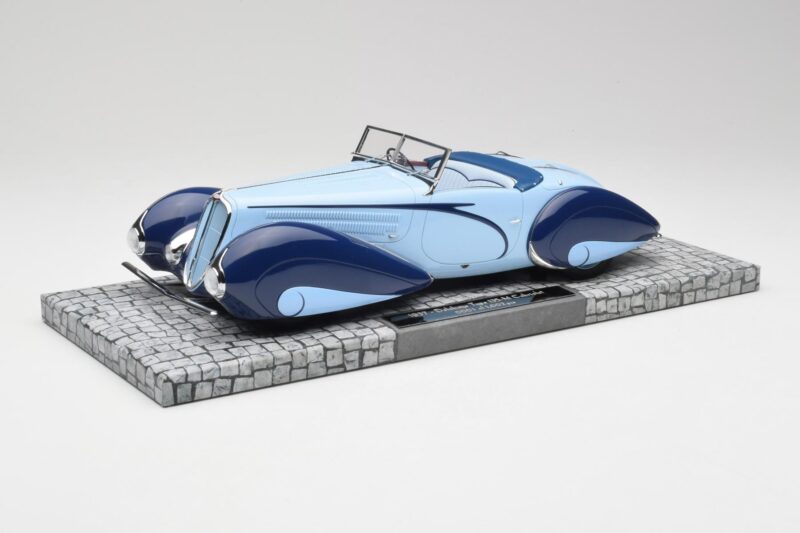
Minichamps' 1:18 diecast Delahaye Type 135-M Cabriolet reproduces a car from the Mullin Museum's renowned French Art Deco collection. Built in 1937, this pre-war cabriolet pairs sweeping coachbuilt fenders with zinc alloy diecast construction, complete with an opening bonnet revealing the six-cylinder engine. A considered centrepiece for Vintage Classics collectors chasing genuine pre-war provenance rather than a generic period casting.
About the Delahaye Type 135-M Cabriolet Mullin Museum Minichamps 1:18
TL;DR: Minichamps' 1:18 diecast reproduces a Delahaye Type 135-M cabriolet from the Mullin Museum's celebrated French Art Deco collection. Built in 1937, the pre-war cabriolet pairs flowing coachbuilt fenders with zinc alloy diecast construction, giving Vintage Classics collectors a museum-grade centrepiece with genuine period elegance.
Few pre-war marques reward close inspection the way Delahaye does. The Type 135-M's cabriolet body, with its sweeping fenders and low waistline, defined French luxury motoring in the late 1930s, and this particular casting nods to a car preserved as part of Southern California's Mullin Museum collection.
Delahaye's Type 135 and the Golden Age of French Coachbuilding
From Le Mans Competition to Cabriolet Refinement
Delahaye built its reputation on the 135 chassis through the second half of the 1930s, campaigning the competition-tuned 135CS at circuits including Le Mans, where the marque took outright victory in 1938. The 135-M sat apart from those stripped-down racers: a touring specification aimed at wealthy clients who wanted the same chassis dynamics wrapped in genuinely elegant coachwork. French houses of the era, working independently of Delahaye's own factory bodies, turned the 135 platform into some of the most fluid Art Deco shapes ever built, with fenders that swept unbroken from headlamp to running board. The cabriolet body on this casting belongs to that tradition of open-top touring rather than the race-bred silhouette, and Minichamps captures the distinction in the roofline and the depth of the front wing.
The Mullin Museum Connection
This casting is drawn from a car held within the Mullin Museum's collection, a Southern California institution built specifically around pre-war French coachbuilt automobiles, with Delahaye, Bugatti, and Talbot-Lago among its core holdings. Reproducing a museum car rather than a generic 135-M gives the model a documented provenance that collectors of pre-war subjects specifically look for, since so many surviving cabriolets carry uncertain histories after decades of ownership changes. It also means the paintwork and trim reference an actual, inspectable original rather than an idealised composite.
Minichamps Diecast Craftsmanship at Pre-War Scale
Zinc Alloy Weight and Panel Execution
Lifting this Delahaye from its tray, the zinc alloy body registers immediately as a heavier, denser object than a resin casting of the same size, a weight that suits a car built from steel panels rather than a lightweight competition shell. Minichamps' diecast approach on pre-war subjects favours opening doors and a bonnet that lifts to expose the six-cylinder engine bay, features a sealed resin body could not offer. The trade-off is panel gaps slightly wider than a hand-finished resin equivalent, though on a subject defined by curves rather than crisp modern shut lines, that difference matters less than it would on an angular 1980s coupe. Paint depth on the flowing fenders catches window light well, showing the compound curves rather than flattening them under a single tone.
Opening Features and Engine Bay Detail
The bonnet splits along its centre hinge and lifts to reveal the inline six, a feature diecast construction makes straightforward and one that rewards a closer look given how visible the engine sat beneath the Delahaye's slender bonnet line. The wire-spoke wheels and running-board trim are rendered as separate, sharply defined pieces rather than moulded into the body colour, and the fold of the cabriolet hood behind the rear seats reads as a genuine fabric contour rather than a flat plastic slab. These are the details that separate a considered pre-war diecast from a simplified toy-grade casting, and Minichamps invests attention exactly where a collector's eye lands first.
Positioning the Delahaye in a Vintage Classics Collection
At roughly 23cm long, the open cabriolet body occupies a modest footprint on a display shelf, leaving room to group it alongside other pre-war Vintage Classics without crowding a cabinet built for more compact companions. Collectors assembling a pre-war French theme find the 135-M sits naturally beside Bugatti or Talbot-Lago subjects from the same coachbuilding era, since all three marques shared clients, coachbuilders, and competition entries during the late 1930s. This is a considered addition rather than an obvious one: the Delahaye name carries less mainstream recognition than Bugatti, but for a collector chasing pre-war Art Deco elegance specifically, that relative obscurity is part of the appeal.
Create a free account and claim 10% off your first order — from hundreds of collectible 1:18, 1:43 and 1:12 models by Porsche, Mercedes-Benz, BMW and more.
{"id":614081,"name":"Delahaye Type 135-M Cabriolet Mullin Museum Minichamps 1:18","price":"£<\/span>235.00<\/bdi><\/span>","image":"https:\/\/models118.co.uk\/wp-content\/uploads\/2026\/06\/delahaye-type-135-m-cabriolet-mullin-museum-minichamps-1-18-400x400.jpg","permalink":"https:\/\/models118.co.uk\/delahaye-type-135-m-cabriolet-mullin-museum-minichamps-1-18-107116160\/","brand":"Delahaye"}