Back in stock
Save £3.00
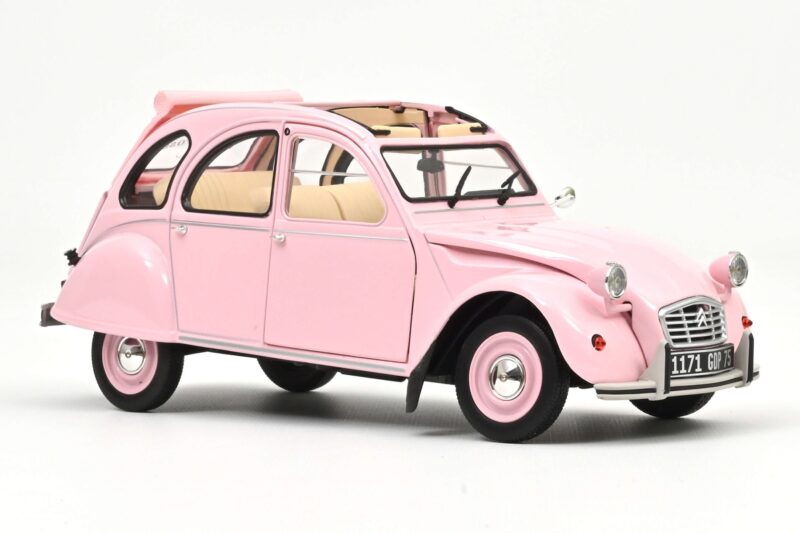
TL;DR: Norev's 1:18 diecast Citroen 2CV 'Paris Mon Amour' reproduces the 1986 French runabout in a Paris-themed special livery, with opening doors, bonnet and boot on a zinc alloy body. At roughly 24cm long, it makes an affordable, characterful anchor for a themed French classics display.
Few cars wear a nickname as fondly as the 2CV's 'tin snail'. Citroen built it as transport for post-war French farmers, stripped to essentials, and it stayed in production for over four decades. Norev's miniature keeps that unpretentious charm intact, right down to the corrugated bonnet panels and upright glasshouse.
Norev casts this 2CV in zinc alloy, giving the miniature real heft against its small footprint. The doors, bonnet and boot all open, revealing a simplified engine bay and the flat-twin's modest proportions underneath. That hinged build suits the 2CV well, since the real car was prized for mechanical simplicity you could inspect at the roadside. Panel gaps stay even around the wheel arches, and the fabric-effect roof moulding, cast rather than canvas, reads correctly from a few feet away. Chrome headlamp surrounds and the corrugated bonnet ribbing pick up light cleanly under a display lamp, details that separate a considered diecast from a toy-shop casting.
The 'Paris Mon Amour' naming points to one of Norev's themed special editions, dressing an everyday 2CV in a livery built around romantic Paris imagery rather than a standard factory colour. Special-run liveries like this sit outside the regular production palette, which is exactly why collectors who already own a 2CV in solid paint often add one anyway. It turns a utilitarian French runabout into a conversation piece, the kind of model that gets picked up and turned over on a shelf rather than glanced past. Buyers assembling a themed Citroen or Francophile display shelf will find this variant does real work, standing in deliberate contrast to a plainer example alongside it.
Citroen developed the 2CV before the Second World War and launched it properly in 1948, briefed to carry four people and a basket of eggs across a ploughed field without breaking a single one. The result was a car stripped to essentials: a corrugated steel body for strength without weight, a soft long-travel suspension, and a simple flat-twin engine that owners could maintain themselves. None of that was accidental. Citroen's engineers treated every unnecessary gram as a design flaw, and the 2CV's awkward, lovable shape is a direct consequence of that discipline, not a failure of styling ambition.
By the time this 1986 example rolled off the line, the 2CV had been in production for nearly forty years with remarkably little fundamental change, a testament to how completely Citroen had solved the brief the first time. Production continued until 1990, by which point the car had outlived most of its contemporaries and become something closer to a folk icon than a product. That longevity is part of why collectors seek out 2CVs from different decades rather than settling for one example: a mid-1980s car like this one represents the model at its most refined, carrying detail improvements the earliest cars never had.
At 1:18, the 2CV's compact real-world dimensions translate into a genuinely small model, one of the more modest footprints in the scale, which makes it easy to fit several French classics on a single shelf without crowding. It pairs naturally with other Norev Citroens or alongside period Renaults and Peugeots for a broader look at post-war French motoring. The opening panels reward handling rather than purely static display, so it suits a collector who likes to pick models up as much as one who prefers them sealed behind glass. For the price point, the detail and mechanism quality are honest value, and those building a themed run of Citroen special editions will want this alongside the standard liveries for contrast.