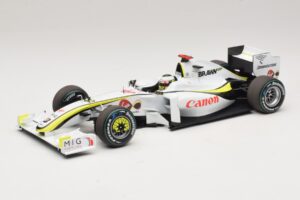
TL;DR: Brawn scale models document Formula 1's most improbable single season: the 2009 championship-winning BGP 001, rendered in 1:18 resin by Minichamps. The narrow, one-year timeline makes this one of the few genuinely completable Formula 1 collecting projects, prized for its underdog story and factory-fresh resin paint depth.
Few Formula 1 stories compress as much drama into so short a timeline as Brawn GP's. A team assembled from the wreckage of Honda's F1 withdrawal took a double-diffuser advantage into the opening race of 2009 and rode it to both championships by season's end, then vanished into Mercedes ownership before a second season ever began. That compressed arc is exactly why the Brawn scale model category rewards attention: a finite, well-documented season with a genuine underdog story behind it.
Brawn F1 Scale Models and the 2009 Season They Document
Brawn F1 scale models exist because of a single remarkable season rather than a long manufacturer relationship, which sets this category apart from brand pages built around decades of racing. Ross Brawn bought the Honda F1 team for a nominal sum weeks before the 2009 season, inherited a chassis with a legal double-diffuser interpretation, and won six of the first seven races. Jenson Button took the drivers' title; the team claimed the constructors' crown in its only year of existence before Mercedes-Benz bought the operation for 2010. That story gives the BGP 001 a genuine underdog narrative that most F1 liveries lack, and it means the entire subject matter for this category sits within one calendar year. Collectors researching this period find the season well documented, the livery instantly recognisable in its distinctive lime green and white, and the finite scope a rare case where completing a themed Formula 1 collection is genuinely achievable rather than open-ended.
Resin Construction Behind the BGP 001 Livery
Minichamps builds its Formula 1 output in resin rather than diecast, and the choice matters for a livery this detailed. Resin casting holds the crisp sponsor decal edges and the fine aerodynamic elements, a front wing, barge boards, mirror stalks, that a die-cast tool would round off or simplify. When assessing a BGP 001 casting, check for:
- Even, factory-depth gloss on the lime green and white bodywork
- Sharp sponsor decal edges without smudging or misalignment
- Crisp, unbroken lines on the front wing and barge boards
- A light, cool feel in the hand consistent with resin rather than diecast
This sits at a mid-to-upper resin price point, reflecting the specialist tooling required for a low-volume, single-season subject rather than a mass-produced road car mould reused across years of production.
Building a Complete Brawn Collection
The appeal of a one-season team is that a collection built around it has a natural endpoint. A focused Brawn shelf might track the BGP 001 across its race-winning liveries from the season, pairing the championship-clinching livery with an early-season variant to show how sponsorship and aerodynamic tweaks changed across the year. Because Minichamps is the primary resin producer working this subject in 1:18, consistency of scale and finish across pieces is less of a concern than with a multi-manufacturer brand collection spanning decades. Many collectors pair a Brawn piece with the Mercedes GP livery that followed in 2010, using the two side by side to illustrate how quickly the same chassis and personnel changed identity. It is a compact, story-driven project rather than a sprawling one, well suited to a single dedicated shelf.
Displaying and Caring for Single-Season Resin Pieces
A resin Formula 1 model rewards the same care any specialist casting needs. Keep it out of direct sunlight, which fades the lime green livery faster than it would a darker road car colour, and handle the front wing and mirror assemblies by the chassis rather than the aerodynamic parts themselves. Dust settles readily into open cockpit detail and exposed suspension arms, so a glass-fronted cabinet earns its keep here more than with a sealed-body road car. Because the subject matter is finite, original packaging and any certificate of authenticity carry real weight if a piece changes hands later; a one-season subject does not get reissued the way an ongoing brand relationship might.
Frequently Asked Questions About Brawn Scale Models
Why did Brawn GP only race for one Formula 1 season?
Ross Brawn's team was formed from Honda's withdrawn operation in early 2009 and won the championship in its debut year, but Mercedes-Benz bought the team outright for 2010 and rebranded it Mercedes GP. The Brawn name and livery therefore exist for exactly one season, which is why the scale model subject matter is so narrow.
Is resin or diecast more common for Brawn F1 models?
Minichamps produces its Formula 1 range in resin rather than diecast, which suits the fine aerodynamic detail and sponsor decal work a season-specific F1 livery demands. Collectors should expect resin construction as the standard for this subject rather than a heavier diecast alternative.
Can a Brawn F1 collection realistically be completed?
Yes. Because the team existed for a single season, the livery variations and race-specific detail are finite and well documented, making Brawn one of the more genuinely completable themed collecting projects within Formula 1 scale models.
What scale do Brawn resin models typically come in?
1:18 is the standard scale for this subject, giving enough size to render the front wing, barge boards, and cockpit detail clearly. It also matches the scale most Formula 1 collectors already use for other team liveries on the same shelf.