BMW X6M F86 Red Norev 1:18
Price:
£81.00
Save £5.00
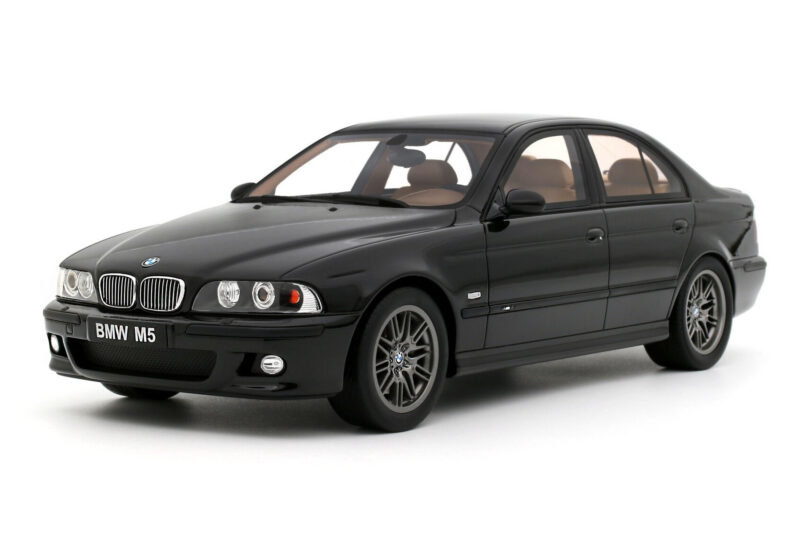
TL;DR: Otto's 1:18 resin BMW M5 E39 reproduces the naturally aspirated M5 generation in Black Sapphire Metallic, powered by the 4.9-litre S62 V8 and offered only with a six-speed manual. Cast as a sealed one-piece resin body, the shell holds crisp, even shut lines around the kidney grille and quad exhaust. An investment-tier subject at a mid-tier resin price.
Ask a BMW enthusiast which M5 generation they would keep forever and the E39 wins more often than not. Built from 1998 to 2003, it paired a hand-assembled V8 with understated three-box saloon styling, a combination BMW has never quite repeated since. Otto's replica lands squarely on that reputation, finished in the deep, correct Black Sapphire Metallic most collectors associate with the car.
BMW's M division hand-assembled the E39 M5's engine separately from the standard production line, a 4.9-litre V8 fitted with individual throttle bodies for each cylinder, a technique borrowed more from racing than from any contemporary saloon. Output landed close to 400PS, sent to the rear wheels alone, with none of the driver aids that later M5 generations would lean on. That throttle-body arrangement gave the engine a sharper, more immediate response than a shared-throttle V8 of the same displacement could manage, and it is one of the reasons enthusiasts still rate this engine above several that followed it.
BMW paired that engine with a six-speed manual and nothing else. No automatic option existed for the E39 M5, a decision that would be unthinkable for a modern M car and part of why this generation holds such a firm grip on driver-focused collectors. Like most fast German saloons of the period, the E39 M5 carried a voluntary 155mph limiter, its true pace disguised by understated three-box styling that gave away almost nothing at a standstill. British buyers in period often specified the car in exactly this dark metallic, a shade that hid its intent better than brighter alternatives.
Otto casts this M5 as a sealed, one-piece resin shell, a construction choice that removes any hinge tolerance from the equation and lets the shut lines around the doors and boot run narrow and consistent from the front wing to the rear valance. Resin holds a mould's fine detail more faithfully than a pressed die, which shows in the crispness of the kidney grille slats and the definition around the quad exhaust outlets. The BBS-style alloy wheel design, a signature of the E39 M5's stance, is reproduced with genuinely sharp spoke edges rather than a soft, blurred casting.
Black Sapphire Metallic is a genuinely difficult shade to match in miniature, its dark base carrying a fine blue-black metallic flake that shifts under changing light rather than sitting flat. Under a direct shelf lamp, the correct finish shows that shift across the bonnet and roof rather than reading as plain black, and it is one of the fastest ways to separate a careful resin cast from a rushed repaint job. Through the glazing, the correct oval gauge cluster and grey-black interior trim typical of the period are just visible, a small confirmation that the detailing extends past the bodywork.
Diecast tooling of the E39 M5 dates mostly to the early 2000s, when several manufacturers ran dies for the car while it was still in production, and those castings show their age in wider panel gaps and softer badge printing by today's standards. A modern resin cast starts from a clean slate, and the difference in shut-line consistency and paint depth is immediately visible set side by side with an older diecast example. At this segment, a buyer should expect that level of surface refinement, correctly matched interior trim colours, and crisp exterior badging, rather than a fully detailed engine bay or opening doors, features that belong to a considerably more expensive tier of hand-built model. A 1:43 version of the same generation exists too, useful for a broader BMW M chronology, but it cannot carry the paint depth or grille detail this larger scale allows.
At 1:18 a saloon of the E39's dimensions comes out to roughly 24 centimetres, comfortable in a standard cabinet row alongside other three-box M cars from later generations. Dark metallics like Black Sapphire reward direct lighting rather than ambient room light, since the flake only reveals itself under a focused lamp; positioned in shadow, the finish can read as flat black instead. The sealed body means no engine bay to admire up close, a fair exchange for the shut-line quality that construction buys. For a collector tracing BMW M saloons from the E28 through to the current M5, this generation remains the one most often named the favourite.


Save £24.00