{"ajaxurl":"https:\/\/models118.co.uk\/wp-admin\/admin-ajax.php?lang=en_GB","nonce":"d590ce0ccb","homeUrl":"https:\/\/models118.co.uk\/","shopUrl":"https:\/\/models118.co.uk\/shop\/","cartUrl":"https:\/\/models118.co.uk\/cart-en-gb\/","checkoutUrl":"https:\/\/models118.co.uk\/checkout\/","skipCart":true,"collectionLimit":12,"i18n":{"addedToCart":"Added to basket","addToWishlist":"Add to wishlist","addedToWishlist":"Added to wishlist","removeFromWishlist":"Remove from wishlist","removedFromWishlist":"Removed from wishlist","undo":"Undo","error":"Something went wrong","loading":"Loading...","outOfStock":"Out of stock","viewCart":"View basket","proceedToCheckout":"Proceed to checkout","addedToCollection":"Added to your collection","reserved":"Reserved!","soldOut":"Sold out","invalidEmail":"Please enter a valid email address","connectionError":"Connection error. Please try again.","loginToSave":"Sign in to save this model","waitlistNotify":"Notify me","waitlistOnList":"On the waiting list \u2713","waitlistJoined":"You're on the waiting list. We'll email you the moment this model is available again.","waitlistRemoved":"Done \u2014 you're off the waiting list for this model.","waitlistRateLimit":"Too many attempts \u2014 please try again shortly","waitlistTurnstile":"We couldn't complete the check \u2014 please try again","waitlistError":"Sorry, something went wrong. Please try again in a moment."},"wishlist":{"loggedIn":false,"loginUrl":"https:\/\/models118.co.uk\/my-account\/","addAction":"models118_wishlist_add","removeAction":"models118_wishlist_remove"},"waitlist":{"loggedIn":false,"subscribeAction":"models118_waitlist_subscribe","toggleAction":"models118_waitlist_toggle","stateAction":"models118_waitlist_state"},"stats":{"models":2159,"brands":206,"manufacturers":127,"collectors":10000},"product":{"id":470432,"sku":"08855B","condition":"used","availability":"out_of_stock","name":"De Tomaso Pantera #32 Jaquemin \/ Deprez 24 Hours of Le Mans 1972 Kyosho 1:18","brand":"De Tomaso","manufacturer":"Kyosho","scale":"1:18","material":"Diecast","price":164.17,"regularPrice":164.17,"isOnSale":false,"savingsAmount":0,"stockQty":0,"stockStatus":"out_of_stock","isDiscontinued":true,"image":"https:\/\/models118.co.uk\/wp-content\/uploads\/2026\/06\/de-tomaso-pantera-n32-jaquemin-deprez-24h-le-mans-1972-kyosho-1-18-300x200.jpg","permalink":"https:\/\/models118.co.uk\/de-tomaso-pantera-32-jaquemin-deprez-24-hours-of-le-mans-1972-kyosho-1-18-08855b\/"}}
Cookies on Models118
We use cookies to remember your preferences, understand how the shop is used and show you models and offers that suit your interests. What you allow is up to you, and you can change it at any time.
Always active
The technical storage or access is strictly necessary for the legitimate purpose of enabling the use of a specific service explicitly requested by the subscriber or user, or for the sole purpose of carrying out the transmission of a communication over an electronic communications network.
The technical storage or access is necessary for the legitimate purpose of storing preferences that are not requested by the subscriber or user.
The technical storage or access that is used exclusively for statistical purposes.
The technical storage or access is required to create user profiles to send advertising, or to track the user on a website or across several websites for similar marketing purposes.
De Tomaso Pantera #32 Jaquemin / Deprez 24 Hours of Le Mans 1972 Kyosho 1:18
Sold out
1/8
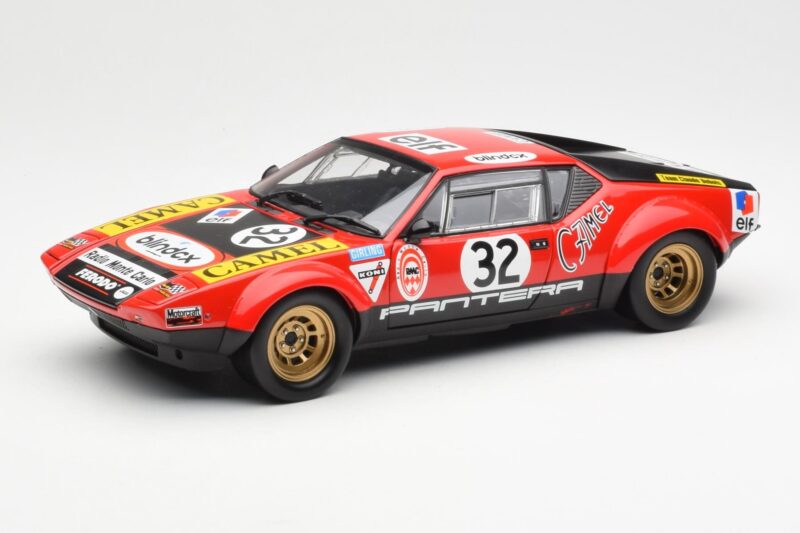
Kyosho's 1:18 diecast De Tomaso Pantera reproduces car #32, driven by Jaquemin and Deprez in the GT class at the 1972 24 Hours of Le Mans. Wide flared arches, a roll-cage-equipped cabin and tampo-printed race graphics capture De Tomaso's endurance racing entry from that season. A compelling pairing piece alongside a standard road-going Pantera.
About the De Tomaso Pantera #32 Jaquemin / Deprez 24 Hours of Le Mans 1972 Kyosho 1:18
TL;DR: Kyosho's 1:18 diecast De Tomaso Pantera reproduces car #32, driven by Jaquemin and Deprez at the 1972 24 Hours of Le Mans in the GT class. Race-liveried bodywork, a roll-cage-equipped cabin and tampo-printed race number graphics capture De Tomaso's competition entry from that season.
The same mid-engined layout that made the Pantera a striking road car also suited it to GT competition, and De Tomaso saw examples racing through the early 1970s, including at Le Mans. This diecast reproduces car #32's specific 1972 entry.
The Pantera's Group 4 GT Campaign at Le Mans
The Pantera's mid-engined layout and Ford V8 made it a natural candidate for GT competition, and De Tomaso saw examples entered in the category through the early 1970s, including at the 24 Hours of Le Mans in 1972. Car #32 ran that year with Jaquemin and Deprez sharing driving duties, one of several Panteras competing in the GT class against a field built for endurance rather than outright speed. Le Mans has always rewarded reliability as much as pace, and a production-based GT entry like the Pantera faced a genuinely different challenge to the purpose-built prototypes running at the front of the field, needing to survive around the clock on a car that started life as a road-going exotic rather than a dedicated racer. That road-racer connection is part of what makes a Le Mans Pantera an interesting subject: the same wedge shape and mid-mounted V8 that defined the street car also went to war at one of endurance racing's toughest events.
Kyosho's Livery and Race Detail on the Diecast
Kyosho applies the number 32 and its surrounding graphics using tampo printing, keeping the race markings flat against the bodywork rather than raised the way stick-on decals age over time. The livery sits over flared arches wider than the road car's, a Group 4-style modification typical of Pantera race entries built to cover wider racing rubber, and the model reproduces that widened stance accurately rather than sharing the narrower road-car body. The doors open on metal hinges to reveal a stripped, roll-cage-equipped cabin in place of the road car's trimmed interior, with racing seats and a simplified dashboard reflecting the car's competition purpose. The rear engine cover lifts to show the V8 in genuine relief, and auxiliary driving lights, fitted to the nose for the demands of night running at Le Mans, are represented as separate applied pieces rather than moulded into the bodywork. Panel gaps stay consistent around the widened arches despite the more complex bodywork.
Street and Race Pantera Side by Side
Displayed alongside a standard road-going Pantera, this Le Mans entry shows how far the same platform travelled from showroom exotic to endurance racer, with wider arches, a stripped cabin and race livery replacing the road car's more restrained specification. That pairing gives a De Tomaso-themed shelf real narrative depth, contrasting the car Ford sold through American dealerships with the version built to survive 24 hours of competition in France. Within a broader Le Mans GT collection, the Pantera sits alongside other production-based competitors from the era, offering a different engineering story to the purpose-built prototypes that usually dominate endurance racing diecast ranges. For collectors focused on historic GT and GTE racing rather than outright prototype classes, this Pantera represents genuine period competition history rather than a livery applied for visual effect alone.
Frequently Asked Questions About the Kyosho De Tomaso Pantera Le Mans
Who drove car #32 at Le Mans in 1972?
Jaquemin and Deprez shared driving duties on this De Tomaso Pantera entered in the GT class at the 1972 24 Hours of Le Mans, one of several Panteras competing in production-based GT racing that season.
How does the race Pantera's bodywork differ from the road car?
This model carries wider, flared arches typical of Group 4-style race modifications, built to cover wider competition tyres, along with auxiliary driving lights for night running, both absent from the standard road-going Pantera.
Does the interior reflect the car's racing specification?
Yes, the doors open to reveal a stripped, roll-cage-equipped cabin with racing seats and a simplified dashboard, replacing the road car's trimmed interior to match the real competition car's specification.
Is this a good pairing with a standard road-going Pantera model?
Yes, displaying the two together shows the platform's range clearly, from the version sold through American dealerships to the widened, roll-caged car built to survive 24 hours of racing at Le Mans.
Create a free account and claim 10% off your first order — from hundreds of collectible 1:18, 1:43 and 1:12 models by Porsche, Mercedes-Benz, BMW and more.