{"ajaxurl":"https:\/\/models118.co.uk\/wp-admin\/admin-ajax.php?lang=en_GB","nonce":"d9bf684b57","homeUrl":"https:\/\/models118.co.uk\/","shopUrl":"https:\/\/models118.co.uk\/shop\/","cartUrl":"https:\/\/models118.co.uk\/cart-en-gb\/","checkoutUrl":"https:\/\/models118.co.uk\/checkout\/","skipCart":true,"collectionLimit":12,"i18n":{"addedToCart":"Added to basket","addToWishlist":"Add to wishlist","addedToWishlist":"Added to wishlist","removeFromWishlist":"Remove from wishlist","removedFromWishlist":"Removed from wishlist","undo":"Undo","error":"Something went wrong","loading":"Loading...","outOfStock":"Out of stock","viewCart":"View basket","proceedToCheckout":"Proceed to checkout","addedToCollection":"Added to your collection","reserved":"Reserved!","soldOut":"Sold out","invalidEmail":"Please enter a valid email address","connectionError":"Connection error. Please try again.","loginToSave":"Sign in to save this model","waitlistNotify":"Notify me","waitlistOnList":"On the waiting list \u2713","waitlistJoined":"You're on the waiting list. We'll email you the moment this model is available again.","waitlistRemoved":"Done \u2014 you're off the waiting list for this model.","waitlistRateLimit":"Too many attempts \u2014 please try again shortly","waitlistTurnstile":"We couldn't complete the check \u2014 please try again","waitlistError":"Sorry, something went wrong. Please try again in a moment."},"wishlist":{"loggedIn":false,"loginUrl":"https:\/\/models118.co.uk\/my-account\/","addAction":"models118_wishlist_add","removeAction":"models118_wishlist_remove"},"waitlist":{"loggedIn":false,"subscribeAction":"models118_waitlist_subscribe","toggleAction":"models118_waitlist_toggle","stateAction":"models118_waitlist_state"},"stats":{"models":2141,"brands":206,"manufacturers":127,"collectors":10000},"product":{"id":452554,"sku":"100910019","condition":"used","availability":"out_of_stock","name":"Benetton Ford B191 #20 R. Moreno F1 1991 Minichamps 1:18","brand":"Benetton","manufacturer":"Minichamps","scale":"1:18","material":"Diecast","price":90,"regularPrice":90,"isOnSale":false,"savingsAmount":0,"stockQty":0,"stockStatus":"out_of_stock","isDiscontinued":true,"image":"https:\/\/models118.co.uk\/wp-content\/uploads\/2026\/06\/f1-benetton-ford-b191-r-moreno-1991-minichamps-1-18-300x200.jpg","permalink":"https:\/\/models118.co.uk\/benetton-ford-b191-20-r-moreno-f1-1991-minichamps-1-18-100910019\/"}}
Cookies on Models118
We use cookies to remember your preferences, understand how the shop is used and show you models and offers that suit your interests. What you allow is up to you, and you can change it at any time.
Always active
The technical storage or access is strictly necessary for the legitimate purpose of enabling the use of a specific service explicitly requested by the subscriber or user, or for the sole purpose of carrying out the transmission of a communication over an electronic communications network.
The technical storage or access is necessary for the legitimate purpose of storing preferences that are not requested by the subscriber or user.
The technical storage or access that is used exclusively for statistical purposes.
The technical storage or access is required to create user profiles to send advertising, or to track the user on a website or across several websites for similar marketing purposes.
Benetton Ford B191 #20 R. Moreno F1 1991 Minichamps 1:18
Sold out
1/6
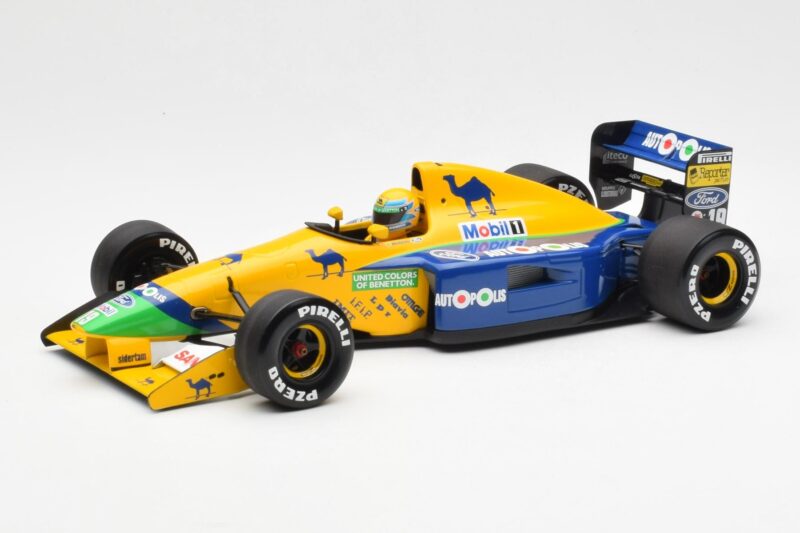
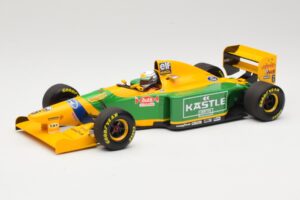
Minichamps' 1:18 diecast Benetton Ford B191 recreates Roberto Moreno's early-1991 Formula 1 season, car number 20, the exact seat Michael Schumacher inherited from the Italian Grand Prix onward. Finished in Camel livery, it captures a genuine turning point in the sport rather than a headline result of its own. Diecast construction with separately fitted aerodynamic parts and a detailed cockpit keeps the finish crisp at 1:18 scale, matching the era's other Benetton entries.
About the Benetton Ford B191 #20 R. Moreno F1 1991 Minichamps 1:18
TL;DR: Minichamps' 1:18 diecast reproduces the Benetton Ford B191 driven by Roberto Moreno during the early rounds of the 1991 Formula 1 season, in Camel livery with car number 20. It represents the seat Michael Schumacher would take over from the Italian Grand Prix onward, a genuine turning point in the sport.
Some seats in Formula 1 history matter less for who sat in them first than for who took over. Minichamps reproduces Roberto Moreno's early-1991 Benetton, the car that would soon carry a very different, and far more famous, driver.
Minichamps' Benetton B191 in 1:18 Diecast
Camel Livery and Number 20 Graphics
Camel's blue, yellow and white scheme covers the B191 in the same crisply registered graphics found across the team's 1991 entries, with car number 20 correctly placed on the nose and sidepods for Moreno's early-season drives. Minichamps keeps the sponsor decals sharp at every panel line, and the smaller partner logos along the sidepod flanks and rear wing remain legible rather than reduced to a blurred printed block.
Construction Shared Across the 1991 Benetton Pair
The zinc alloy body shares its construction approach with the matching Piquet-liveried B191 from the same season, with the front wing, mirrors and aerial fitted as separate components to keep these slender aerodynamic pieces properly scaled. The cockpit shows a modelled steering wheel and harness through the roll hoop opening, and the exposed Ford HB V8 airbox intake sits correctly proportioned above the driver's position. Lifting the casting from its stand, the weight signals genuine zinc alloy tooling rather than a lightweight promotional shell, a distinction worth checking on any Formula 1 diecast before assuming its build quality.
Moreno's Early-Season Drive and a Seat That Changed Hands
Moreno's Place in the 1991 Line-Up
Roberto Moreno began the 1991 season as Benetton's second driver alongside Nelson Piquet, a capable if less heralded pairing compared to what the team would field only a few months later. Moreno had experience across several midfield teams by this point in his career, and his early-1991 Benetton results were solid without being spectacular, the kind of steady but unremarkable form that made him vulnerable when a sensational new talent appeared elsewhere on the grid. He would go on to race for several more teams through the 1990s without ever again holding a seat at a genuine front-running outfit.
The Seat Schumacher Would Take
Michael Schumacher made his Formula 1 debut with Jordan at the Belgian Grand Prix in 1991, and his performance was striking enough that Benetton moved swiftly to sign him, replacing Moreno in the car for the Italian Grand Prix that same season. It is one of the most consequential driver changes in the sport's history, and this B191 in Moreno's colours represents the exact seat and specification Schumacher inherited. That mid-season swap also reflects how differently driver management worked in this period, with a promising newcomer able to jump straight into a competitive car mid-championship.
Where This Fits a Schumacher-Origins or Benetton Collection
For a collection tracing the earliest days of Schumacher's career, this Moreno-liveried B191 is arguably more interesting than a car Schumacher himself drove, since it shows precisely what he took over rather than what he built from that point onward. For a Benetton collection, it pairs naturally with the matching Piquet car from the same season, letting both 1991 team entries sit side by side on the same shelf. At roughly 20 centimetres, checking the sidepod air intake and front wing flap detail against period photographs remains the fastest way to judge fidelity on any early-1990s Formula 1 diecast. Against a 1:43 version of the same livery, the larger 1:18 scale earns its shelf space by rendering the cockpit and sponsor detail with considerably more clarity. Displayed away from direct light, the Camel livery's printed colours should hold their depth for years to come.
Create a free account and claim 10% off your first order — from hundreds of collectible 1:18, 1:43 and 1:12 models by Porsche, Mercedes-Benz, BMW and more.
{"id":452554,"name":"Benetton Ford B191 #20 R. Moreno F1 1991 Minichamps 1:18","price":"£<\/span>90.00<\/bdi><\/span>","image":"https:\/\/models118.co.uk\/wp-content\/uploads\/2026\/06\/f1-benetton-ford-b191-r-moreno-1991-minichamps-1-18-400x400.jpg","permalink":"https:\/\/models118.co.uk\/benetton-ford-b191-20-r-moreno-f1-1991-minichamps-1-18-100910019\/","brand":"Benetton"}