{"ajaxurl":"https:\/\/models118.co.uk\/wp-admin\/admin-ajax.php?lang=en_GB","nonce":"67d70c6a5f","homeUrl":"https:\/\/models118.co.uk\/","shopUrl":"https:\/\/models118.co.uk\/shop\/","cartUrl":"https:\/\/models118.co.uk\/cart-en-gb\/","checkoutUrl":"https:\/\/models118.co.uk\/checkout\/","skipCart":true,"collectionLimit":12,"i18n":{"addedToCart":"Added to basket","addToWishlist":"Add to wishlist","addedToWishlist":"Added to wishlist","removeFromWishlist":"Remove from wishlist","removedFromWishlist":"Removed from wishlist","undo":"Undo","error":"Something went wrong","loading":"Loading...","outOfStock":"Out of stock","viewCart":"View basket","proceedToCheckout":"Proceed to checkout","addedToCollection":"Added to your collection","reserved":"Reserved!","soldOut":"Sold out","invalidEmail":"Please enter a valid email address","connectionError":"Connection error. Please try again.","loginToSave":"Sign in to save this model","waitlistNotify":"Notify me","waitlistOnList":"On the waiting list \u2713","waitlistJoined":"You're on the waiting list. We'll email you the moment this model is available again.","waitlistRemoved":"Done \u2014 you're off the waiting list for this model.","waitlistRateLimit":"Too many attempts \u2014 please try again shortly","waitlistTurnstile":"We couldn't complete the check \u2014 please try again","waitlistError":"Sorry, something went wrong. Please try again in a moment."},"wishlist":{"loggedIn":false,"loginUrl":"https:\/\/models118.co.uk\/my-account\/","addAction":"models118_wishlist_add","removeAction":"models118_wishlist_remove"},"waitlist":{"loggedIn":false,"subscribeAction":"models118_waitlist_subscribe","toggleAction":"models118_waitlist_toggle","stateAction":"models118_waitlist_state"},"stats":{"models":2106,"brands":206,"manufacturers":127,"collectors":10000},"product":{"id":1679658,"sku":"107054131","condition":"new","availability":"in_stock","name":"Volkswagen Beetle Convertible Black Cream Minichamps 1:18","brand":"Volkswagen","manufacturer":"Minichamps","scale":"1:18","material":"Resin","price":114,"regularPrice":114,"isOnSale":false,"savingsAmount":0,"stockQty":2,"stockStatus":"very_low","isDiscontinued":false,"image":"https:\/\/models118.co.uk\/wp-content\/uploads\/2026\/09\/volkswagen-beetle-convertible-black-cream-minichamps-1-18-107054131-1-1-300x200.jpg","permalink":"https:\/\/models118.co.uk\/volkswagen-beetle-convertible-black-cream-minichamps-1-18-107054131\/"}}
Cookies on Models118
We use cookies to remember your preferences, understand how the shop is used and show you models and offers that suit your interests. What you allow is up to you, and you can change it at any time.
Always active
The technical storage or access is strictly necessary for the legitimate purpose of enabling the use of a specific service explicitly requested by the subscriber or user, or for the sole purpose of carrying out the transmission of a communication over an electronic communications network.
The technical storage or access is necessary for the legitimate purpose of storing preferences that are not requested by the subscriber or user.
The technical storage or access that is used exclusively for statistical purposes.
The technical storage or access is required to create user profiles to send advertising, or to track the user on a website or across several websites for similar marketing purposes.
Volkswagen Beetle Convertible Black Cream Minichamps 1:18
New arrival
1/6
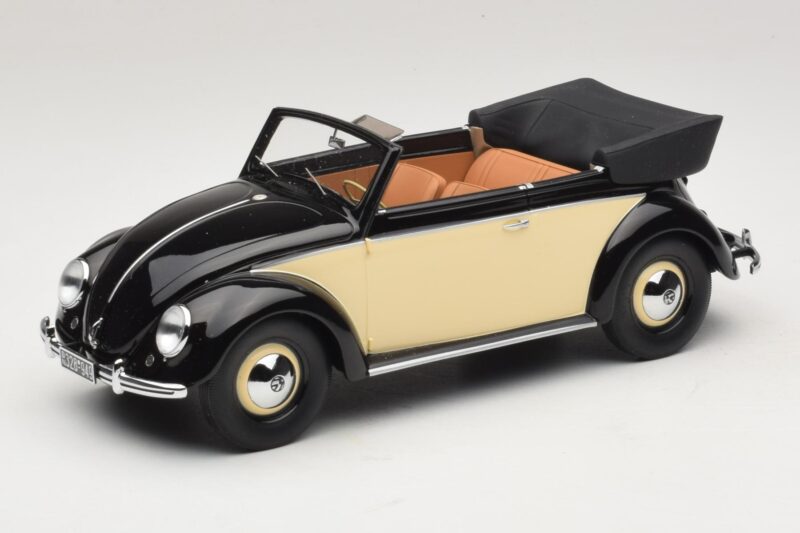
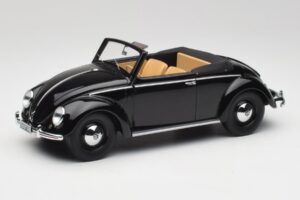
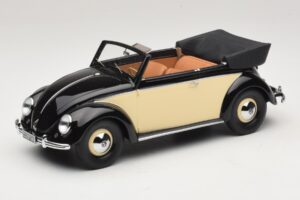
Minichamps' 1:18 resin Volkswagen Beetle Convertible in black and cream reproduces the earliest Karmann-built cabriolet from 1949, the first year Osnabrück coachbuilder Karmann turned Wolfsburg's saloon into a genuine open car. The sealed resin body holds crisp split-window styling and clean two-tone paint registration across the Beetle's rounded surfaces. A distinctive early piece for collectors tracing the Beetle's long postwar production history.
About the Volkswagen Beetle Convertible Black Cream Minichamps 1:18
TL;DR: Minichamps' 1:18 resin Volkswagen Beetle Convertible in black and cream reproduces the earliest Karmann-built cabriolet from 1949, the first year Osnabrück coachbuilder Karmann turned Wolfsburg's saloon into an open car. The sealed resin body holds crisp, split-era styling detail, suited to collectors tracing the Beetle's history from its first postwar decade onward.
Few cars carry as much cultural weight in as humble a package as the Volkswagen Beetle, and this 1949 convertible captures it at the very start of its open-top story, the year Karmann first turned the saloon into a genuine drop-top rather than a stopgap conversion.
Cast as a sealed, one-piece resin body, this Beetle carries no opening doors or boot, so every detail a collector judges sits on the exterior: the folded soft-top's moulded pleats, the split rear window's tight, symmetrical shape, and the running boards that curve smoothly into the front and rear wings. Resin's tighter casting tolerance matters more on a body this rounded than on almost any angular subject, since every panel on an early Beetle is a compound curve rather than a flat surface, and a die-cast tool would struggle to hold the same crispness across the domed bonnet and bulbous rear haunches. The result is a shape that reads as continuously smooth rather than assembled from separate stamped pieces.
Two-Tone Paint Registration on Curved Surfaces
Splitting a two-tone finish cleanly across a body with almost no straight lines is a genuine test of factory paint registration, and here the black lower body meets the cream upper deck and wings in a consistent, level line that follows the Beetle's curves without wandering or bleeding at the join. That kind of registration is a small-batch resin strength: hand-masking and finishing across a limited run allows the kind of attention a high-volume diecast line rarely affords at this price point. Chrome-effect trim around the headlamps, bumpers, and split window surround sits crisply against both colours, and the whitewall-style tyre detail, where present, completes a period-correct look that a flatter, single-colour casting could never sell as convincingly.
Karmann's Cabriolet and the Beetle's Postwar Story
Osnabrück Coachbuilding Turns a Saloon Into an Open Car
Karmann, the Osnabrück coachbuilder, began converting Volkswagen's saloon into a proper convertible in 1949, reinforcing the floor and body structure to compensate for the loss of the roof and engineering a folding top that actually sealed out weather rather than merely gesturing at one. That relationship between Volkswagen and Karmann would run for decades afterward, well beyond the Beetle, but this early convertible is where it started, in a Germany still rebuilding from the war and an export market Volkswagen had barely begun to reach. Producing an open Beetle this early meant genuine engineering investment in a car most people at the time still associated purely with basic, functional transport.
1949 and the Split-Window Beetle's Place in the Lineage
1949 sits at the split-window end of Beetle production, before the 1953 switch to the single-piece oval rear window that most casual buyers picture when they think of the shape. Collectors who know the model treat that split window as the clearest, fastest way to date an early car at a glance, and it is exactly the detail Minichamps has reproduced with the tight symmetry a resin casting can hold. Set beside a later oval-window Beetle or one of the countless variants that followed across the model's extraordinarily long production run, this convertible marks a genuine beginning rather than a mid-life update, the point where the shape was still settling into the form the world would recognise for the next half-century.
An Early Beetle for a Deep Volkswagen Shelf
The Beetle's production run stretched across seven decades and multiple continents, which makes an early, correctly dated example like this one genuinely useful for a chronological Volkswagen display rather than just another Beetle among many. Resin's small-batch pricing sits above mass-market diecast, and the two-tone black-and-cream finish, reproduced with the registration and consistency described above, justifies that gap on sight rather than on spec sheet alone. Because the body is sealed with no opening doors or boot, care is straightforward: keep it out of strong sunlight to protect the paint split, dust with a soft brush rather than a cloth that might catch the folded soft-top detail, and it will hold its shape and colour balance for decades on a shelf, exactly as the real cars once did on the road.
Create a free account and claim 10% off your first order — from hundreds of collectible 1:18, 1:43 and 1:12 models by Porsche, Mercedes-Benz, BMW and more.