Used
Back in stock

McLaren 12C GT3 #82 Russian Team A. Vasiliev / D. Vasiliauskas / M. Asmer / B. Spengler Spa 24 Hours 2014 Minichamps 1:43
Only 2 left
Price:
£40.00
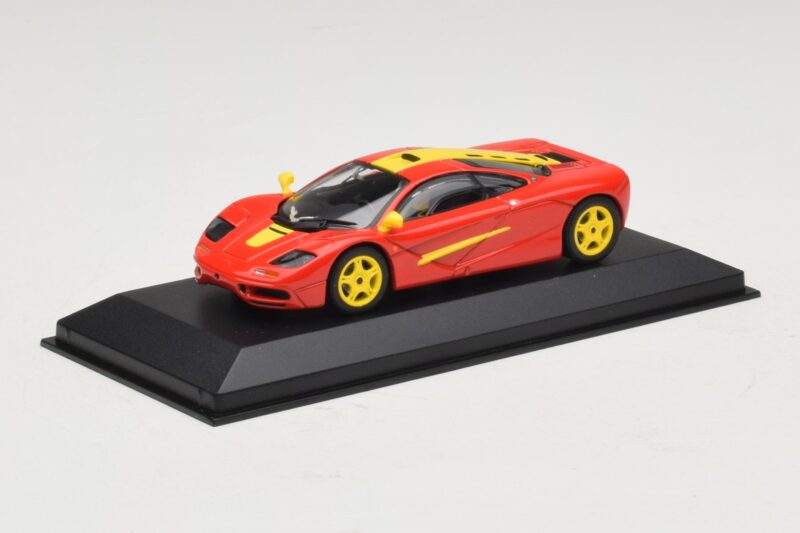
TL;DR: Minichamps' 1:43 diecast reproduces the McLaren F1 in red with yellow stripes, a sealed one-piece body capturing Gordon Murray's central-driving-position layout and distinctive dihedral doors. Built as a road car rather than a racer, the F1 remains one of the defining performance cars of the 1990s, and this diecast anchors that era on a shelf.
Gordon Murray built the F1 with one uncompromising idea: create the ultimate road car with no reference to racing regulations at all, a three-seat cabin with the driver positioned centrally and slightly ahead of two passengers either side. Minichamps captures that road car, not a competition variant, in red with bold yellow stripes, a livery choice that suits the car's dramatic shape.
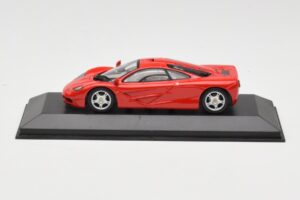
Minichamps builds this F1 as a sealed, one-piece diecast body, a treatment that suits a car whose original bodywork prized aerodynamic purity above almost everything else. The red base coat sits deep and glossy on the hard metal shell, and the yellow stripes are applied with clean, sharp edges rather than any blur or bleed at the boundary, a level of registration that matters enormously on a livery this graphic. Zinc alloy gives the model genuine weight, helping the F1's distinctively low, tapered tail and the pronounced diffuser beneath it hold their exact shape across years of display rather than softening the way lighter materials sometimes do. Because the body doesn't open, the shut lines around the F1's famous upward-hinging doors, one of the road car's signature engineering touches, run as fine, continuous grooves rather than the wider practical gaps an opening mechanism would require, letting that dramatic door shape read as pure sculpture rather than mechanism. The distinctive central driving position is suggested through the glazing, with the offset seating arrangement visible behind tinted windows, though full cabin detail is inevitably simplified at 1:43. Wheel design follows the road car's own multi-spoke pattern, and the wing mirrors, a small but often-botched detail on lesser diecast, sit at the correct angle and scale. Every surface a collector would actually examine closely receives careful, deliberate attention.
Gordon Murray, fresh from designing championship-winning Formula 1 cars for Brabham and McLaren, set out in the early 1990s to build a road car with no compromises borrowed from motorsport regulations, only from his own idea of automotive perfection. The result, launched in 1992, used a carbon-fibre monocoque chassis, a gold-foil-lined engine bay to reflect heat away from a bespoke 6.1-litre BMW V12, and that unmistakable three-seat cabin with the driver positioned centrally, ahead of two passenger seats angled slightly back on either side. Every material and manufacturing decision prioritised weight saving and structural purity over cost, an approach few road car makers before or since have been able to justify commercially. The F1 was never designed as a racing car, yet a lightly modified version went on to win the Le Mans 24 Hours outright in 1995 on its first attempt, a result that startled a field of purpose-built prototypes. On the road, a specially prepared F1 also set the naturally aspirated production car speed record in 1998, a mark that stood unchallenged for years afterward. Total production stayed remarkably low across the model's run, reserved for buyers who understood exactly what they were paying for rather than simply chasing a badge. Nearly three decades on, the F1 still defines what an engineering-led, compromise-free supercar can look like when cost genuinely doesn't dictate the outcome.
At 1:43, this F1 sits comfortably on a shelf that would need serious space at 1:18, making it practical to display alongside contemporary rivals from Ferrari, Porsche and Bugatti without needing a dedicated cabinet. The red and yellow livery gives it real visual presence even at this compact scale, standing out clearly from the silver and grey tones many original F1s wore. As one of the defining performance cars of its decade, a genuine engineering outlier rather than a marketing exercise, the F1 anchors a 1990s hypercar collection in a way few other subjects can match. Pairing it with later McLaren road and GT3 racing models on the same shelf traces a clear line from this uncompromising original through to the manufacturer's modern output today.







Save £14.00