Last one
Used
Back in stock
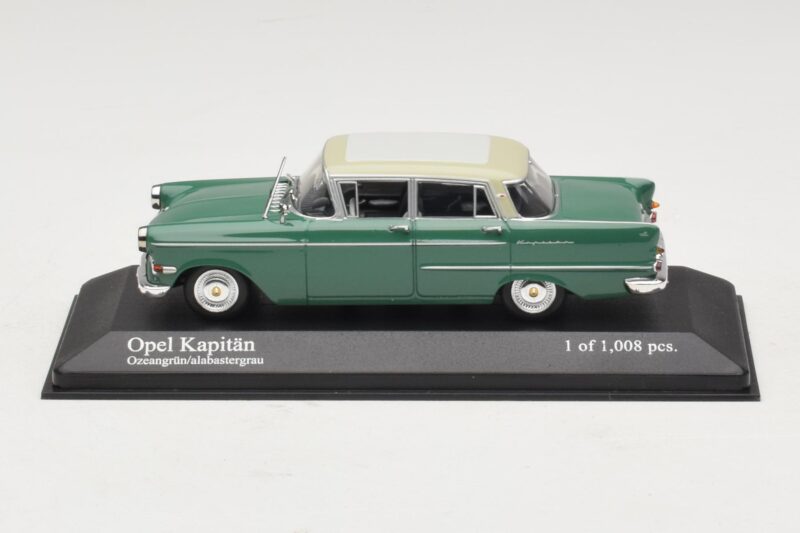
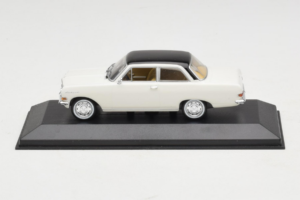
TL;DR: Minichamps' 1:43 Opel Kapitän A reproduces the entry point of Opel's flagship KAD range from 1964, a large saloon cast as a sealed diecast body in green. Sharing its platform with the Admiral and Diplomat, the Kapitän A represents German prestige motoring a step below Opel's true flagship coupe.
Opel's Kapitän name had signalled its largest saloon since the 1930s, and the KAD generation launched in 1964 relaunched that idea alongside two new siblings, the Admiral and Diplomat. The Kapitän A sat as the accessible entry point of the three, sharing its body with the pricier Diplomat. Minichamps reproduces it in green 1:43 diecast, a sealed body focused on a large saloon's proportions.
When Opel relaunched its senior saloon range in 1964, it built three related cars, the Kapitän, Admiral and Diplomat, on a shared platform known within the company as the KAD generation. The Kapitän name itself dated back to the 1930s, always denoting Opel's largest and most prestigious saloon, and the A generation revived that positioning with a genuinely large body, a straight-six engine, and styling that borrowed clear cues from contemporary American saloons rather than the more conservative shapes typical of German rivals at the time. Within the KAD family, the Kapitän sat as the entry model, offering the same imposing bodywork as the Admiral and Diplomat but with a more modest six-cylinder engine rather than the Diplomat's Chevrolet-sourced V8. That positioning made the Kapitän A the most attainable route into Opel's flagship saloon experience, a genuinely large, well-equipped car aimed at buyers who wanted presence without the running costs of the range-topping V8. Production ran through the mid-1960s before Opel restructured the range, and the Kapitän name was eventually dropped as the Admiral and Diplomat continued alone into their B generation. Green was a period-correct, conservative choice for a car aimed at buyers who wanted substance over flash, in keeping with the Kapitän's role as the sensible member of the KAD trio.
Nothing opens on this casting, so the model's large, flat body panels carry the entire weight of its accuracy, and a big 1960s saloon like the Kapitän A is a genuinely demanding shape to get right at this scale. The car's long bonnet, upright grille and generous glass area all depend on correct proportion rather than fine surface detail, since the styling itself was about presence rather than intricate ornament. Minichamps casts the body as a single zinc alloy shell, giving it real weight in the hand relative to its size, a density that matters more on a large saloon than on a small hatchback because the model needs to feel substantial to match the car's original road presence. The sealed construction removes any hinge tolerance the doors or bonnet would otherwise require, letting the bodyside crease lines and the chrome-trimmed window surrounds run as clean, unbroken details rather than being interrupted by a panel gap. Green paint over that shell holds its depth well under indirect light, showing the slightly muted, formal tone period Kapitän buyers tended to favour. Getting the roofline's slope right relative to the long bonnet is the single detail most likely to expose a poorly proportioned casting of this generation.
Judging this casting starts with the chrome, because a 1960s German flagship saloon carried far more brightwork than the cars that followed it: window surrounds, a substantial front grille, bumper overriders and side trim strips all needed picking out cleanly against the green bodywork for the model to read as authentic rather than simplified. The grille itself is one of the more distinctive details of the Kapitän A's styling, wider and more heavily chromed than a contemporary Kadett or Rekord, and it should dominate the model's nose the way it dominated the real car's front end. Wheel covers, rather than exposed alloy spokes, were the period-correct fitment on a car like this, and their size relative to the wheel arch is worth checking against period photography. Badge placement on the boot and the C-pillar, along with the shape of the rear light clusters, are smaller details that separate a careful casting from a generic large 1960s saloon shape with different badges applied.
On its own, this Kapitän A stands as a solid entry point into 1960s German flagship saloons, but its real value shows once it sits beside a Diplomat or Admiral from the same KAD generation, since the three cars shared so much of their bodywork that the differences between them, mostly in trim level and engine badge, become genuinely interesting to compare side by side. Green gives this piece a distinct identity against a more common Diplomat in silver, and the accessible tier this Kapitän occupies within Minichamps' range matches its role as the accessible member of the original trio. For a collector building out Opel's flagship history rather than just its headline V8 model, the Kapitän A is the sensible, complete-the-set piece. It rewards a shelf arranged by hierarchy rather than by rarity alone.

Save £33.00



Save £14.00