Last one
Used
Back in stock
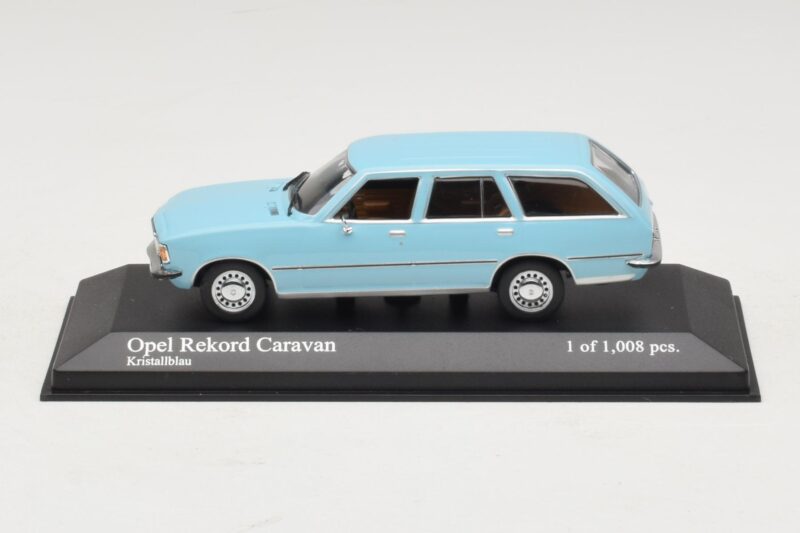
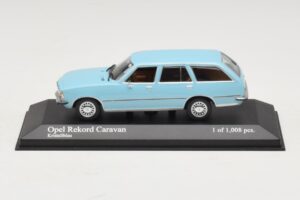
TL;DR: Minichamps' 1:43 Opel Rekord D Caravan Light Blue reproduces Opel's 1970s estate body on the same Rüsselsheim platform as the family saloon. The sealed diecast body holds a longer roofline than the sedan casting, finished in a pastel shade typical of the decade's colour charts. An honest, accessible piece for a themed 1970s German estate collection.
Pastel colours were everywhere on 1970s European family cars, a decade that leaned toward soft blues, greens and creams long before darker, more serious palettes returned to fashion. Minichamps' 1:43 Rekord D Caravan in light blue captures that specific period taste, applied to the practical estate body Opel built for carrying loads rather than making a styling statement. It is a shade that dates the model as precisely as any badge could.
Opel stretched the Rekord D's roof rearward to create the Caravan, trading the saloon's tapering rear deck for a flat load floor and an upright tailgate that maximised carrying space over aerodynamic style. That change reshaped the rear pillars and the glasshouse in ways the saloon casting never has to account for, giving Minichamps a genuinely different set of surfaces to model rather than a simple colour and badge swap on the same shell. Families and tradespeople alike valued that practicality through the 1970s.
This estate variant carried children to school, furniture from a shop, and holiday luggage across borders, doing the unglamorous work a Maserati or Porsche of the same decade never had to consider. That everyday usefulness is exactly why a well-cast Caravan model matters to a specific kind of collector, someone chasing a genuine memory of a family car rather than an aspirational one. The tall, upright rear glass, distinct from the saloon's more raked boot line, is the clearest visual signal of the Caravan's different purpose.
A longer, flatter roof leaves little room for a casting to disguise unevenness, since there is no deep curve to distract from a wavering line running from the windscreen to the tailgate. Zinc alloy's rigidity gives Minichamps the structural stability that long, thin section needs, holding the roofline level and the rear pillars consistent across the whole run rather than letting a longer body flex or bow. That stability is a genuine engineering consideration on an estate shape, more so than on the shorter saloon or coupé bodies sharing the same platform.
The tailgate is cast as part of the sealed body, with no hinge or handle that opens, letting the line run continuously from the roof through the rear glass and down to the bumper without the shadow a working hinge would leave. On an estate car, where the tailgate's proportions define the whole rear-end character, that unbroken line matters more than it would elsewhere. Chrome trim around the tailgate and the roof rails, moulded rather than fitted as separate pieces, sits flush enough to avoid the slightly cheap look lesser estate castings can carry. Wiper detail, picked out cleanly against the light blue, confirms the same finishing standard applied to the saloon carries through to this longer body.
Light blue was a common, unpretentious colour choice on family estates through the 1970s, favoured for looking clean and presentable without drawing undue attention on a car built for practical work. Minichamps' rendering keeps that period honesty, avoiding the temptation to brighten or deepen the tone for shelf appeal, and under direct light the pastel reads with a soft, slightly matte character distinct from the deeper metallics found on sportier Opels of the same era. At roughly ten and three-quarter centimetres nose to tail in 1:43, the Caravan's longer body carries the pastel across more surface than the saloon does, giving the colour a calmer, more restful presence across a themed shelf. Set next to the darker blue saloon or a bolder red coupé from the same range, this light blue estate becomes the gentlest note in a 1970s Opel display, useful for anyone building a collection around period colour variety rather than a single hue. Diecast holds that pastel consistently across the long roof and tailgate panels, with no visible mismatch where separate casting sections meet, a small detail that matters more on a longer body than a shorter one.
An estate car rarely anchors a serious display on its own, but a light blue Rekord D Caravan does useful work alongside its saloon and coupé siblings, showing the practical end of a range otherwise remembered for its more conventional saloon body. Minichamps' 1:43 diecast keeps this piece accessible, well within reach for a collector building out the whole Rekord D family rather than chasing a single rare variant. The sealed body means the tailgate and load area stay fixed, a display detail rather than an interactive one, which suits a model meant to be studied on a shelf rather than played with. For anyone drawn to the quieter, more honest end of 1970s European motoring, this pastel estate tells that story plainly.



Save £14.00