Last one
Used
Back in stock
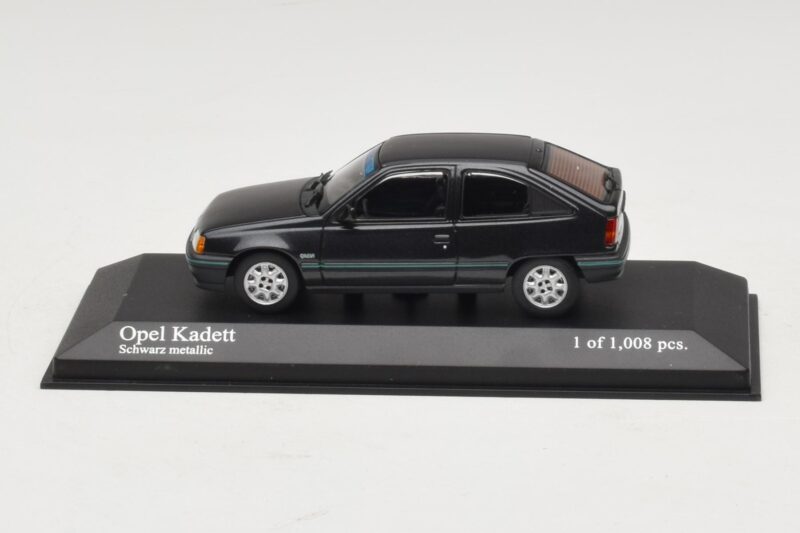
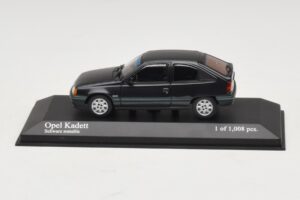
TL;DR: Minichamps' 1:43 Opel Kadett E reproduces the 1989 hatchback in black metallic diecast, cast as a sealed one-piece body with no opening panels. Named European Car of the Year in 1985, the Kadett E shared its platform and styling with the Vauxhall Astra Mk2 sold in Britain, making it a familiar shape to UK collectors under a different badge.
British buyers of a certain age will recognise this shape instantly, even under its German name, because Vauxhall sold the same car as the Astra Mk2 through the second half of the 1980s. Minichamps' Kadett E revives the original Opel badge in a deep black metallic finish, a colour that suits the hatchback's simple, slab-sided lines better than the brighter shades more commonly seen on surviving examples.
The Kadett E's bodywork is deliberately unfussy, all flat glass and straight shoulder lines aimed at aerodynamic efficiency rather than visual drama. That simplicity suits a sealed diecast casting well. Minichamps builds this model as a single fixed shell, with no doors, tailgate or bonnet that open, keeping the shut lines tight along the hatchback's rear opening and around the door skins. Because the original car relied on clean surfacing rather than sculpted detail to look modern for its era, a one-piece body loses very little compared with an articulated equivalent; the shape itself was always the main event, not a set of opening features.
Black metallic is a harder finish to photograph than it is to admire in person, because it hides panel definition unless the light falls just right. Under a direct lamp, this Kadett E should show its metallic flake as fine, even grain across the bonnet and doors, with enough gloss depth to avoid looking flat or matte. Zinc alloy diecast gives the small hatchback genuine weight in the hand, a quality that photographs poorly but matters enormously once the model is actually held, turned and compared against lighter alternatives on the same shelf.
Opel's jury-voted European Car of the Year award for 1985 went to the Kadett E, recognition of a genuinely modern front-wheel-drive design that replaced the older, boxier Kadett D. The award reflected real engineering progress: better aerodynamics, a lighter structure and a driving experience that felt considerably more contemporary than its predecessor. For a mainstream family hatchback to win against more glamorous competition said something about how seriously General Motors had taken the redesign, and it is that award, more than any single feature, which still gives the Kadett E its credibility among 1980s European car historians today.
General Motors sold this same platform and bodywork across Europe under different badges depending on the market, and in Britain that meant the Vauxhall Astra Mk2 rather than the Opel Kadett E. The mechanical underpinnings, the glasshouse and most of the sheet metal were shared, with only badging and minor trim differing between the two. For a British collector, that relationship gives this Opel-badged model an unusual double identity: a genuinely familiar car from the driveways of 1980s Britain, presented under the name it actually carried in its home market rather than the one most UK buyers would remember.
A Kadett E sits naturally alongside contemporaries like the Volkswagen Golf Mk2 or Ford Escort Mk4, cars that competed directly for the same family hatchback buyer across Western Europe through the second half of the 1980s. Displayed together, the differences in proportion and detailing between these rivals tell a clear story about how European manufacturers each interpreted the same brief: efficient, front-wheel-drive, practical transport for a growing middle-class market. The Kadett E's clean, slightly rounded surfacing looks notably more modern than the Escort's sharper creases from the same period, a contrast that rewards side-by-side comparison more than most people expect from ordinary family cars.
At 1:43, the model's compact footprint makes this kind of grouped display genuinely practical, allowing several period hatchbacks to sit together without dominating a shelf. For UK-based collectors specifically, owning both the Opel-badged Kadett E and a Vauxhall Astra Mk2 from the same generation, when both are available, offers a small but genuinely interesting study in badge engineering: identical cars, different names, sold to buyers who may never have realised how closely related their family runabouts really were.
This Kadett E works best as an entry point into 1980s European hatchback collecting rather than as a headline piece. Its value lies in representing a genuinely significant, award-winning design at a price that reflects its mainstream origins rather than any artificial scarcity.
For British collectors, the appeal runs a little deeper than badge curiosity: this is the shape that shaped a generation's idea of an ordinary family car, whether they knew it as an Opel or a Vauxhall. Displayed beside its Astra Mk2 twin or alongside rival hatchbacks of the same period, it earns its place through genuine automotive history rather than rarity alone. Either way, it rewards a second look for anyone who lived through the era it represents.

Save £33.00
Save £14.00