{"ajaxurl":"https:\/\/models118.co.uk\/wp-admin\/admin-ajax.php?lang=en_GB","nonce":"8688bd9d48","homeUrl":"https:\/\/models118.co.uk\/","shopUrl":"https:\/\/models118.co.uk\/shop\/","cartUrl":"https:\/\/models118.co.uk\/cart-en-gb\/","checkoutUrl":"https:\/\/models118.co.uk\/checkout\/","skipCart":true,"collectionLimit":12,"i18n":{"addedToCart":"Added to basket","addToWishlist":"Add to wishlist","addedToWishlist":"Added to wishlist","removeFromWishlist":"Remove from wishlist","removedFromWishlist":"Removed from wishlist","undo":"Undo","error":"Something went wrong","loading":"Loading...","outOfStock":"Out of stock","viewCart":"View basket","proceedToCheckout":"Proceed to checkout","addedToCollection":"Added to your collection","reserved":"Added to your collection","soldOut":"Sold out","invalidEmail":"Please enter a valid email address","connectionError":"Connection error. Please try again.","tocToggle":"On this page","close":"Close","inCartTooltip":"Already in your basket \u2013 open your basket to check out","loginToSave":"Sign in to save this model","waitlistNotify":"Notify me","waitlistOnList":"On the waiting list \u2713","waitlistJoined":"You're on the waiting list. We'll email you the moment this model is available again.","waitlistRemoved":"Done \u2014 you're off the waiting list for this model.","waitlistRateLimit":"Too many attempts \u2014 please try again shortly","waitlistTurnstile":"We couldn't complete the check \u2014 please try again","waitlistError":"Sorry, something went wrong. Please try again in a moment."},"wishlist":{"loggedIn":false,"loginUrl":"https:\/\/models118.co.uk\/my-account\/","addAction":"models118_wishlist_add","removeAction":"models118_wishlist_remove"},"waitlist":{"loggedIn":false,"subscribeAction":"models118_waitlist_subscribe","toggleAction":"models118_waitlist_toggle","stateAction":"models118_waitlist_state"},"stats":{"models":2418,"brands":213,"manufacturers":128,"collectors":10000},"product":{"id":1659310,"sku":"S1800519","condition":"used","availability":"out_of_stock","name":"Volkswagen Beetle 1303 Go with Moon Solido 1:18","brand":"Volkswagen","manufacturer":"Solido","scale":"1:18","material":"Diecast","price":32,"regularPrice":32,"isOnSale":false,"savingsAmount":0,"stockQty":0,"stockStatus":"out_of_stock","isDiscontinued":true,"image":"https:\/\/models118.co.uk\/wp-content\/uploads\/2026\/08\/volkswagen-beetle-1303-go-with-moon-solido-1-18-s1800519-1-1-300x200.jpg","permalink":"https:\/\/models118.co.uk\/volkswagen-beetle-1303-go-with-moon-solido-1-18-s1800519\/"}}
Cookies on Models118
We use cookies to remember your preferences, understand how the shop is used and show you models and offers that suit your interests. What you allow is up to you, and you can change it at any time.
Always active
The technical storage or access is strictly necessary for the legitimate purpose of enabling the use of a specific service explicitly requested by the subscriber or user, or for the sole purpose of carrying out the transmission of a communication over an electronic communications network.
The technical storage or access is necessary for the legitimate purpose of storing preferences that are not requested by the subscriber or user.
The technical storage or access that is used exclusively for statistical purposes.
The technical storage or access is required to create user profiles to send advertising, or to track the user on a website or across several websites for similar marketing purposes.
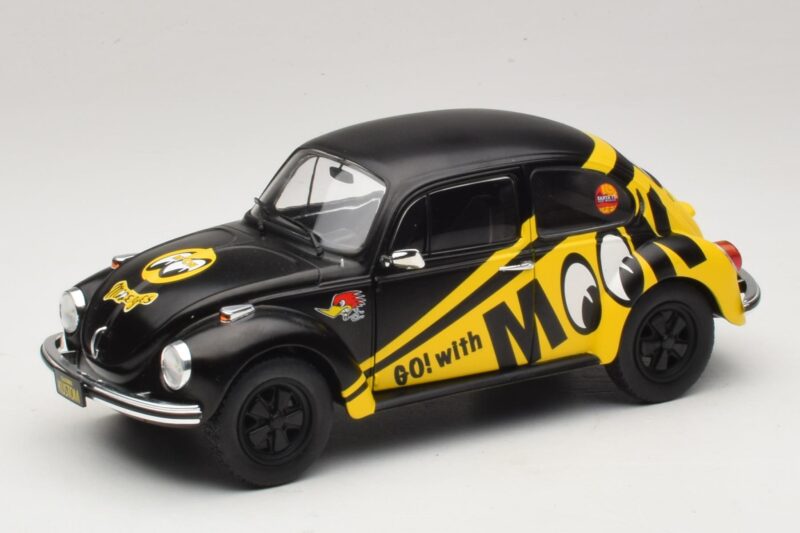
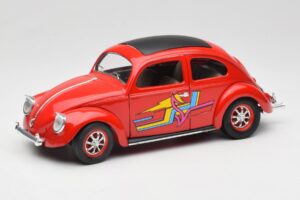
Solido's 1:18 diecast Volkswagen Beetle 1303 carries the Go with Moon livery, a nod to the Moon Equipment eyeball logo that became a fixture of California custom-VW culture through the 1970s. The doors, bonnet and rear engine cover all open, letting the rear-mounted air-cooled flat-four show through the louvred deck lid Volkswagen fitted to the top-spec 1303. Diecast weight and a curved 1303 windscreen mark this as the flagship late Beetle, dressed for the custom scene rather than the showroom, with hinges that hold their position rather than swinging loose.
About the Volkswagen Beetle 1303 Go with Moon Solido 1:18
TL;DR: Solido's 1:18 diecast Volkswagen Beetle 1303 reproduces a customised 1974 example finished in the Go with Moon livery, referencing the Moon Equipment eyeball logo from California's custom-VW scene. Doors, bonnet and the rear engine cover all open, exposing the air-cooled flat-four behind the louvred deck lid that marked the range-topping 1303.
By 1973 Volkswagen gave the Beetle a curved, panoramic windscreen and a new type number, 1303, to head the range. Solido's 1:18 rendition wears a Go with Moon livery, built around Moon Equipment's yellow eyeball emblem, the badge that defined hot-rod and Cal-look Volkswagen culture through the 1970s custom scene.
Solido's 1303 and the Curved-Windscreen Super Beetle
MacPherson Struts and the Super Beetle Line
Volkswagen introduced the 1302 in 1970 and the 1303 in 1973 as the top of the Beetle range, distinguished by a wider front track and, on the 1303, a deeply curved panoramic windscreen that gave the dashboard far more room than the flat-glass Beetles it sat alongside. Both models replaced the traditional torsion-bar front suspension with MacPherson struts, a change that improved ride comfort and increased front luggage space, even as the rear-mounted air-cooled flat-four and swing-axle rear suspension carried over largely unchanged from decades earlier. By 1974, the year this example left the factory, the 1303 represented the most refined version of a design that had barely altered in silhouette since the 1930s.
Moon Equipment and the Cal-Look Custom Scene
Somewhere between the factory gates and its current life as a display piece, this Beetle picked up the Go with Moon treatment, a livery built around the yellow eyeball logo of Moon Equipment, the Californian speed-parts company founded by Dean Moon in the 1950s. That eyeball became one of the most recognisable badges in hot-rod and drag racing circles, and through the following decades it crossed over into the Volkswagen scene as Cal-look customising, lowered stances, polished trim and period-correct wheels, became its own transatlantic subculture. A Beetle wearing Moon branding signals a specific corner of that history rather than a generic custom paint job.
Diecast Build and Opening Panels on This Beetle
Doors, Bonnet and the Rear Engine Cover
Unlike the sealed single-seaters that make up much of an F1 diecast range, this 1303 is built to open: both doors, the front luggage bonnet and the rear engine cover all operate, letting a collector examine the model the way an owner would walk around the real car. Lifting the rear cover reveals the air-cooled flat-four sitting where a conventional car keeps its boot, a layout that still surprises anyone unfamiliar with the Beetle's rear-engine configuration, and the louvred deck lid Volkswagen fitted to let the engine breathe is reproduced as a distinct, separately finished panel rather than a flat casting line.
Zinc Alloy Weight Against the Custom Graphics
The doors swing on a hinge with a defined stop rather than flopping loosely, settling roughly where they are left rather than snapping shut under their own weight, and the bonnet lifts cleanly to show a shaped luggage bay ahead of the front axle. All of that hinged engineering sits inside a zinc alloy body, so the model carries real heft in the hand despite the opening panels, the weight distributed enough that it does not feel unbalanced with a door left open on a shelf. The Go with Moon graphics run across painted metal rather than a decal applied over resin, which keeps the eyeball logo and lettering crisp along the curved wheel arches and rocker panels where a lesser print would show its edges.
Display Footprint for a Special and Unique Beetle
A 1303 measures a little over four metres in real life, which at 1:18 comes out to roughly 23 centimetres nose to tail, a compact footprint that leaves generous room either side for opened doors without the model spilling into a neighbouring shelf space. Because Solido builds this one to open, display choices multiply: closed for a clean side profile that shows off the Go with Moon graphics uninterrupted, or with a door and the rear cover open to reveal both the flat-four engine and the louvred deck panel at once. This piece is catalogued as a Special and Unique model rather than a standard street car, an accurate reflection of a livery built for custom-car shows rather than a factory colour chart. That distinction matters on a themed shelf: paired with unmodified Beetles from the same decade, this one reads immediately as the outlier, the car built to be looked at from underneath a spotlight at a custom show rather than parked outside a house, even before the eyeball logo comes into view. A single directed lamp across the roofline picks out the curvature Volkswagen engineers achieved with that panoramic windscreen, one of the more distinctive silhouette details separating the 1303 from earlier flat-glass Beetles.
Where a Moon-Liveried Beetle Fits a Collection
Solido's diecast heritage stretches back to 1932, and this Beetle sits at the more playful end of a catalogue built mostly around correctly liveried European classics: a custom-culture novelty rather than a museum-accurate stock reproduction. That is worth stating plainly, because a buyer wanting a factory-original 1303 in a standard colour should look elsewhere in the range; this piece exists specifically to celebrate the Moon Equipment connection and the wider Cal-look scene it represents. What it offers in return is genuine opening-panel engineering rarely found on novelty-liveried diecast at this price point, real diecast weight, and a period-correct 1974 shape underneath the graphics. On a themed shelf built around custom and special-interest vehicles rather than showroom colours, it holds its own as a conversation piece rather than a background entry. British buyers researching before a purchase, a habit strong in this hobby, will find the opening doors and bonnet a genuine point of difference against sealed-body customs from other manufacturers at the same scale.
Create a free account and claim 10% off your first order — from hundreds of collectible 1:18, 1:43 and 1:12 models by Porsche, Mercedes-Benz, BMW and more.
{"id":1659310,"name":"Volkswagen Beetle 1303 Go with Moon Solido 1:18","price":"£<\/span>32.00<\/bdi><\/span>","image":"https:\/\/models118.co.uk\/wp-content\/uploads\/2026\/08\/volkswagen-beetle-1303-go-with-moon-solido-1-18-s1800519-1-1-400x400.jpg","permalink":"https:\/\/models118.co.uk\/volkswagen-beetle-1303-go-with-moon-solido-1-18-s1800519\/","brand":"Volkswagen"}