Used
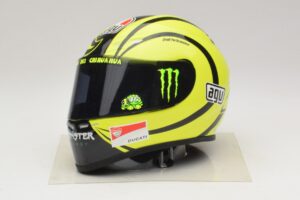
AGV Helmet V. Rossi MotoGP Valencia Test 2009 Minichamps 1:2
Price:
£150.00
At half the size of the real thing, 1:2 scale models turn a racing helmet into a substantial display piece. This collection centres on Minichamps diecast replicas in AGV designs from MotoGP and motorcycle racing, with a 2000s focus. Browse it for finish, graphics and display presence that few other scales can match.

TL;DR: 1:2 scale models reproduce an object at half its real size, and this collection centres on Minichamps diecast helmet replicas in AGV designs from the MotoGP and motorcycle racing world, with the 2000s era covered. A real helmet shrinks to a hand-sized display piece; paint, visor and decal fidelity decide quality.
Most scale model collecting lives at 1:18 or 1:43, so 1:2 scale models feel like a different hobby. Everything is simply bigger and heavier than the shelf expects. Here the subject is the racing helmet, reproduced in diecast by Minichamps in AGV designs, and the half-size format gives a surface the size of a cupped hand on which to judge paint and graphics. It rewards slow looking.
Divide a real object by two and the result is not a miniature in the usual collector sense. It is a large, solid display piece. A racing helmet measures roughly 30 centimetres front to back in real life, so a 1:2 version sits around 15 centimetres, which puts it in the same size bracket as a 1:18 car. That is why helmets suit this scale so well. A car at 1:2 would need a floor stand; a helmet fits a shelf.
The format also changes what you inspect. At 1:18 you judge shut lines and interiors. At half size on a helmet you judge the gloss of the paint, the sharpness of the sponsor graphics, the clarity of the visor and the finish of the vents and trim. Those are the things that separate a convincing replica from a toy-like one. For collectors who already own cars at 1:18 or 1:43, a 1:2 helmet adds a different texture to the cabinet: one dominant object among rows of vehicles, a focal point for a motorsport themed display. Which pieces carry which detail varies by model, and each product card spells it out.
The collection is narrow by design, and that is its strength. Read plainly, the assortment looks like this:
Because manufacturer, brand and scale are shared, comparison is unusually clean. Differences between pieces come down to the design reproduced and how well it is executed, not to differences in house style. That also makes this a focused scope rather than a full landscape. A collector wanting several manufacturers at 1:2 will find a single name here; one wanting depth in a coherent family will find it.
The 2000s tag gives the group a defined period, which helps when planning a themed shelf. Entry into this niche can be a single piece. One well-chosen helmet already works as a focal point, and a second shows how designs differ on the same shell shape. Check each product card for the specific design, finish and any features, as these vary from piece to piece.
Metal changes how a helmet replica behaves on the shelf. Diecast is zinc alloy poured into a die, so the shell has mass that resin of the same shape would lack, and it sits firmly rather than feeling hollow. Paint on a hard metal surface reads deep and even under a cabinet lamp, which matters because a helmet is almost all smooth, curved surface.
A car body has panel breaks and shut lines to interrupt the reflection; a helmet shell has nowhere to hide. Any orange peel, dust nib or mould seam shows in the highlight. Casting tolerances in metal run a touch wider than resin allows, so fine edges around the visor surround and vents can read slightly softer. Resin holds crisper edges but is lighter and more brittle, so neither material wins outright.
Over the years a metal shell keeps its shape and tolerates being moved between shelves, while glossy paint will still mark from fingerprints and chip at exposed edges. Clear parts, whatever they are made from, are usually the first area to pick up scratches, so treat them gently. Which parts move on a particular piece is a per-model detail recorded on its product card.
Judging a helmet replica needs a different checklist from judging a car. Start with photographs of the real helmet from the same angles: left, right, front, back and top. Then compare.
Symmetry comes first. Designs are often not mirrored, so check that left and right match the reference rather than assuming they should be identical. Colour next: reds, golds and fluorescents drift easily, so compare in daylight rather than under warm bulbs. Look at the edges of graphics and sponsor logos. A crisp line suggests tampo printing or well-applied decals, while a fuzzy edge or a lifting corner suggests compromise.
Check gloss uniformity across the dome, where a patch of dull paint shows instantly. Examine the visor for clarity, tint and fit against the shell, and the trim and vents for definition. Finally, look at presentation: base, packaging and any paperwork. British collectors in particular value the full set, boxed and complete, and a missing item is noticed at resale. None of these checks needs a measuring tool, only patience and good light.
A 1:2 helmet is compact for its presence. Around 15 centimetres front to back, it needs less floor area than a long 1:18 car but more height, so check shelf clearance of at least 20 centimetres before committing. In a glass-fronted model car display case the helmet reads best at eye level, turned slightly so the main graphic faces the viewer. A flat front-on position hides the curve that makes the shell interesting. Allow a few centimetres either side so adjacent helmets do not visually merge.
Lighting matters more here than with cars. A small LED lamp angled from above and to one side reveals the gloss and exposes flaws, while direct sunlight fades graphics and warms clear parts over time, so keep the cabinet away from windows. Dust settles on a dome quickly; a soft brush works better than a cloth, and a closed cabinet cuts cleaning to a minimum.
Lift pieces with both hands supporting the shell, never by the visor. Keep the box and inserts, which protect the finish and carry weight with collectors who value provenance.
Building around 1:2 helmets works best with a stated limit. A set of random pieces looks like stock; a defined group looks like a collection. Because this range centres on one brand, one manufacturer and one era, the natural lines run by design family, by season or by colour. Colour grouping is underrated: three helmets in similar liveries show how the same shell shape carries different graphic ideas.
Many collectors pair a half-size helmet with vehicles at smaller scales, so a single 1:2 piece anchors a shelf of 1:18 or 1:43 models from the same racing theme, though that pairing depends on what else you own. The helmet becomes the focal point and the vehicles supply context.
Start with one piece whose design you already know well, since you will spot errors fastest on a familiar subject. Add a second only after living with the first for a few weeks, and keep original boxes, inserts and any certificates, as completeness and numbering matter to British buyers and dealers alike. This is a niche with a deliberately narrow scope, so patience suits it better than haste.
Roughly half the size of a real helmet, so around 15 centimetres front to back against about 30 for the original. Allow at least 20 centimetres of shelf height and a few centimetres either side. It sits in a similar size bracket to a 1:18 car, but stands taller.
Compare gloss, colour accuracy, graphic edges, left and right symmetry, visor clarity and trim against photographs of the real helmet in daylight. Pieces from one manufacturer share a house standard, so differences usually come from the design reproduced and how cleanly it is finished.
Diecast gives metal weight, a deep paint surface and robustness under handling, with fine edges a shade softer. Resin holds crisper edges but is lighter and more brittle. This collection is diecast, so expect heft and a firm seat on the shelf.
Check the design reproduced, the manufacturer, the scale, the material and any listed features or included display parts, since these vary by model. Packaging and any certificate also matter to many British collectors who value completeness, so note what comes with the piece.