Used
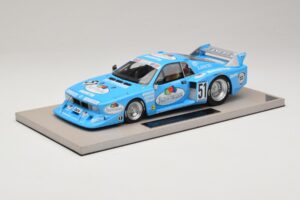
Top Marques renders Lancia’s Group 5 and silhouette racing programme in 1:18 resin, covering an era when factory-backed touring cars wore dramatically flared bodywork and full aerodynamic packages far removed from their road-going origins. This is a specialist corner of motorsport collecting, aimed at enthusiasts tracing Lancia’s competition history through one of its most visually striking periods.
TL;DR: Top Marques renders Lancia's Group 5 and silhouette racing cars in 1:18 resin, documenting a 1980s era when factory touring cars carried dramatically flared bodywork over standard road-car silhouettes. Resin construction suits the era's aggressive aerodynamic addenda, giving collectors a specialist route into Lancia's motorsport heritage beyond its better-known rally programme.
Lancia's rally exploits tend to dominate the marque's motorsport reputation, but the silhouette racing era of the early 1980s produced some of the most visually dramatic touring cars the brand ever fielded. Group 5 regulations allowed enormous flared arches, deep front splitters, and rear wings bolted onto a recognisable road-car silhouette, turning a Beta Montecarlo into something closer to a rolling aerodynamics experiment than a production coupe.
Group 5 regulations in the early 1980s permitted extraordinarily loose interpretation of a road car's bodywork, and Lancia used that freedom on the Beta Montecarlo to build a competition car that shared little more than a roofline with its showroom counterpart. Enormous flared arches accommodated wide racing tyres, front splitters and rear wings generated genuine aerodynamic load, and the resulting silhouette became one of the era's most recognisable competition shapes. Lancia's factory-backed programme in this category ran across multiple seasons of what was then the World Championship for Makes, and the marque's competitive results through the period helped cement its reputation for engineering ambition beyond the rally stages it is more commonly remembered for today. Top Marques' resin coverage of this specific era gives collectors access to a chapter of Lancia's history that receives far less scale attention than the marque's Delta and Stratos rally programmes, despite the cars themselves being every bit as visually striking.
Silhouette racing bodywork places real demands on any casting. A collector assessing a Top Marques piece should look for:
Livery accuracy matters as much as bodywork here, since period sponsor decals and factory racing colours identify the specific season and car represented, and this is where casting quality shows most clearly on a silhouette racing subject.
A Lancia motorsport shelf built around the silhouette racing era pairs naturally with the marque's better-known rally coverage, showing the range of engineering approaches the brand pursued across different competition categories in the same general period. Displaying a flared, wide-bodied Beta Montecarlo alongside a rally-liveried Delta or 037 highlights just how differently regulations shaped each car's silhouette despite both wearing the same badge. Because silhouette racing subjects receive less scale attention than rally cars, building this side of a Lancia collection often means watching for occasional specialist releases rather than expecting a steady, predictable supply, which gives the pursuit a genuine long-term collecting quality.
Flared arches and low splitters are the most exposed points on a silhouette racing casting, so handle the model by its roof or chassis rather than by any extended bodywork. Dust settles readily in the gap between a flared arch and a wide racing tyre, making a glass-fronted cabinet worthwhile for this subject in particular. Keep the model out of direct sunlight to preserve period sponsor decal colours, which can fade faster than a solid factory paint finish. Original packaging matters more for a specialist subject like this, since reissues of a specific 1980s silhouette racing livery are unlikely to appear on a predictable schedule.
Group 5 regulations allowed dramatic departures from a road car's standard bodywork, permitting flared arches, splitters, and wings while keeping only the basic silhouette recognisable. This freedom let Lancia turn the Beta Montecarlo into a car that looked radically different from its showroom version despite sharing the same underlying shape.
Lancia is more widely remembered for rally successes with the Delta and Stratos, but its silhouette racing programme ran alongside that history and produced equally dramatic, factory-backed competition cars. It receives considerably less scale model attention despite comparable engineering ambition.
Resin holds sharp, thin definition on splitter lips, wing endplates, and arch flare transitions more convincingly than diecast tooling, which typically needs to thicken these elements for structural strength. That precision matters on a subject defined by aggressive, purpose-built aerodynamic addenda.
Generally yes. Rally subjects receive more consistent scale coverage across manufacturers, while silhouette racing releases appear more sporadically from specialist producers, making this a collecting pursuit that rewards patience rather than an on-demand purchase.