Last one
Used
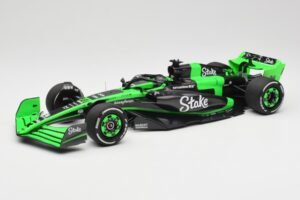
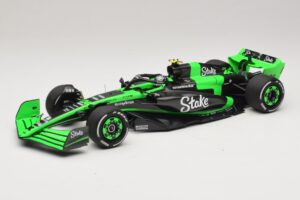
Stake F1 Team Kick Sauber C44 #77 V. Bottas Emilia Romagna GP 2024 Minichamps 1:18
Only 1 left
Price:
189.00 €
This model is currently sold out. Enter your email and we'll let you know when it's back in stock.
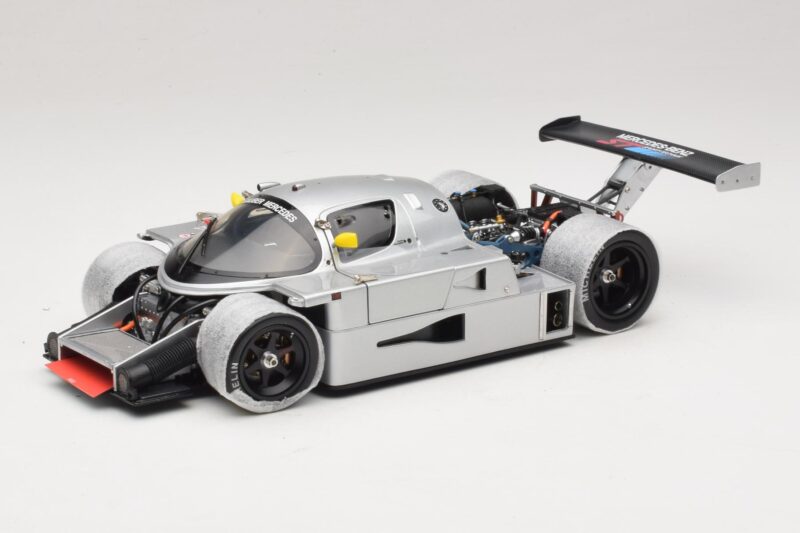
TL;DR: Exoto's 1:18 diecast Sauber C9 in Ice Silver reproduces the Mercedes-powered Group C prototype that won the 1989 24 Hours of Le Mans, marking Mercedes-Benz's return to top-level sports car racing under the Silver Arrows banner. Built with opening doors and finished in exacting diecast detail, it captures one of Group C's defining turbocharged prototypes.
Mercedes-Benz walked away from top-level motorsport after the tragic 1955 Le Mans disaster and did not return as a full works effort for more than three decades. When it did, partnering with the Swiss constructor Sauber, the result was the C9, a car that carried the Silver Arrows name back to Le Mans and won in 1989. Exoto's diecast reproduction, finished in Ice Silver, captures that moment in exacting detail.
Mercedes-Benz's motorsport withdrawal after the 1955 Le Mans tragedy left a decades-long gap in the marque's sports car racing history. That changed through a partnership with Swiss constructor Peter Sauber, whose team had been building competitive prototypes independently before Mercedes-Benz began supplying engines and, eventually, full factory backing. The Sauber C9 was the result of that escalating relationship, a car built to Group C regulations and painted in the silver associated with Mercedes racing history stretching back to the 1930s.
At the 1989 24 Hours of Le Mans, the Sauber-Mercedes team achieved what the partnership had been building toward: victory, with drivers Jochen Mass, Manuel Reuter and Stanley Dickens sharing the winning car. That result marked Mercedes-Benz's return to the very top of endurance racing after more than three decades away, a genuinely significant chapter in both Sauber's and Mercedes-Benz's competition history. Exoto's Ice Silver reproduction captures the car in the livery that carried that win.
Group C defined sports car racing through the 1980s by combining strict fuel consumption limits with almost total freedom over engine configuration, a formula that produced some of the fastest and most technically ambitious prototypes ever raced. The Sauber C9 used a Mercedes-Benz-developed twin-turbocharged V8, an engine built to extract maximum efficiency within Group C's fuel rules while still producing the power needed to compete with Porsche's dominant 962 and Jaguar's V12-powered prototypes.
Underneath the striking silver bodywork, the C9 relied on a carbon-composite monocoque chassis and sophisticated aerodynamics refined across several racing seasons before that 1989 Le Mans win arrived. Group C cars of this era reached genuinely extraordinary top speeds on Le Mans's long Mulsanne straight, a factor that eventually led organisers to introduce chicanes to slow the fastest prototypes down. The C9 sits among the cars that forced that change, a measure of how far turbocharged prototype engineering had pushed the boundaries of what a closed-cockpit sports racer could achieve.
Exoto built its reputation on diecast models that prioritise engineering accuracy and multi-part construction over shortcuts, an approach that suits a technically dense subject like the Sauber C9 well. Where a simpler diecast casting might simplify a prototype's underbody and cockpit surrounds into a single moulded shape, Exoto's construction typically separates these elements into individually finished parts, assembled to reflect how the real car was actually built. This particular casting includes opening doors, a genuine functional detail rather than a cosmetic afterthought, letting a collector display the model with the distinctive Group C door design shown open as well as closed. Zinc alloy diecast brings real weight to a model at this scale, and that heft, combined with tight panel tolerances around the opening sections, gives the C9 a substantial, engineered feel in the hand. The Ice Silver finish itself demands careful, even application, since an uneven silver instantly reveals casting imperfections that a bright livery would hide.
Exoto's diecast models sit at a premium tier within the hobby, priced above mass-market production but positioned below the most exclusive hand-built resin specialists, a reflection of the multi-part construction and detail work that goes into a subject like this. The opening doors add genuine display versatility, letting a collector choose between a closed racing stance or an open cockpit view most sealed-body models cannot offer. Set beside a period Porsche 962 or Jaguar XJR-9, this Sauber C9 completes a genuine snapshot of Group C's final, fastest years, and for anyone building a Le Mans-winner collection specifically, a car that returned Mercedes-Benz to the top step after three decades away earns a prominent place on the shelf.