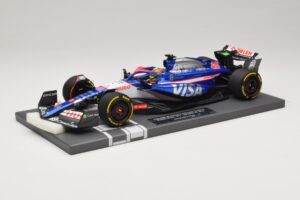
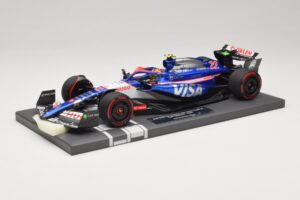
TL;DR: RB scale models document the current identity of Red Bull's second Formula 1 team, previously known as Scuderia AlphaTauri and Toro Rosso. Minichamps renders the 2020s-era livery in 1:18 resin, giving collectors who track the team's repeated rebranding a fresh chapter to add alongside its earlier liveries.
Few Formula 1 teams have changed names as often as Red Bull's second entry, passing from Toro Rosso to Scuderia AlphaTauri and now to its current RB identity. That repeated rebranding gives scale model collectors an unusual opportunity: a single chassis lineage and driver programme documented across several distinct visual identities, each a genuine chapter rather than a cosmetic refresh.
RB Scale Models and Red Bull's Second F1 Team
RB is the current name for the Formula 1 operation that has carried Red Bull's junior driver programme since the early 2000s, previously racing as Toro Rosso and, more recently, Scuderia AlphaTauri. Each rebrand has coincided with a fresh visual identity and, often, a shift in title sponsorship, which means the team's scale model history reads less as one continuous livery and more as a series of distinct eras. Collectors drawn to this category tend to be those following the broader Red Bull racing programme, since the junior team has historically served as a proving ground for drivers who later move to the senior Red Bull Racing entry. That connection gives the RB category a role beyond its own results: a chassis and driver pipeline that feeds directly into the sport's most successful modern operation, making the team's current livery worth tracking even for collectors whose primary interest sits elsewhere on the grid.
Minichamps Resin Craftsmanship on Current F1 Liveries
Minichamps builds its current-era Formula 1 range in resin, and a modern livery like RB's benefits from the material's ability to hold fine sponsor decal work and complex aerodynamic surfaces accurately. When comparing a current-season release, look for:
- Sharp colour separation between sponsor zones on the livery
- Consistent gloss across the bodywork without uneven sheen
- Crisp detail on barge boards, floor edges, and front wing elements
- Correct livery details matching the specific season represented
Because current F1 liveries change from season to season, pricing and availability track the specific season represented rather than any broader brand premium, so a collector comparing releases should check the exact livery year before assuming interchangeability.
Collecting Across a Team's Name Changes
A collection built around this team's history works well organised chronologically by identity rather than by driver, since each name change, Toro Rosso, AlphaTauri, RB, marks a genuinely distinct visual era worth displaying as its own chapter. Placing liveries from different periods side by side on the same shelf highlights how sponsorship and title backing shifted the team's colour scheme even while the underlying chassis programme continued uninterrupted. Collectors already following the senior Red Bull Racing team often extend into this junior operation specifically to track drivers before their promotion, giving the RB category a genuine narrative thread beyond its own championship standing. Because current liveries are produced in step with an active season, availability for the newest identity tends to be stronger than for earlier, now-discontinued team names.
Display and Care for Modern F1 Resin Models
Modern Formula 1 cars carry more exposed aerodynamic detail than earlier eras, floor edges, complex diffusers, and slender wing elements, all of which need careful handling on a resin casting. Lift the model by the chassis rather than by any wing or floor element, and keep it away from direct sunlight, which can dull sponsor decal colours faster than a solid paint finish. A glass-fronted cabinet helps protect the fine floor and diffuser detail from dust, which is harder to remove from these areas than from a simpler road car underside. Retaining original packaging matters for current-season releases too, since team liveries and sponsor arrangements can change within a single year, making a specific variant harder to find once a season ends.
Frequently Asked Questions About RB Scale Models
Why has this Formula 1 team changed names so often?
The team has operated under Red Bull ownership as a proving ground for junior drivers, and its identity has shifted with sponsorship and rebranding decisions, from Toro Rosso to Scuderia AlphaTauri and now to RB. Each change reflects a fresh commercial identity rather than a change in ownership or purpose.
Is RB connected to the main Red Bull Racing team?
Yes. RB operates as Red Bull's second Formula 1 entry, historically developing drivers who go on to race for the senior Red Bull Racing team. Collectors following the main team often extend into this junior operation for that reason.
Should older team liveries be collected alongside the current RB identity?
Many collectors do, using earlier Toro Rosso and AlphaTauri liveries to build a chronological display of the team's repeated rebranding. It is not necessary, but the visual contrast between eras is one of this category's more distinctive collecting angles.
What should a collector check when comparing current F1 liveries?
Check the specific season the livery represents, since sponsor colours and aerodynamic details change year to year even within the same team identity. Two releases from different seasons under the same team name are not necessarily interchangeable in appearance.