Last one
Used
This model is currently sold out. Enter your email and we'll let you know when it's back in stock.
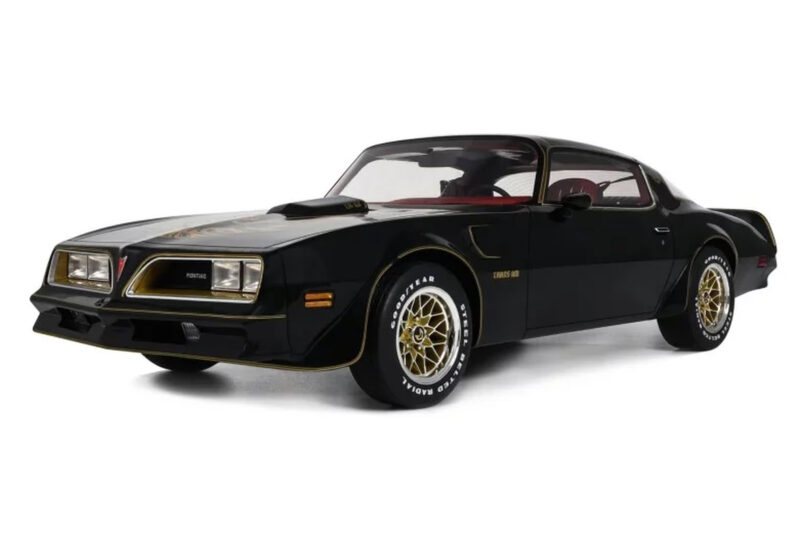
TL;DR: Otto's 1:12 resin Pontiac Firebird Trans Am reproduces the 1978 Starlight Black coupe as a sealed one-piece body with fixed panels. The larger scale carries the screaming chicken hood graphic and T-top roofline in sharp, unbroken detail. A museum-scale muscle car for collectors who want presence over interior access.
By 1978 the American muscle car era was fading under tightening emissions rules, yet the Pontiac Firebird Trans Am kept selling in strength, carried by the screaming chicken graphic and a big-hood presence that outlasted the horsepower wars that spawned it. Otto's 1:12 resin replica gives that late-decade survivor a scale where every line of black paint holds its own.
By the late 1970s, tightening emissions regulations had throttled the horsepower that defined the previous decade's muscle car boom. Compression ratios fell, catalytic converters arrived, and several nameplates that had once ruled the segment quietly vanished from showrooms. The Firebird Trans Am was one of the few holdouts still selling in real numbers through 1978, carried by cultural momentum as much as raw output. Two years earlier, Smokey and the Bandit had placed a black-and-gold Trans Am at the centre of a Hollywood blockbuster, and Pontiac dealers still felt the lift in Firebird demand as the decade wound down. Buyers wanted the look and the presence of a muscle car even as the numbers on the spec sheet softened, and Pontiac's styling department understood that better than most of Detroit. Flared fenders, a shaker hood scoop and a wide stance carried the promise visually long after horsepower alone stopped making the case.
Every Trans Am from this era carried Pontiac's Firebird hood graphic, a spread-wing bird decal enthusiasts nicknamed the screaming chicken almost as soon as it appeared. On lighter body colours the graphic reads as an accent; on Starlight Black it becomes the dominant visual feature, since the paint gives the artwork nothing to compete with. Otto's resin casting holds that contrast well, with the black finish deep enough to show genuine reflection rather than a flat, chalky surface. T-top roof panels were among the Trans Am's most popular options that year, letting owners remove both glass sections for open-air driving without sacrificing the coupe's structural rigidity, a feature that also defined the car's silhouette from directly above. Pontiac paired the graphic and the T-tops with wide rear haunches and a shovel-nosed front end, proportions this scale model follows closely enough that the car reads correctly from every angle, not only in profile.
Otto's range centres on 1:18, so a 1:12 release like this one is worth pausing on. At 1:12, a Trans Am of the Firebird's length comes out close to 40 centimetres nose to tail, noticeably larger than the 1:18 pieces most muscle car shelves are built around. That extra size matters most on a long, flat-hooded car like this one, where a bigger canvas gives the screaming chicken graphic and the shaker scoop room to sit at something closer to their real visual weight relative to the body. Resin suits the jump in scale better than diecast would. A larger diecast casting adds real weight and cost as the tooling scales up, while resin keeps the production process manageable at 1:12 without demanding a correspondingly larger production run. The trade-off is one every resin buyer already understands: lower mass in the hand than an equivalent diecast piece, in exchange for sharper edges and a body free of the seams a pressed metal shell would show at this size.
Nothing on this casting opens. The doors, hood and T-top roof panels are all part of one fixed resin shell, a construction choice rather than a shortcoming, and one that suits Starlight Black particularly well. Black paint punishes uneven gaps and orange-peel texture more than any other colour, because there is no metallic fleck to scatter the light and hide a flaw. A sealed body removes the hinge clearances a functioning door or bonnet would need, so the panel lines run as continuous grooves rather than gaps that could catch stray light and break up the finish. Run a fingertip along the door line and it tracks a single, unbroken channel. Under a raking lamp, the black holds an even, glassy depth from the shaker hood scoop back to the tail, exactly the kind of surface that rewards close inspection rather than an open door.
A 1:12 muscle car does not sit quietly among 1:18 company. It commands more shelf depth than most cabinets are built for, and Starlight Black paint rewards angled light rather than a flat overhead spot, which flattens black finishes into a silhouette. Position it where a side lamp can rake across the hood and the raised shaker scoop, and the surface shows the depth the resin actually has. Because the body is sealed, there is no interior lighting rig or open door to plan a display around; the whole model reads from the outside, so distance and angle do more work here than they would on a model with a lifted hood competing for attention. Muscle cars from this era already suit a lower vantage point, closer to how they sat on the road, and the larger scale makes that low-angle view worth arranging deliberately rather than leaving to chance.
This Trans Am suits a collector already running a 1970s American shelf, or one looking to add a single large-scale anchor piece alongside smaller 1:18 muscle cars without duplicating a colour or body style already owned. It is not the model for someone who wants to lift the bonnet and study the powertrain; Otto built this one for the exterior, and that is the honest trade to weigh before buying. What it does deliver is a genuinely large, correctly proportioned Trans Am in one of the era's most recognisable colours, with the screaming chicken graphic given the room a smaller scale cannot provide. For UK buyers building an Americana theme, it is a strong, self-contained centrepiece.