Last one
Used
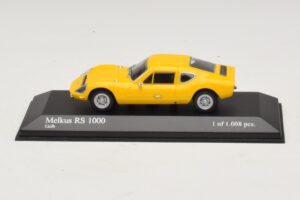
Melkus remains the only sports car marque East Germany ever produced, and its rarity behind the Iron Curtain gives every replica real historical weight. Minichamps brings the Melkus RS1000 to 1:43 diecast, letting collectors add a genuinely obscure chapter of European motorsport history to a shelf built around more familiar western marques.
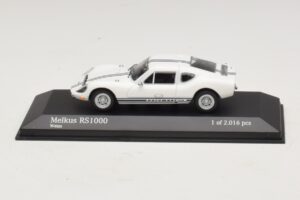
TL;DR: Melkus scale model cars document East Germany's only sports car marque, built around the Dresden-produced RS1000. In 1:43 diecast, Minichamps reproduces this rare DDR-era machine, giving collectors access to a genuinely scarce chapter of European motorsport history at an accessible, mid-tier price point rather than specialist resin pricing.
Few marques carry the historical curiosity of Melkus, the sole sports car manufacturer to operate behind the Iron Curtain in East Germany. Built in Dresden on mechanicals borrowed from the Trabant and Wartburg, the Melkus RS1000 turned ordinary DDR engineering into a genuine, mid-engined sports car, built in tiny numbers for a state that officially discouraged private motoring ambition. Minichamps brings that rarity to 1:43 diecast, making an obscure chapter of European automotive history genuinely collectible.
Most brand-focused diecast categories offer a spectrum of manufacturers competing to reproduce the same subject at different tiers, from mass-market castings through to investment-grade resin. Melkus inverts that pattern. Because the marque built so few cars across such a short production run, there was never a wide commercial incentive for multiple manufacturers to chase the licence, so the scale model landscape for Melkus is narrow by nature rather than by collecting fashion.
That narrowness is not a weakness in this case. Minichamps, a manufacturer respected for tight panel tolerances and accurate livery work across its wider motorsport and road-car catalogue, gives the RS1000 a level of diecast fidelity that matches the seriousness of the subject. In 1:43, the format favours breadth over close inspection, which suits a marque collectors are more likely to encounter one piece at a time rather than build a themed shelf around. Judging a Melkus release the way any unfamiliar manufacturer's output should be judged, by panel fit, paint depth, and finish quality rather than by catalogue size, remains the sound approach here.
Heinz Melkus built his sports car in Dresden using the engine and running gear available within the DDR's planned economy, drawing on Trabant and Wartburg componentry rather than bespoke performance engineering. The result was a lightweight, mid-engined machine with a fibreglass body, modest by Western sports car standards of the 1970s, but remarkable for having existed at all within a state that treated private car ownership as a low priority and motorsport ambition as a tolerated curiosity rather than a national project.
That context gives the RS1000 a different kind of significance than a Western sports car from the same decade. It is not a story about outright performance or racing silverware, but about engineering resourcefulness under genuine material constraint, a theme that resonates with collectors drawn to Eastern Bloc automotive history more broadly. For British collectors used to the abundance of western 1970s sports car choice, a Melkus replica offers a useful contrast: a reminder of how differently the same decade played out on the other side of the Iron Curtain.
A single-model marque like Melkus rarely anchors a themed collection on its own, so most collectors place it within a broader context rather than building a dedicated shelf around it.
At 1:43, the RS1000 sits comfortably within either strategy, since the scale's compact footprint lets a collector mix eras and regions on a single shelf without the space demands a larger format would impose. For a collector already running a comprehensive 1:43 motorsport or marque-lineage display, a Melkus release adds genuine rarity value rather than filling a gap that other manufacturers could easily cover. It rewards the kind of collector who values historical curiosity as much as catalogue completeness.
Melkus built a tiny number of cars across a short production run, so there was never a strong commercial case for multiple manufacturers to compete for the subject. The diecast landscape for the marque stays narrow because the real car's production was narrow too.
It was the only sports car ever produced in East Germany, built with Trabant and Wartburg mechanicals under genuine material constraints. That resourcefulness, rather than outright performance, is what gives the car its lasting appeal to collectors interested in Eastern Bloc automotive history.
Pairing it with other Eastern Bloc subjects such as Trabants or Wartburgs builds a coherent themed shelf. Alternatively, placing it within a general 1970s sports car collection lets its scarcity stand out against more familiar Western marques from the same decade.
Within this collection, yes. The compact footprint of 1:43 suits a marque more often collected as a single standout piece than as the centre of a dedicated shelf, letting it sit comfortably alongside subjects from other eras and regions.