


Last one
New arrival
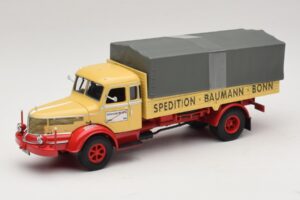
Krupp diecast trucks bring a lesser-known chapter of German commercial vehicle engineering to the collector’s shelf. Produced by Minichamps in 1:43 scale diecast, this focused range documents the heavy-duty haulage trucks that carried West Germany’s post-war reconstruction, built by a company better known for steel and armaments than for road transport. It rewards the collector who values engineering pedigree over mainstream marque recognition.
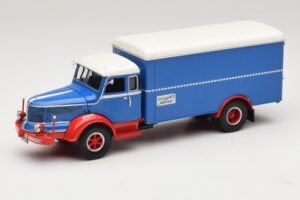
TL;DR: Krupp diecast trucks in 1:43 scale document Germany's 1950s heavy-duty commercial vehicle sector, produced by Minichamps in diecast zinc alloy. The range reflects Krupp's engineering heritage as an early adopter of diesel truck power, giving collectors a specialist niche within post-war European commercial vehicle collecting alongside contemporary Magirus-Deutz and Setra subjects.
Few names in German industrial history carry the weight of Krupp, and fewer still know the firm built heavy trucks alongside its steel and engineering works. The Krupp diecast trucks in this collection, all rendered in 1:43 scale by Minichamps, capture that overlooked corner of commercial vehicle history. For collectors assembling a 1950s West German fleet, or simply drawn to unusual industrial marques, these models fill a gap that mainstream truck ranges rarely touch.
Krupp is remembered first as a steelmaker and armaments manufacturer, the industrial engine of the Ruhr valley for generations. Less well known is that the same works built heavy trucks, applying that engineering depth to diesel power at a time when many German manufacturers still leaned on petrol engines. Krupp was among the early adopters of diesel truck propulsion in Germany, a technical choice that suited the punishing demands of construction and long-haul freight in the difficult years of post-war reconstruction.
By the 1950s, Krupp's heavy trucks were a familiar sight on West German building sites and motorways, hauling steel, timber and rubble as the country rebuilt. The brand's truck operations did not survive as an independent line for much longer, folded into a larger German truck manufacturer during the 1960s, which is part of why Krupp trucks remain such an overlooked subject today. That obscurity is exactly what makes the 1:43 scale range interesting: it documents a marque that most truck collections skip entirely, giving a themed 1950s German commercial vehicle shelf a genuinely distinctive centrepiece.
Commercial vehicle diecast asks different questions of a manufacturer than a sports car does. There is no sweeping bodywork to admire, so fidelity lives in smaller details that reward a careful eye. When assessing a Krupp model on the shelf, a few checkpoints matter most:
Minichamps has built its 1:43 scale reputation largely on motorsport and passenger car subjects, and that same attention to proportion and panel definition carries into its commercial vehicle work. A truck that gets its axle spacing or cab proportions wrong looks wrong immediately to anyone who knows the subject, which is why these small details carry so much weight in judging a model's quality.
Diecast zinc alloy is the natural material for a heavy truck at 1:43 scale, and the reasons are practical as much as visual. A truck cab and chassis are large, flat-panelled forms rather than the curved surfaces a sports car offers, and cast metal holds those flat planes and sharp edges cleanly without the warping risk a lighter material might carry over time. The weight of diecast also suits a subject built to look and feel substantial: a Krupp truck model has real heft in the hand, echoing the mass of the vehicle it represents.
Casting tolerances at this scale mean shut lines around cab doors and load bed sections read as fine, hairline gaps rather than true opening features, and that is normal for the segment rather than a shortcoming. Whether a given Krupp model has any opening parts, such as a tipping load bed or cab doors, is a detail that varies by piece and sits on the individual product listing rather than being a rule of the material or the scale. Paint sits well on the metal shell, holding flat industrial colours evenly across large panel surfaces, exactly what a 1950s haulage truck needs to look correct.
Scale choice matters more for trucks than for passenger cars, because the real vehicles are so much larger to begin with. A heavy truck at 1:18 scale, the format many collectors default to for cars, would occupy a footprint closer to a small sofa than a shelf ornament, with a single cab-and-trailer combination stretching well beyond half a metre. That size works for a single showpiece, but it makes building any kind of fleet or thematic collection impractical.
At 1:43, a Krupp truck sits at a scale most collectors already use for saloon cars and racing subjects, which means it slots onto existing shelving without demanding a separate display strategy. A row of period-correct commercial vehicles, mixed marques and body types, reads convincingly as a small haulage yard or building site scene at this size, something no larger scale could achieve without a room of its own. The detail that 1:43 sacrifices compared with 1:18 matters far less on a working truck than on a road car, since much of that finesse was never present on the real vehicle to begin with.
A Krupp truck rarely stands alone on a serious collector's shelf. Because the range documents a specific slice of German commercial history, it naturally pairs with contemporary marques from the same period and country, forming a themed display built around post-war reconstruction rather than around a single brand. Adding Magirus-Deutz haulage or fire apparatus and Setra coach subjects from the same 1950s window turns three narrow, individually thin ranges into a coherent, well-populated shelf that tells a genuine story about the era.
This kind of collecting rewards patience more than most brand-focused pursuits, since commercial vehicle subjects surface less often than passenger car reissues. Collectors who enjoy the research side of the hobby tend to find this the appeal rather than the drawback: tracking down period photographs, matching liveries to real operators, and understanding why a particular chassis configuration suited a particular job. For a new collector, starting with one or two Krupp subjects alongside a handful of contemporary German commercial vehicles is a realistic entry point rather than chasing a complete range that may not exist.
Commercial vehicle models bring a different set of display considerations than passenger cars. Their flat panels and large glazed areas show dust more readily than a curved sports car body, so a glass-fronted cabinet earns its keep here more than almost anywhere else in the hobby. Open shelving works, but it demands more frequent attention with a soft brush or blower to keep flat cab roofs and windscreens free of the fine dust that settles fastest on horizontal surfaces.
Mirrors, exhaust stacks and roof-mounted details are often separately fitted on truck models and can be more fragile than the cast body itself, so handling by the chassis or base rather than the cab avoids the risk of snapping a wing mirror or aerial. Keeping the original packaging matters here as much as with any diecast subject, since a niche marque like Krupp tends to hold interest with a small, dedicated group of collectors who value completeness. Direct sunlight remains the enemy of any painted finish, fading flat industrial colours just as readily as gloss road car paint, so positioning a commercial vehicle display away from a window protects the collection over years rather than months.
The Krupp trucks in this collection are produced in 1:43 scale, the standard format for commercial vehicle diecast. That scale keeps a heavy truck to a practical shelf footprint while matching the size most collectors already use for saloon cars and racing subjects, making it easy to build a mixed period display.
Krupp trucks in this range are diecast zinc alloy rather than resin. The metal construction suits the flat, large-panelled forms of a heavy truck cab and chassis, holding sharp edges cleanly and giving the model real weight in the hand that echoes the mass of the original vehicle.
The range focuses on the 1950s, the decade when Krupp's heavy trucks were a common sight on West German building sites and motorways during post-war reconstruction. That narrow era focus makes the models a natural fit for a themed 1950s German commercial vehicle display.
Yes. Krupp sits naturally alongside contemporary German commercial subjects such as Magirus-Deutz and Setra from the same decade, since all three document different corners of 1950s West German transport. Combining them builds a fuller, more coherent themed shelf than any single marque could achieve alone.