


Last one
New arrival
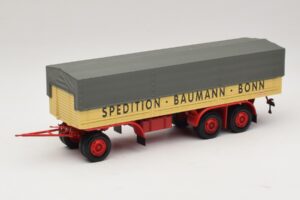
Kässbohrer diecast models reproduce the semi-trailer trucks the German manufacturer built through the 1960s, cast in 1:43 by Minichamps. Best known elsewhere for pioneering self-supporting bus construction under the Setra name, Kässbohrer’s haulage division supplied the trailers documented here, giving commercial vehicle collectors a route into post-war German road freight.
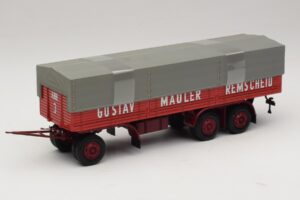
TL;DR: Kässbohrer diecast models reproduce the semi-trailer trucks the German manufacturer built through the 1960s, cast in 1:43 by Minichamps. Best known in the wider hobby for pioneering self-supporting bus construction under the Setra name, Kässbohrer's haulage division supplied the trailers that kept post-war German road freight moving.
Kässbohrer built its reputation twice over: once through Setra, the self-supporting bus construction that changed how coaches were engineered, and again through the semi-trailers that carried freight across West Germany's expanding road network. This category concentrates on the second story, reproducing 1960s semi-trailer trucks in 1:43 diecast through Minichamps. For collectors of commercial vehicle history, it offers a route into road haulage apart from Kässbohrer's better-known bus heritage.
Kässbohrer's name carries more weight in bus history than in truck history, thanks to Setra, the self-supporting coach construction the company pioneered that did away with a separate chassis frame beneath the body. That engineering reputation extended into the company's other divisions, including the semi-trailers reproduced in this category, which served the haulage firms moving freight across West Germany during the 1960s road transport boom. Unlike a bus, which carries passengers and invites a different kind of collecting interest built around routes and liveries, a semi-trailer is a working tool, and the diecast versions of it appeal to a collector interested in the mechanics of freight movement rather than passenger transport. A Kässbohrer trailer collection reads as a companion to broader commercial vehicle collecting rather than an extension of Setra bus collecting, even though both trace back to the same manufacturer.
Minichamps brings its standard 1:43 diecast approach to the Kässbohrer range, and the checks worth running are similar to those for any commercial vehicle casting:
Because semi-trailer combinations involve two separate castings, fit and alignment between the two when coupled is worth checking as its own quality signal, since poor coupling geometry undermines the display even when each individual casting is well made. Pricing for articulated combinations tends to sit above single-vehicle diecast, reflecting the additional tooling and materials involved in producing both halves of the set. That combined cost is a fair reflection of what a genuine two-piece haulage set actually requires to produce well.
Diecast suits a working commercial vehicle better than resin does, and the reasoning is practical rather than aesthetic. A semi-trailer combination is a larger, heavier object on the shelf than a passenger car, and the durability diecast construction provides matters more here, particularly around the coupling mechanism, which sees repeated handling if a collector regularly separates and rejoins the two halves. The weight of a diecast trailer also gives it a stable footing on a shelf, useful given how much of its length can overhang if not properly supported. Paint sits well on the large flat panels a trailer body presents, and print detail for haulage company liveries reproduces cleanly on diecast, adding character to what would otherwise be a plain rectangular shape. Panel lines and edges are a touch softer than a resin equivalent would achieve, though for a working vehicle subject, that softness is rarely a meaningful drawback.
A coupled tractor-trailer combination at 1:43 still occupies considerably more shelf length than a single passenger car or even a rigid truck at the same scale, worth planning for before building out a haulage collection. 1:43 remains the practical scale for this subject regardless, since larger scales would push an articulated combination well beyond what most display cabinets can accommodate. The scale also matches what most collectors already use for passenger car and rigid truck diecast, keeping a broader commercial vehicle collection visually consistent even as vehicle types and lengths vary considerably within it. Detail resolution at 1:43 is sufficient to render coupling mechanisms, landing legs and mudflaps clearly. Collectors accustomed to passenger car diecast should expect to dedicate proportionally more shelf space per unit here than elsewhere in their collection.
Plan shelf depth around the longest coupled combination in the collection rather than an average length, since a single articulated trailer set can occupy the space of two or three passenger car models side by side. Decoupling the tractor from the trailer for storage or transport is possible with most combinations, offering some flexibility if shelf space is tight, though many collectors prefer displaying them permanently joined for visual impact. Keep the collection out of direct sunlight to protect painted trailer sides and printed livery graphics, and dust the large flat panels regularly, since they show accumulated dust more visibly than a curved car body would. Grouping several haulage combinations together, rather than scattering them among unrelated passenger car diecast, gives a shelf a coherent freight-industry theme.
A Kässbohrer trailer collection works well as one strand within a broader post-war German road transport project, sitting alongside other haulage marques and, for those interested in the fuller manufacturer story, Setra buses from the same company's coach division. Starting with a single combination rather than several at once helps establish how much shelf space a realistic collection will require. Because Minichamps supplies the assortment behind this category, quality is consistent across pieces, simplifying comparison against mixed-manufacturer commercial vehicle ranges where fidelity varies release to release. For anyone building a fleet-style display, mixing rigid trucks with articulated combinations from the same era gives the collection the visual variety a real period haulage yard would have shown.
Kässbohrer pioneered self-supporting coach construction under the Setra name, a genuine engineering milestone that shaped how buses were built afterwards. The semi-trailer trucks in this category come from the same manufacturer's haulage division, a less publicised but equally real part of its output.
More than a single passenger car or rigid truck at the same scale, since a tractor and trailer coupled together can run to a substantial combined length. Plan cabinet depth around the longest set in the collection rather than an average.
Most combinations can be decoupled for storage or transport, though many collectors prefer displaying them joined for the full visual effect of an articulated set. Decoupling offers flexibility where shelf space is limited.
Look at how the coupling and landing legs are detailed, check paint consistency across the trailer's large flat panels, and confirm the tractor and trailer align cleanly when joined. These are the signals that separate a considered casting from a basic one.