Last one
Used
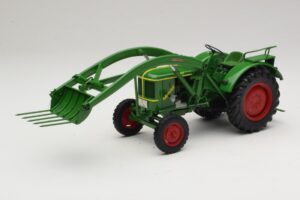
Deutz built its reputation on engines and agricultural machinery rather than passenger cars, which places this collection firmly outside the usual scale model conversation. Minichamps renders the marque’s 1950s engineering in 1:18 diecast, filed under Special and Unique Models rather than any conventional body-type category. For collectors whose shelves already run heavy on saloons and sports cars, a Deutz offers a genuinely different subject to consider.
TL;DR: Deutz scale models in this collection means Minichamps' 1:18 diecast interpretation of the marque's 1950s machinery, filed under Special and Unique Models rather than the usual saloon or sports car categories. Diecast construction gives the subject genuine weight and durability, suited to reproducing industrial engineering rather than road-car glamour.
Deutz's name belongs to Germany's industrial and agricultural engineering story rather than to its road-car history, and that distinction shapes everything about this collection. Minichamps' 1:18 diecast interpretation of the marque's 1950s machinery sits under Special and Unique Models, a category built for subjects that refuse to fit the saloon, coupe, or sports car mould. For a collector seeking something outside the expected, Deutz scale models reward a closer look.
Deutz occupies a corner of scale model collecting that has almost nothing to do with the usual criteria of racing pedigree or road-going glamour. The marque built its name on engines and agricultural machinery, and that industrial identity carries directly into how it is collected: there is no motorsport chronology to chase, no flagship road car to anchor a display, just a single considered subject filed under Special and Unique Models because nothing else fits. In this collection, the landscape is deliberately narrow. Minichamps supplies the diecast, Deutz supplies the subject, and 1950s German engineering supplies the era. There is no tier ladder running from entry-level to investment-grade here, because there is only one manufacturer's interpretation to consider. That narrowness is not a shortcoming so much as an honest description of where this subject sits: a focused, specialist addition rather than a sprawling category with competing options. For a collector building a display around unusual engineering stories rather than familiar marque hierarchies, that focus is precisely the point.
Minichamps built its reputation on precision diecast across a genuinely wide vehicle range, from motorsport subjects to road cars and beyond, and that breadth of experience matters when the subject in question is not a car in the conventional sense. Reproducing agricultural or industrial machinery in scale asks for a different set of judgments than reproducing a saloon: proportions read differently when a vehicle is built around function rather than aerodynamics or style, and the mechanical detail that defines the real machine, exposed linkages, functional guards, working-vehicle textures, needs a manufacturer willing to treat those details as seriously as any road car's chrome trim. Diecast construction suits this brief well. The zinc-alloy body carries genuine weight, which reads as substance rather than delicacy on a subject whose real-world counterpart was built for hard use rather than showroom display. The finish is durable rather than precious, matching the character of the original machine more closely than a fragile hand-built resin piece might, even though resin would resolve certain fine details with more precision than diecast tolerances typically allow.
Deutz's engineering roots reach back to the nineteenth century, tied to some of the earliest commercially viable internal combustion engines to come out of German industry, and that long history gives the marque a credibility in industrial circles that has little to do with consumer car culture. By the 1950s, Deutz machinery was doing quiet but essential work across West Germany's post-war agricultural and industrial recovery, at a time when mechanisation was transforming farms and factories at a pace the previous generation had never seen. That context matters for how the subject reads in miniature: this is not a nostalgia piece built around a beloved road car, but a document of the practical engineering that underpinned a period of genuine economic transformation. Collectors drawn to industrial and agricultural history rather than motorsport glamour find something substantial here, a scale model that stands in for an entire chapter of how a country rebuilt its productive capacity through unglamorous, dependable machinery.
At 1:18, a road car typically runs somewhere around 25 centimetres, but a Special and Unique Models subject like this one does not necessarily follow that template, since agricultural and industrial machinery carries proportions that owe nothing to automotive styling conventions. Height, width, and working details such as exposed mechanisms or functional attachments can shift the model's footprint and visual weight in ways a saloon or sports car never would. That difference is part of the appeal rather than a complication: a display built entirely from road cars settles into a predictable rhythm, and a piece with genuinely different proportions breaks that rhythm in an interesting way. Shelf planning benefits from treating this subject as its own category rather than assuming it will slot in neatly beside conventional 1:18 cars. Checking the listed dimensions before planning shelf space is worth doing here more than with most road-car subjects, precisely because the usual scale assumptions do not carry over cleanly.
Diecast and resin are not a hierarchy of quality, and that principle holds as firmly for an industrial subject as it does for any road car, but the two materials suit different kinds of subjects for different reasons.
The metal body tolerates handling well, which matters for a subject some collectors will want to pick up and examine rather than leave sealed behind glass. That is a reasonable compromise for this subject: functional detail and structural presence matter more than showroom-grade paint depth. Whether any specific moving parts feature on this model is a detail worth checking on the listing directly rather than assuming from the material or the subject type.
A single Deutz does not build a themed shelf by itself, but it works well as a deliberate anchor for a broader collecting interest in industrial and agricultural history, one that few scale model displays make room for. Some collectors pair it with other unconventional subjects, commercial vehicles, construction machinery, historic engines, building a corner of the display dedicated to engineering stories that sit outside the usual marque hierarchies entirely. Others use it more sparingly, as a single considered piece that breaks up a shelf otherwise dominated by saloons and sports cars, inviting the kind of question a conventional model rarely prompts. Given that this collection currently holds one manufacturer's take on one marque in one scale and material, there is no range to complete or tier to climb, which changes the collecting calculation entirely. This is not a subject to chase across editions; it is a single, deliberate addition to a wider display, valuable precisely because it says something a hundred more predictable models could not.
This model sits under the Special and Unique Models category rather than a standard body type, reflecting Deutz's identity as an engineering and machinery marque from the 1950s. Checking the specific listing gives the most accurate picture of the subject's exact form.
Diecast's zinc-alloy construction brings genuine weight and durability that suits a machine built for function rather than display, and the metal body tolerates handling better than a more delicate resin casting would across years on a shelf.
A single Deutz works best as a deliberate anchor for an interest in industrial and agricultural history, paired with other unconventional subjects or set apart from the usual saloons and sports cars to introduce genuine variety into a display.
Not always in the same proportions. Agricultural and industrial machinery follows functional dimensions rather than automotive styling, so shelf footprint and visual weight can differ from a conventional 1:18 car, which is worth checking before planning display space.