
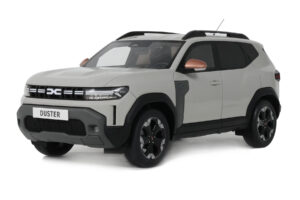
TL;DR: Dacia scale models in this collection means Otto's hand-built 1:18 resin, focused on the marque's 2020s compact sport SUV line. Resin construction gives crisp panel lines and factory-correct paint on a marque diecast manufacturers largely overlook, making this corner of collecting a considered, deliberate choice rather than an obvious one.
Dacia rarely features in scale model conversations dominated by racing pedigree and prestige badges, yet that absence is exactly what makes this corner of collecting worth exploring. Otto's resin interpretation of the marque's current compact sport SUV design captures a genuinely honest engineering story in 1:18, one built on value and practicality rather than motorsport glamour. For a collector drawn to distinctive choices, Dacia scale models offer a considered alternative to the usual roster.
Dacia Scale Models and the Case for an Overlooked Marque
Dacia has spent decades building a reputation for stripped-back practicality rather than showroom drama, which is exactly why it rarely appears on a typical collector's shortlist. That absence is the opportunity. A marque built on honest engineering and value pricing tells a different story than the usual roster of supercars and racing legends, and scale model collecting has room for that story. In this collection, the landscape is deliberately narrow: Otto supplies the resin, Dacia supplies the subject, and the compact sport SUV class supplies the silhouette. There is no tier ladder to climb here, no entry-level diecast competing against a hand-built rival. What exists instead is a single, considered interpretation of a marque most manufacturers never bother to reproduce. That narrowness is worth stating plainly: this is a focused corner of the catalogue, not a sprawling one, and it rewards a collector who values distinctiveness over breadth. Placing a Dacia alongside the usual parade of prestige marques on a shelf makes a quiet statement about what collecting can be when it steps outside the expected hierarchy.
Otto's Resin Approach to an Unlikely Subject
Resin is the natural choice for a marque that diecast manufacturers have largely ignored. Tooling a full diecast production run demands volume to justify the investment, and a value-focused marque without racing pedigree rarely generates that volume among mainstream producers. Hand-built resin sidesteps the problem entirely. Small-batch casting needs no die investment, so a manufacturer can commit to a niche subject without betting on mass sales, which explains why resin specialists so often carry the cars diecast catalogues skip. The construction rewards close inspection: resin holds tighter panel gaps and sharper body-line edges than a cast metal equivalent, and the factory-correct paint sits with real depth under display lighting. What resin sacrifices is the reassuring heft of a diecast body in the hand, and that trade-off matters to some collectors more than others. For a Dacia specifically, that precision suits the brief. The compact SUV's simple, functional surfacing has few complex curves to disguise a soft casting, so a crisp resin body reads the design honestly, without the visual noise a rougher casting method would introduce.
The Compact Sport SUV Story Behind the Subject
Dacia's recent design direction has moved away from the purely utilitarian toward something with genuine visual ambition, and the compact sport SUV class is where that shift shows most clearly. The Duster nameplate, Dacia's long-running and best-known SUV, has carried this evolution through successive generations, trading a basic, boxy stance for sharper surfacing and a more confident silhouette without abandoning the practicality the marque built its reputation on. That balance between accessible pricing and deliberate design is unusual, and it is precisely what makes a 2020s Dacia worth reproducing in scale. The era matters too: this is a genuinely current design language, not a heritage reissue or a nostalgia play, which places the subject alongside contemporary compact SUVs from far more expensive marques on equal visual terms. A collector building a shelf around affordable engineering, or around the compact SUV segment generally, gains a reference point that costs nothing in credibility despite costing considerably less than the marque's rivals to buy new.
1:18 Scale and What It Means for This Subject
At 1:18, a compact SUV runs somewhere around 24 to 26 centimetres in length, slightly more compact than a saloon or coupe at the same scale but still substantial enough on a shelf to hold its own beside larger subjects. The scale suits the Dacia particularly well: a compact SUV's higher stance and boxier proportions read clearly at this size, and the surfacing detail that defines the current design language, the crease lines along the flank, the sculpted wheel arches, has room to register properly. Smaller scales would compress those details past the point of legibility, while a larger scale would demand more shelf depth than the subject's understated character really justifies. 1:18 also keeps the model in step with the wider collection: most serious collecting displays are built around this scale, so a Dacia sits comfortably alongside marques with far longer racing pedigrees without looking out of place in size or presentation.
Resin Versus Diecast: What the Material Choice Signals
Resin and diecast are not a quality hierarchy, whatever their relative price tags might suggest, and that principle applies as much to a Dacia as it does to any flagship marque. For a subject with restrained, functional bodywork, resin's precision does more useful work than diecast's mass would.
- Resin: tighter panel gaps, sharper edges, lighter in the hand, more fragile.
- Diecast: greater heft, more forgiving of handling, slightly wider tolerances.
- Neither material signals higher quality on its own; the subject decides which suits best.
Whether any given model's doors or bonnet open is a detail specific to each release, never something the material itself decides, and it is worth checking the product listing directly rather than assuming either way. What matters more for this subject is that resin lets a manufacturer commit to a niche marque without the tooling risk diecast production would demand, which is exactly the economics that make a Dacia model possible at all.
Building a Collection Around Distinctive Choices
A single Dacia does not anchor a themed shelf on its own, but it works well as a deliberate counterpoint within a broader collection built around a specific idea rather than a specific badge. Some collectors organise displays around value engineering and honest design across marques that rarely receive scale model attention, pairing a Dacia with similarly overlooked subjects from other budget-focused manufacturers. Others use it as a single conversation piece among a shelf of more conventional prestige marques, a deliberate contrast that invites the obvious question of why it is there. Either approach treats the model as a statement rather than filler, which suits a subject this narrow in scope. Given the collection currently holds one manufacturer's interpretation of one marque in one scale and material, there is no ladder of alternative editions to chase or complete. That is a genuinely different kind of collecting decision: not building toward completeness within a range, but adding a single considered piece to a wider, more varied display.
Frequently Asked Questions
Why is Dacia worth collecting as a scale model?
Dacia offers something rare in scale model collecting: an honest, value-focused marque built on practical engineering rather than badge prestige. For collectors who value distinctive choices over obvious ones, a Dacia model provides a genuine talking point that few other marques in this hobby can match.
Why resin rather than diecast for this subject?
Resin lets a manufacturer commit to a niche marque without the tooling investment diecast production demands, which is exactly why a value-focused subject like Dacia appears here rather than in a mainstream diecast catalogue. It also holds tighter panel lines and sharper edges than casting in metal typically allows.
What does 1:18 scale offer for a compact SUV subject?
At 1:18 a compact SUV's higher stance and boxier surfacing read clearly, and the scale keeps proportions consistent with the wider collecting display, where most serious shelves are already built around 1:18 as the standard size, letting a Dacia sit comfortably beside marques with far longer motorsport pedigrees.
How does a single-marque, single-manufacturer collection fit into a wider display?
Rather than building toward completeness within one range, a Dacia works best as a considered counterpoint inside a broader, more eclectic collection, paired with other overlooked marques or set deliberately against prestige badges to invite comparison and conversation.