Last one

This model is currently sold out. Enter your email and we'll let you know when it's back in stock.
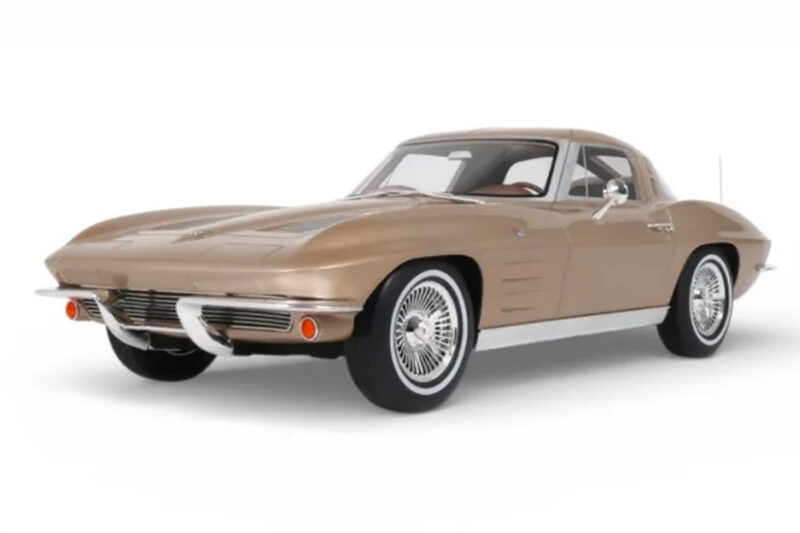
TL;DR: GT Spirit's 1:12 resin Chevrolet Corvette Sting Ray reproduces the 1963 coupe in Saddle Tan, the only year to carry the split rear window before Chevrolet removed it. Built as a sealed, one-piece resin body with no opening panels, the larger 1:12 scale gives the fastback roofline real shelf presence at roughly 37 centimetres long.
Chevrolet's design team, led by Bill Mitchell and drawing heavily on Larry Shinoda's Mako Shark concept, gave the 1963 Corvette an entirely new fastback silhouette split down the centre by a rear window bar. That one detail lasted a single model year before complaints about rear visibility forced Chevrolet to remove it, making the 1963 split-window the most sought-after Sting Ray among collectors of the C2 generation.
The second-generation Corvette arrived for 1963 with a completely reworked body, dropping the softer curves of the earlier C1 in favour of a sharper, more aggressive fastback shape that borrowed heavily from the Mako Shark show car. Bill Mitchell's studio, with Larry Shinoda handling the detailed styling, gave the new coupe a distinctive rear window split by a vertical bar running down the centre of the backlight, a design touch that looked striking from every angle but drew immediate complaints from owners about restricted rear visibility.
Zora Arkus-Duntov, the engineer most associated with the Corvette's performance reputation, reportedly pushed for the split to be removed almost as soon as the car reached production, and Chevrolet obliged for the 1964 model year, replacing the divided glass with a single unbroken rear window. That change means the split-window treatment exists on exactly one model year of Corvette, and it is precisely why the 1963 coupe commands more attention among C2 collectors than any other year in the generation. GT Spirit's resin casting reproduces that split accurately, the two panes and central bar rendered with the same proportion as the original glasswork.
At 1:12, the Corvette comes out to roughly 37 centimetres in length, nearly double the footprint of a comparable 1:18 model and closer to the commanding presence a museum-scale piece delivers. That larger canvas matters on a car whose defining feature is its roofline: the Sting Ray's fastback profile relies on a long, unbroken curve running from the windscreen to the tail, and the extra size at 1:12 lets that curve read with genuine drama rather than compressing it into a smaller, less legible shape.
GT Spirit builds the body as a sealed, one-piece resin casting, which suits the fastback roof particularly well, since there is no hinge or opening seam to interrupt the sweep of the glass and the surrounding bodywork. Saddle Tan sits as a warm, period-appropriate colour choice against that shape, avoiding the brighter reds and blues that dominate most Corvette reproductions and giving this casting a more understated, classic American presence on a shelf.
Reproducing the 1963 split-window accurately means getting the proportions of that divided rear glass exactly right, since even a slightly wrong bar width or window angle undermines the detail that makes this specific model year worth collecting over any other Sting Ray. GT Spirit works primarily in resin, a material that favours exactly this kind of compound-curve accuracy over the wider tolerances a die-cast body would need to accommodate opening doors and a lifting bonnet. Because this casting is sealed with no moving panels, the entire body benefits: shut lines around the door openings read as continuous, moulded lines rather than functional gaps, and the roofline stays uninterrupted from the windscreen header to the rear deck. Set beside more common diecast Corvette reproductions at 1:18, this 1:12 resin piece occupies a different collecting tier.
A 1963 split-window Corvette earns its place as a centrepiece rather than a supporting piece in an American classic sports car collection, and the 1:12 scale reinforces that role by giving it genuine physical presence next to smaller companions. Saddle Tan works particularly well as a shelf colour, warm enough to stand out without competing for attention against brighter European sports cars from the same decade. The sealed resin body asks nothing beyond stable, dust-free storage, trading interior access for a fastback roofline that holds its shape indefinitely without a hinge gap in sight. For a collector chasing a specific, historically limited detail, this is the model year that carries the story.