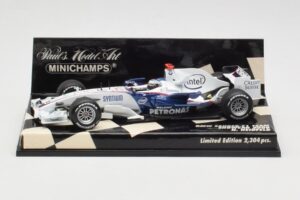
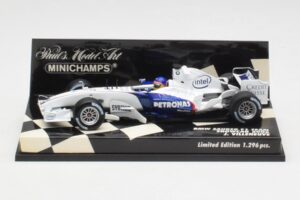
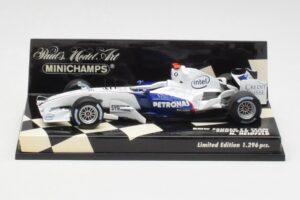
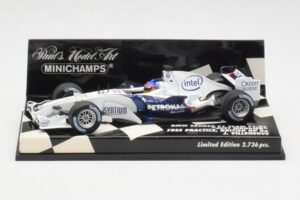
Last one
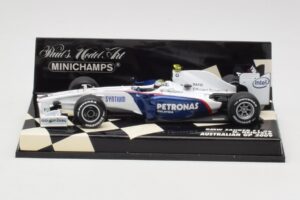
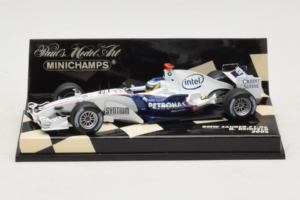
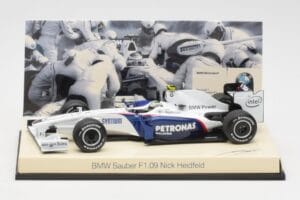
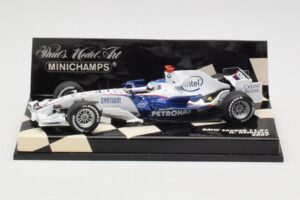
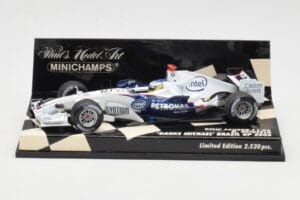
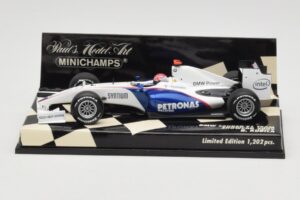
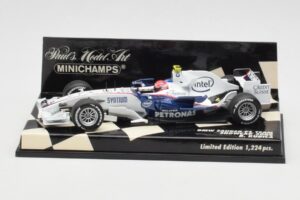
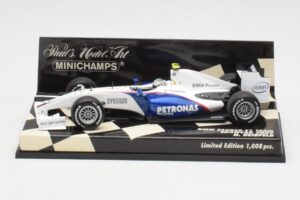
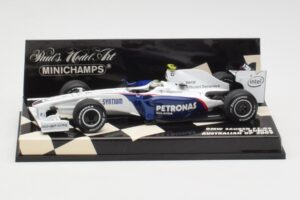
This category gathers Minichamps’ 1:43 diecast tributes to the BMW Sauber Formula 1 Team, the factory outfit that raced from 2006 to 2009 and delivered Robert Kubica’s win at the Canadian Grand Prix. A focused, single-manufacturer range for motorsport specialists building a 2000s Formula 1 shelf.
TL;DR: BMW Sauber's Formula 1 models here come as Minichamps 1:43 diecast, capturing the team's brief factory era from 2006 to 2009, including Robert Kubica's Canadian Grand Prix win. A single manufacturer, single scale collection, narrow but genuinely documented, suited to focused motorsport displays rather than broad brand chronologies.
Four seasons, one factory-backed effort, and a single grand prix win define the BMW Sauber era, and Minichamps' 1:43 diecast is the only manufacturer represented in this collection covering it. That narrowness of scope is itself part of the appeal for collectors chasing a complete, well-documented slice of 2000s Formula 1.
BMW's factory-backed grand prix project began in 2006, when BMW took full ownership of the Sauber team and rebranded the Hinwil-based outfit as BMW Sauber F1 Team. Nick Heidfeld and Robert Kubica formed the core driver line-up through most of the era, delivering regular podium finishes, and in 2008 Kubica gave the team its only grand prix victory at the Canadian Grand Prix in Montreal. BMW withdrew from Formula 1 at the end of the 2009 season, and the team reverted to Sauber ownership soon after. Four seasons is short by constructor standards, which is exactly why the 1:43 range built around it reads as a self-contained chapter rather than an open-ended brand story: every livery and every season sits within a defined, collectable window rather than an ongoing catalogue still being written.
Minichamps built its reputation on systematic 1:43 motorsport coverage, documenting Formula 1 grids season by season rather than cherry-picking standout cars, which is why a narrow team era like BMW Sauber's still receives thorough treatment rather than a token release or two. The diecast construction sits at a mid-to-premium tier: metal bodywork, accurately applied sponsor livery, and driver-specific detailing finished to a standard that rewards close inspection without the hand-built pricing of resin specialists. At roughly 10cm in length, a 1:43 BMW Sauber car takes up modest shelf space, so an entire four-season team history fits comfortably along a single Vitrine shelf. Judge any 1:43 F1 diecast on the same points regardless of manufacturer:
These are the areas where budget diecast tends to soften first, and where the mid-to-premium tier earns its position.
BMW Sauber sits naturally alongside broader Formula 1 collecting themes: a 2000s grid shelf covering the era's full field, a BMW brand chronology bridging touring cars and grand prix racing, or a Robert Kubica driver collection that continues into his later career. Because the assortment here is narrow by design, it works best as a defined block within a larger display rather than a display on its own, four seasons and one livery family, one manufacturer's interpretation of it. Collectors documenting the wider 2000s F1 era should treat BMW Sauber as one team among several worth covering in parallel, keeping to a consistent 1:43 scale across teams so proportions and shelf depth stay uniform. That consistency matters more here than in broader brand categories, since the entire BMW Sauber range in this collection sits in a single scale and material.
The appeal of a BMW Sauber collection lies in its containment: a clear start, a defining win, and a clear end, all captured in one manufacturer's consistent interpretation. That makes it a satisfying secondary project alongside a wider Formula 1 collection rather than a demanding one requiring cross-manufacturer comparison or scale decisions. For collectors newer to motorsport diecast, this is as approachable an entry point into 1:43 Formula 1 collecting as any team era offers.