Last one
Used
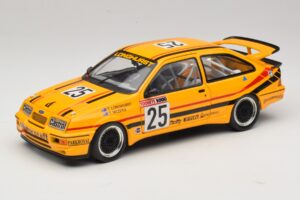
Ford Sierra RS500 #25 T. Longhurst / T. Mezera Bathurst 1000 Winner 1988 Replacement Box Biante 1:18
Only 1 left
Price:
£165.83
Biante built its reputation documenting Australian touring car racing at 1:18 scale, with Ford Falcon liveries from the 1970s and 1980s forming the heart of its catalogue. This collection gathers that era’s livery diversity, from works teams to privateer entries, giving collectors a focused window into a specific motorsport chapter.
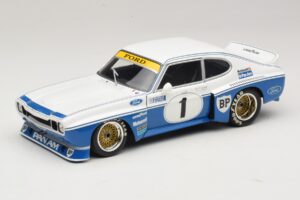

TL;DR: Biante diecast models document Australian touring car racing in 1:18 scale, centred on Ford Falcon liveries from the 1970s and 1980s. Diecast construction gives weight and durability to recreations of Bathurst-era racers, making this collection a focused source for touring car livery variety rather than road-car breadth.
Australian touring car racing of the 1970s and 1980s produced some of the most aggressive liveries in motorsport, and Biante has built a dedicated following for reproducing that era at 1:18 scale. Rather than chasing breadth across every marque, the manufacturer concentrates on Ford's Falcon-based racers, letting collectors follow a single competitive lineage through multiple seasons, teams, and sponsor schemes.
Biante occupies a specific niche within the broader 1:18 diecast landscape: rather than spreading across road cars, supercars, and multiple marques the way volume manufacturers do, it concentrates almost entirely on Australian touring car racing. That focus shows in the construction. Zinc-alloy diecast bodies carry real weight in the hand, panel gaps hold tight tolerances around bonnets and boot lids that needed to look race-correct, and the livery printing carries the sharp sponsor logos and number-board detail that separate a documented racing reproduction from a generic road-car finish.
Against the wider manufacturer landscape, Biante sits above mass-market, general-purpose diecast and below the fully hand-built resin specialists, because tooled diecast at this level of livery accuracy demands more careful production than an off-the-shelf road car casting. Collectors who already run a themed touring car shelf tend to treat Biante as a reference point: a manufacturer whose Ford Falcon output can be judged release by release for printing crispness and panel fit, rather than assumed uniform across its wider range.
The Ford Falcon's competition career across these two decades produced some of Australian motorsport's most recognisable liveries, from factory-backed entries to independent teams running their own sponsor schemes. Bathurst, the country's best-known endurance race, sits at the centre of that story, and the cars that competed there carry a reputation that extends well beyond Australian borders into the wider touring car collecting community.
British collectors with an existing interest in touring car racing, whether through the BTCC or European Group A and Group C era, often find the Falcon's story a natural extension of that same period. The regulations shared similar philosophies internationally during this period: production-based bodies heavily reinforced for competition, bold sponsor liveries, and intense rivalries between manufacturer-backed teams. A Biante Falcon from this period captures a chapter that ran in parallel with, rather than apart from, the touring car racing British collectors already know, giving the subject a familiar competitive texture even without local exposure to the series itself.
A manufacturer that concentrates on one competitive lineage invites a different collecting approach than a broad road-car range does. Rather than chasing variety across marques, a Biante-focused shelf rewards depth, following one chassis generation through several seasons or tracking how sponsor liveries shifted from year to year.
Scale consistency matters here more than in a mixed-brand collection, since 1:18 is the format Biante works in and the size at which its livery printing and panel detail read most clearly. Grouping these pieces together by team colour or by season on a single shelf plane creates a visual narrative that a single isolated model cannot deliver on its own. Collectors building toward Bathurst specifically often pair Biante's Falcon releases with the Holden entries that provided the era's defining rivalry, even where those pieces come from a different manufacturer, since the racing story only makes sense with both sides represented.
Biante concentrates almost entirely on Australian touring car racing rather than spreading across road cars and multiple marques. That focus shows in sharper livery printing, tighter panel fit around race-correct bodywork, and a level of sponsor-logo detail general-purpose diecast rarely matches.
The Falcon's long competitive history in Australian touring car racing, particularly at Bathurst, gives it a deep well of distinct liveries across multiple seasons. Biante's catalogue reflects that racing legacy rather than attempting to cover other marques or genres in equal depth.
Yes, grouping by era or series works well. A Biante Falcon from the 1970s or 1980s sits comfortably alongside BTCC or European Group A models from a similar period, since the production-based racing philosophy of that era was broadly shared internationally.
Within this collection, yes, 1:18 is the scale represented. That format suits the detailed livery printing and panel work Biante is known for, giving the sponsor graphics and race-correct bodywork room to read clearly on a shelf.