Used
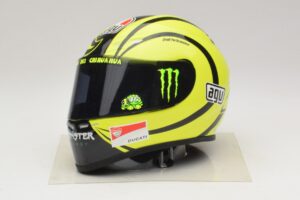
AGV Helmet V. Rossi MotoGP Valencia Test 2009 Minichamps 1:2
Price:
£150.00
AGV is the brand on every piece in this collection, reproduced by Minichamps in 1:2 diecast and drawn from MotoGP and motorcycle racing in the 2000s. The half-size format gives paint, graphics and trim room to show. It makes a focused brand shelf, built around one manufacturer and one scale.
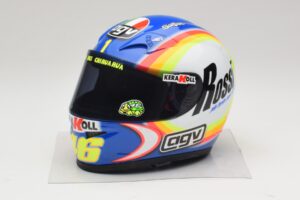
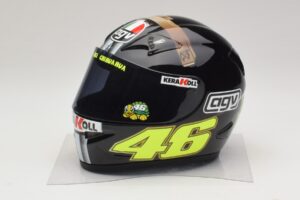
TL;DR: AGV helmet replicas in this collection are Minichamps diecast pieces at 1:2 scale, half the size of the real helmet, reproducing race designs from MotoGP and motorcycle racing in the 2000s. One brand, one manufacturer and one scale make comparison simple; judge each piece on paint, graphics, visor and trim finish.
A brand collection usually means choosing between manufacturers. This one removes that decision: every AGV helmet replica here is a Minichamps piece in 1:2 diecast, so the interest lies in the designs and in how well each is executed. AGV is a name collectors link with motorcycle racing, which makes the half-size replicas natural companions to bike models on a motorsport shelf.
In this collection the brand is the helmet, not the vehicle. That is an unusual angle in a model car catalogue, where a marque page normally means a manufacturer's cars. Here AGV is the name on every shell, and the models reproduce racing helmets in 1:2 diecast, produced by Minichamps.
Half size puts a real helmet of about 30 centimetres at around 15 centimetres, which is large enough for logo placement, visor surround and trim to read clearly without a magnifier. Collectors who follow motorcycle racing often know riders by their helmets before their faces, so a replica of a race design carries recognition quickly.
The assortment centres on MotoGP and motorcycle racing, with the 2000s as its era. It would be wrong to read that as a full account of everything AGV or Minichamps has produced; it describes what this collection holds, and the product card for each piece gives the specific design and details. What the focus does give a buyer is consistency: one brand, one scale and one manufacturer, so each piece can be judged against the last.
With a single manufacturer there is no tier map to draw, so quality is read piece by piece. Six signals do most of the work:
Minichamps will be familiar to many collectors from other scales, so it is natural to carry expectations across. Test them instead of assuming them. Place a new arrival next to an earlier one, under the same lamp, and see whether the finish matches. Consistency across a run is itself a quality marker, and a brand collection lives on it.
Diecast adds mass and a deep paint surface. Its limits show up as slightly softer fine edges rather than flaws of design. Judge on what you can see, and use the product card for anything that differs between models.
A team machine is shared across a garage, but a helmet design belongs to one rider. That personal quality is what makes a helmet a strong collecting subject. The livery works as a canvas: colour blocks, sponsor placements and the brand's own mark combine into a graphic identity that can be recognised across a circuit. Reproduced at 1:2, that graphic has room to breathe.
For a brand collector the appeal is also visual unity. When every shell carries the same brand and sits at the same scale, a shelf reads as a set rather than an assortment, and the differences in design become the point of interest. Collectors in Britain tend to prize provenance and completeness, so boxes, inserts and any certificates matter, and numbering on limited pieces is part of the record.
An honest note: these are scale replicas, not rider-worn items, and nothing here should be read as a claim of that kind. Their value to a collector lies in finish, fidelity and the story the design tells.
The era tag on this collection is the 2000s, and it gives a brand shelf a defined chapter instead of a loose span of decades. Grouping by period lets you see how graphic styles shift on essentially the same shell shape: colour palettes, logo treatments and the balance between busy and clean designs all change over time.
Period grouping also suits the British appetite for nostalgia in motorcycle and motorsport collecting. Any specific link to a race, a season or a rider should come from the product card rather than assumption, and this page makes none. What it can say is that a decade-based approach is easy to explain to a visitor and easy to extend.
If you already own models from the same racing period at other scales, a 1:2 helmet works as the anchor of that shelf. If you do not, the helmets stand alone well, since each is a complete object in its own right. A narrow period is a benefit here: it keeps the display coherent while the collection is small.
The arithmetic explains the scale. A real helmet is roughly 30 centimetres long. At 1:12 it would be about 2.5 centimetres, at 1:18 under 2 centimetres and at 1:43 well under 1 centimetre. At those sizes a sponsor logo shrinks to a speck and a visor becomes a sliver. At 1:2 the same helmet is around 15 centimetres, large enough for graphic edges, gloss and trim to be read directly.
That is the real argument for 1:2 here: it is the scale at which a helmet stays a helmet rather than becoming a token. The trade-off is space and weight. A half-size diecast shell takes a shelf of its own, and a cabinet needs vertical clearance of at least 20 centimetres.
Compared with a 1:18 car of about 25 centimetres, the helmet takes less floor area but stands taller and carries more surface detail per square centimetre. Both scales sit well together when a collector wants variety of presence on one display.
It names the helmet brand reproduced, not a car or motorcycle marque. Every piece here shows an AGV design from MotoGP and motorcycle racing, made by Minichamps in 1:2 diecast. Use the label to understand the scope and the product card to identify the specific design and any features.
Set them side by side under one lamp and compare gloss, colour, graphic edges, symmetry and visor fit against photographs of the real helmets. Since manufacturer and scale are shared, differences come from the design reproduced and the quality of its finish.
Set a limit first: a colour family, a season or a design theme within the 2000s. Start with one helmet you know well, then add pieces that contrast with it. Keep boxes and paperwork, because completeness matters to British collectors and to any later sale.
Keep it out of direct sunlight, which fades graphics, and display it in a closed cabinet to limit dust. Clean with a soft brush rather than a cloth, support the shell with both hands when lifting, and avoid touching the visor. Store boxes and inserts for protection.