Back in stock
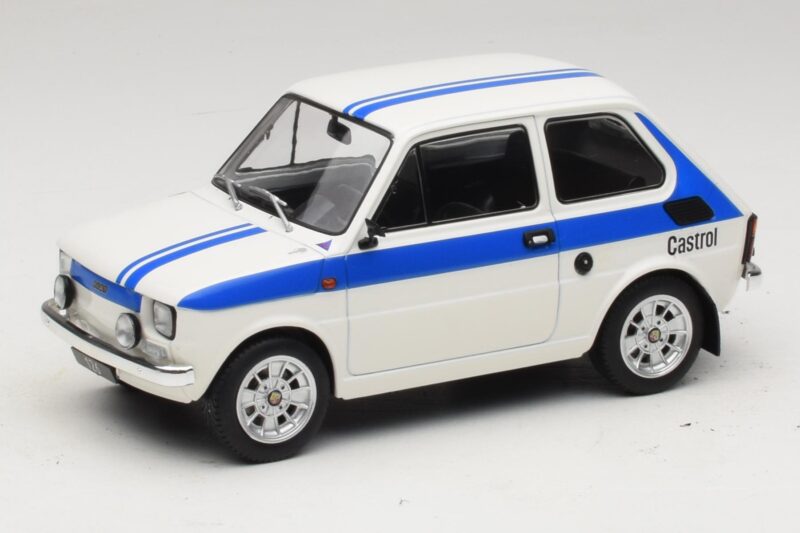
TL;DR: MCG's 1:18 diecast Fiat 126 wears a white and blue Castrol livery, evoking the small car's unlikely life in period club and rally racing. Cast as a sealed body with no opening doors or bonnet, it carries sharp sponsor graphics across an otherwise honestly plain city car shape.
The Fiat 126 was never built with motorsport in mind, a rear-engined city car designed for cheap, reliable transport rather than speed. That makes a period-style Castrol racing livery, reproduced here on MCG's 1:18 diecast in white and blue, a genuinely unexpected but charming take on a subject usually associated with everyday charm rather than competition.
Fiat launched the 126 in 1972 as a successor to the 500, keeping the same basic formula of a rear-mounted, air-cooled engine driving a small, simple, affordable car built for city use rather than the open road. It was never a quick car by any measure, and its appeal rested entirely on low cost and mechanical simplicity rather than performance of any kind. That popularity only grew once production shifted to Poland, where the 126 became a genuinely mass-market car for an entire generation of buyers.
Small, inexpensive cars like the 126 found a natural home in period club and rallycross racing, categories where low cost mattered as much as outright pace and where a sponsor like Castrol could put its branding on a genuinely wide range of competitors rather than only the fastest machinery. A livery like this one reflects that world, more grassroots enthusiasm than factory works effort. It is exactly the kind of livery that rewards a collector's curiosity rather than requiring a documented result to justify its place on a shelf.
This 126 is cast as a single sealed shell, with no door, bonnet or boot that opens. A racing livery depends on continuous, unbroken panels to keep sponsor logos aligned correctly, and a fixed body gives the printer exactly that surface across the doors, bonnet and roof, with no shut line to interrupt a mark positioned across a panel join. That precision matters more on a small car than a large one, since there is simply less surface area to work with before a misaligned logo becomes obvious.
White and blue was a common Castrol colour pairing across period motorsport more broadly, and MCG applies it here with clean, sharply registered graphics that hold up under close inspection rather than blurring at the edges. Diecast construction gives the finish real depth under direct light, and the weight of the casting in the hand is a reminder that even a small subject like the 126 benefits from the solidity metal construction brings. Getting that registration right across such a compact body is a genuine test of a manufacturer's printing quality, one this casting passes cleanly. Few subjects this size carry as much printed detail per square centimetre.
The 126 belongs to a distinct category of European micro cars built around affordability and simplicity rather than styling ambition or performance, a category that includes contemporaries from several manufacturers but few subjects with quite the cultural staying power the 126 achieved, particularly once Polish production extended its life well beyond the original Italian run. That extended production gave the car a second identity almost entirely separate from its Italian origins, one shaped by different buyers, different roads and a different economic context altogether. A racing livery like this one adds an unexpected layer to that story, showing that even a car built with no sporting ambition whatsoever found its way onto grids and stages through the enthusiasm of private competitors and small sponsors. For a collector building a micro car or city car theme, the 126 is close to essential, and a livery variant like this one offers a genuinely different angle on the subject than a standard colour would. Curiosity is enough of a reason to want this one on a shelf.
This Castrol-liveried 126 works best as a contrast piece, sitting deliberately at odds with the larger, more overtly sporting subjects that tend to dominate a typical motorsport-themed shelf. Its sealed body keeps display simple: no hinges to check, no interior trim to protect, just a finish that holds its printed graphics indefinitely under normal shelf conditions. Paired with MCG's plain yellow 126, the two colours together show the full range of the car's identity, from everyday city runabout to unlikely grassroots racer, in a way that neither casting alone quite manages. For a collection built around small-displacement or micro-class cars specifically, or simply one that values a bit of unexpected character alongside its bigger names, this 126 earns its place through genuine surprise rather than obvious pedigree. That surprise is, in the end, most of the appeal.