{"ajaxurl":"https:\/\/models118.co.uk\/wp-admin\/admin-ajax.php?lang=en_GB","nonce":"a985a1cee8","homeUrl":"https:\/\/models118.co.uk\/","shopUrl":"https:\/\/models118.co.uk\/shop\/","cartUrl":"https:\/\/models118.co.uk\/cart-en-gb\/","checkoutUrl":"https:\/\/models118.co.uk\/checkout\/","skipCart":true,"collectionLimit":12,"i18n":{"addedToCart":"Added to basket","addToWishlist":"Add to wishlist","addedToWishlist":"Added to wishlist","removeFromWishlist":"Remove from wishlist","removedFromWishlist":"Removed from wishlist","undo":"Undo","error":"Something went wrong","loading":"Loading...","outOfStock":"Out of stock","viewCart":"View basket","proceedToCheckout":"Proceed to checkout","addedToCollection":"Added to your collection","reserved":"Added to your collection","soldOut":"Sold out","invalidEmail":"Please enter a valid email address","connectionError":"Connection error. Please try again.","tocToggle":"On this page","close":"Close","inCartTooltip":"Already in your basket \u2013 open your basket to check out","loginToSave":"Sign in to save this model","waitlistNotify":"Notify me","waitlistOnList":"On the waiting list \u2713","waitlistJoined":"You're on the waiting list. We'll email you the moment this model is available again.","waitlistRemoved":"Done \u2014 you're off the waiting list for this model.","waitlistRateLimit":"Too many attempts \u2014 please try again shortly","waitlistTurnstile":"We couldn't complete the check \u2014 please try again","waitlistError":"Sorry, something went wrong. Please try again in a moment."},"wishlist":{"loggedIn":false,"loginUrl":"https:\/\/models118.co.uk\/my-account\/","addAction":"models118_wishlist_add","removeAction":"models118_wishlist_remove"},"waitlist":{"loggedIn":false,"subscribeAction":"models118_waitlist_subscribe","toggleAction":"models118_waitlist_toggle","stateAction":"models118_waitlist_state"},"stats":{"models":2385,"brands":213,"manufacturers":128,"collectors":10000},"product":{"id":1179063,"sku":"OT589","condition":"used","availability":"out_of_stock","name":"Matra Bagheera S Orange Otto 1:18","brand":"Matra","manufacturer":"Otto","scale":"1:18","material":"Resin","price":153,"regularPrice":153,"isOnSale":false,"savingsAmount":0,"stockQty":0,"stockStatus":"out_of_stock","isDiscontinued":true,"image":"https:\/\/models118.co.uk\/wp-content\/uploads\/2026\/06\/simca-bagheera-s-orange-otto-1-18-300x200.jpg","permalink":"https:\/\/models118.co.uk\/matra-bagheera-s-orange-otto-1-18-ot589\/"}}
Cookies on Models118
We use cookies to remember your preferences, understand how the shop is used and show you models and offers that suit your interests. What you allow is up to you, and you can change it at any time.
Always active
The technical storage or access is strictly necessary for the legitimate purpose of enabling the use of a specific service explicitly requested by the subscriber or user, or for the sole purpose of carrying out the transmission of a communication over an electronic communications network.
The technical storage or access is necessary for the legitimate purpose of storing preferences that are not requested by the subscriber or user.
The technical storage or access that is used exclusively for statistical purposes.
The technical storage or access is required to create user profiles to send advertising, or to track the user on a website or across several websites for similar marketing purposes.
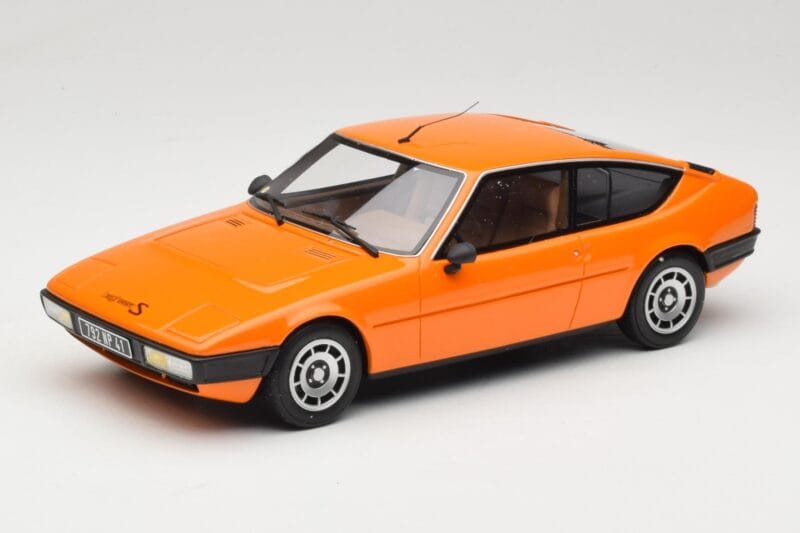
Otto's 1:18 resin Matra Bagheera S in orange reproduces the 1978 French sports coupe famous for seating three people abreast across a single front bench, a genuinely unusual layout for a two-door sports car. Otto's sealed resin construction delivers sharp panel lines on this low, wedge-shaped body at a mid-tier collector price.
TL;DR: Otto's 1:18 resin Matra Bagheera S in orange reproduces the 1978 French sports coupe famous for its three-abreast front seating, a genuinely unusual layout for a two-door car. Sealed resin construction captures the wedge-shaped body's sharp lines, suiting collectors after a distinctive French sports coupe.
Fitting three seats across the front of a sports coupe sounds like a compromise nobody would choose, yet Matra made it work well enough to sell the Bagheera in real numbers through the 1970s.
Otto's Sealed Resin Approach to a Low Wedge Body
The Bagheera's low, angular wedge shape rewards the sharp shut lines resin construction is known for, and Otto's build shows that clearly, with consistent, tight panel gaps along the doors and hatch that a heavier diecast casting would struggle to match. Orange paint sits with real depth across the coupe's flat, angular surfaces, a colour that period Matra brochures used often and one that suits the car's slightly wedge-era aggression. As a sealed resin piece, there are no opening doors or hood, a trade-off that lets the body achieve panel precision a moving diecast hinge cannot, appropriate for a subject prized more for silhouette accuracy than interactive features.
A Three-Abreast Layout That Actually Reached Production
Matra, better known at the time for aerospace and Formula 1 chassis work, built the Bagheera around a genuinely novel idea: seating a driver and two passengers side by side on a single bench rather than the conventional two-plus-two or strict two-seat layout. Built in partnership with Simca and later Talbot, the Bagheera used a mid-mounted engine and a fibreglass body over a steel backbone chassis, unusual engineering for a mainstream-priced French sports coupe. The S variant, arriving toward the end of the model's run, sharpened performance without abandoning that distinctive three-seat format that remains the car's single most talked-about feature.
Placing the Bagheera in a French Sports Coupe Display
This model earns its place through genuine novelty rather than outright performance, and it works well alongside other 1970s French coupes to show a period when French manufacturers were still willing to try genuinely unconventional engineering solutions rather than following established sports car formulas.
Create a free account and claim 10% off your first order — from hundreds of collectible 1:18, 1:43 and 1:12 models by Porsche, Mercedes-Benz, BMW and more.
{"id":1179063,"name":"Matra Bagheera S Orange Otto 1:18","price":"£<\/span>153.00<\/bdi><\/span>","image":"https:\/\/models118.co.uk\/wp-content\/uploads\/2026\/06\/simca-bagheera-s-orange-otto-1-18-400x400.jpg","permalink":"https:\/\/models118.co.uk\/matra-bagheera-s-orange-otto-1-18-ot589\/","brand":"Matra"}