Last One
New
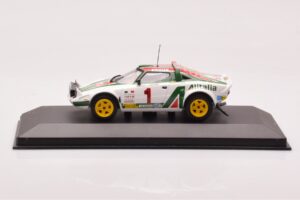
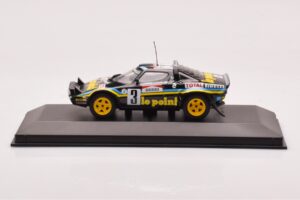
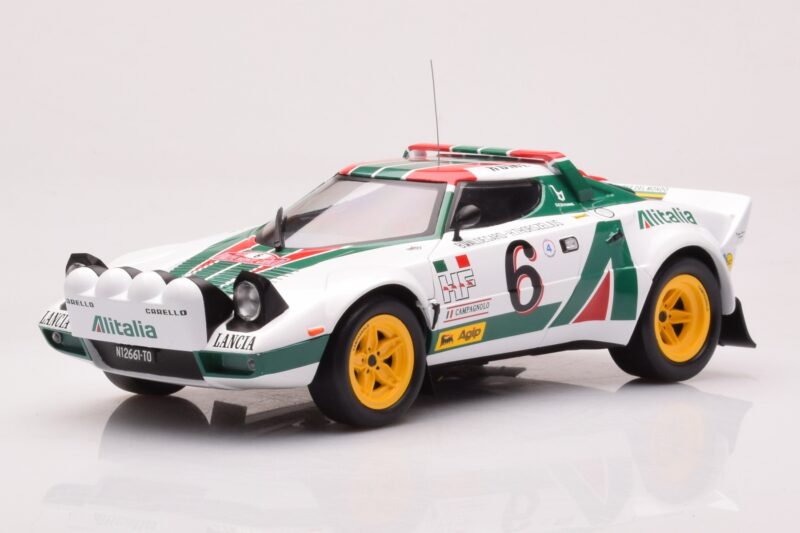
Lancia Stratos #1 S. Munari / S. Maiga Rally Monte Carlo 1977 Minichamps 1:43
Only 1 left
Price:
£49.00
We'll notify you once when this item is available. No spam.
A rally team's second entry at the same event carries a different weight than the leading car. Björn Waldegård drove Lancia's car #6 at Monte Carlo 1976 as one of the most accomplished WRC drivers of his generation — a competitor whose range across gravel, snow, and tarmac surfaces gave the Stratos programme championship points that a single-car strategy could not accumulate alone. IXO documents this second Lancia factory entry from the title-defending season in 1:18 diecast, co-driven by Hans Thorszelius.
Björn Waldegård brought a different driving character to the Stratos than Munari. Where Munari's Monte Carlo mastery came from deep familiarity with the specific stage roads, Waldegård represented the Swedish rally tradition: mechanical sympathy, measured pace across diverse surfaces, and the experience of competing at the highest level across multiple manufacturers over more than a decade. By 1976, Waldegård had already driven for Porsche and Toyota in international competition — his Lancia campaign added one chapter to one of the most varied manufacturer CVs in WRC history.
Car #6 at Monte Carlo 1976 gave the Lancia team redundancy in points accumulation alongside Munari's championship-focused #10. The Waldegård/Thorszelius pairing provided Lancia with insurance across the event's unpredictable conditions — if Munari encountered mechanical trouble or made a rare navigation error on the mountain stages, Waldegård's consistently high placings kept the manufacturer's championship bid intact. This tactical dimension, standard among professional factory teams, is part of what the dual-Lancia Monte Carlo display represents as a collected pair.
Both cars ran identical Stratos HF specification — the same Ferrari Dino V6, the same aerodynamic package, the same Marlboro red livery. The distinction between them lies in crew identity, car number, and the slightly different strategic function each entry served within Lancia's title defence. IXO's documentation preserves this specificity in a form that benefits collectors who approach WRC history with that level of event detail.
Reproducing a 1976 Lancia livery presents different challenges than documenting a modern WRC entry. Period racing liveries relied on painted and taped graphics rather than today's printed vinyl wraps, and the Marlboro treatment on the Stratos — the geometric red-white-black pattern that identified Philip Morris branding across motorsport through the mid-1970s — requires precise colour blocking across the Stratos's curved bodywork.
IXO applies tampo printing across multiple colour passes to achieve the layering the Marlboro livery demands. The red body establishes the dominant colour, with white and black graphic elements placed in register above it. At 1:18, the Stratos's compact 23-centimetre length means these graphics cover a smaller total surface area than on a modern car — higher printing precision per centimetre is required to maintain graphic legibility at scale. IXO's output for period livery documentation is consistent with their position in the market: accurate enough for serious display, accessible enough for collectors building broad WRC historical coverage rather than single-subject depth.
Diecast construction gives the Waldegård car the same opening features as the Munari entry. Doors and bonnet provide access to interior detail and Ferrari Dino V6 engine representation. When both Monte Carlo 1976 pieces sit side by side — #6 and #10, Waldegård and Munari — the matched Marlboro red livery and identical zinc alloy construction immediately read as a coherent factory team deployment. Lifting either model from its packaging, the solid diecast weight registers as appropriate to a display piece intended for a Vitrine shelf rather than casual handling.
The primary collecting case for this model rests on completing the Monte Carlo 1976 Lancia deployment. Alongside the Munari #10, the Waldegård #6 produces a full factory team picture from one of the most historically significant rounds in early WRC history — the championship-defending Lancia squad at maximum strength on the most prestigious January event.
For British collectors whose interest in classic WRC extends to the Goodwood Revival paddock and to historic rally events where period Stratos entries remain among the most competitive and visually arresting machines present, this model provides a 1:18 reference point for the specific livery that Lancia ran in their final consecutive championship season. Waldegård's later Monte Carlo appearances with other manufacturers also make this 1976 Lancia entry part of a broader career narrative that WRC historians with a Swedish rally following — a loyal audience within the British rally community — will recognise as significant beyond the single event.