


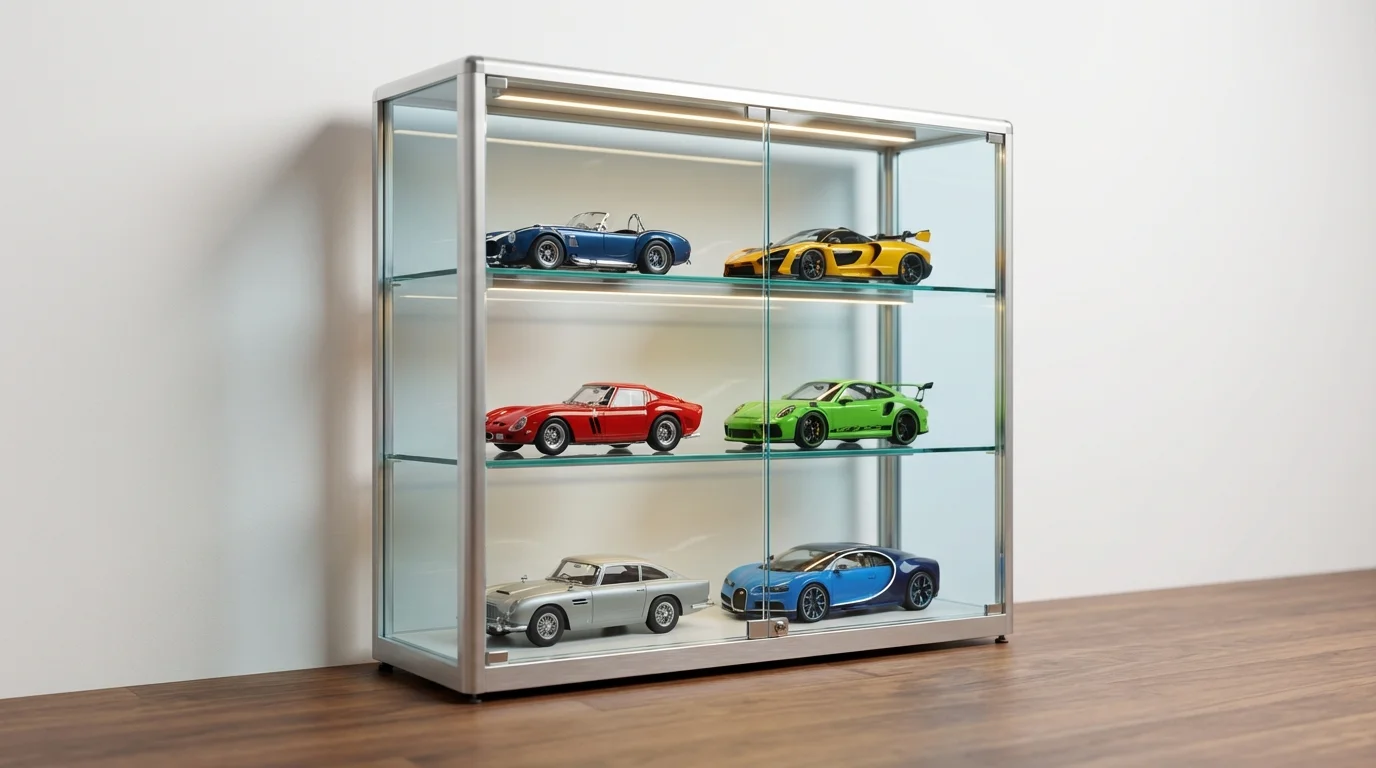
We’ve lost count of how many collectors have written to us after discovering a yellowed resin model or a diecast piece showing the first signs of corrosion. It’s heartbreaking, honestly. You spend months tracking down a limited-edition GT Spirit 1:18, only to watch its paintwork fade because the model car display case sits next to a south-facing window. We’ve handled thousands of models over the years, and we can tell you that proper care isn’t complicated. But it does require knowing what actually damages your collection and what doesn’t.
This guide covers cleaning techniques for every material type, UV and climate control, the differences between diecast and resin models, display case options, safe handling, and emergency repairs when things go wrong. Whether you’re protecting your first model or managing a collection of fifty, you’ll find something useful here.
TL;DR: Keep models in enclosed display cases with UV-filtered glass, maintain humidity below 60%, dust with microfibre cloths only, and handle resin models by the base. Diecast tolerates gentle cleaning; resin doesn’t. Store original packaging for moves and resale value.
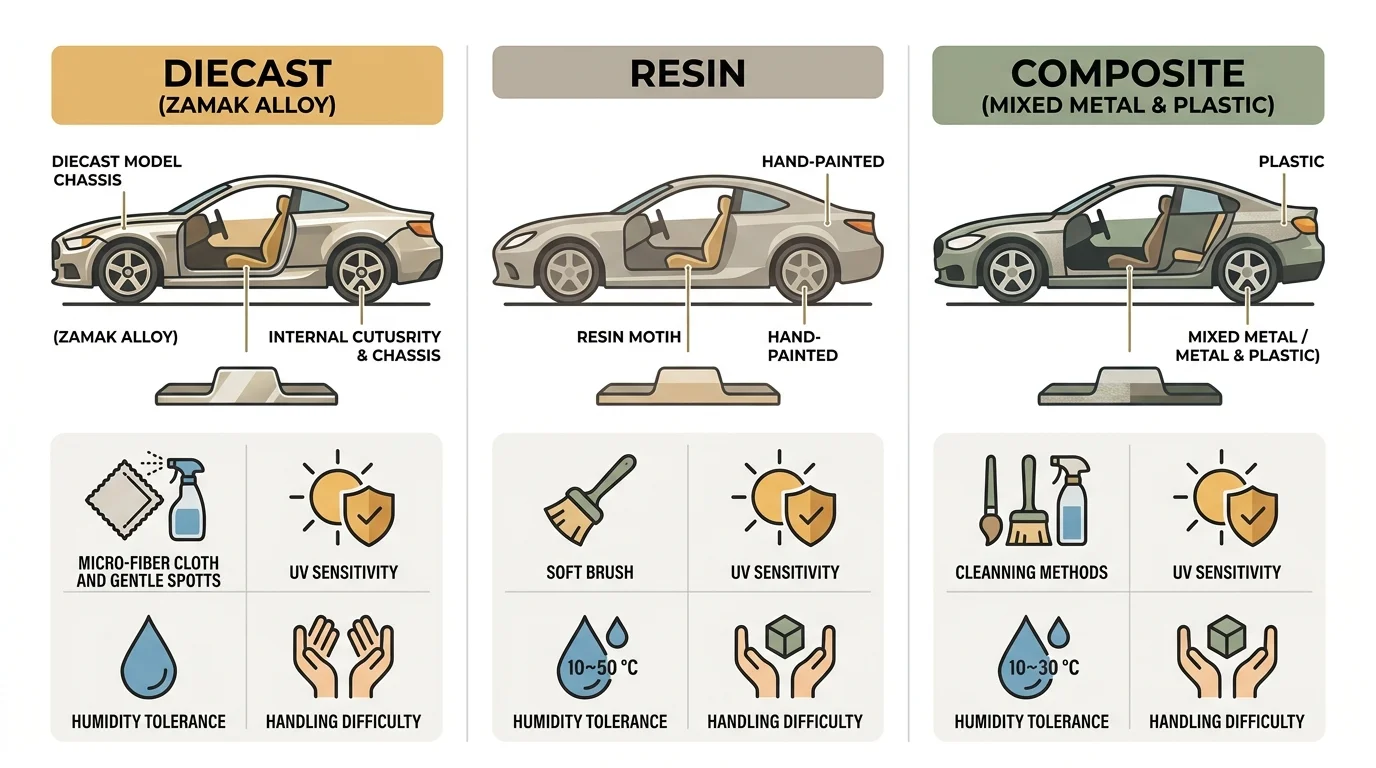
Quick Reference Table: Material x Care Aspect
Before we get into the detail, here’s a cheat sheet we keep pinned above our packing station. It’s saved us from more than a few mistakes over the years. Which material does your collection lean towards? That’ll determine which sections matter most to you.
| Care Aspect | Diecast (Zamak) | Resin (Polyurethane) | Composite (Metal + Plastic) |
|---|---|---|---|
| Dust Removal | Microfibre cloth, slightly damp | Soft-bristle brush only | Microfibre for body, brush for details |
| Deep Cleaning | Lukewarm water + mild soap, 30s max (Auto World Store) | Never submerge; dry brush only | Wipe metal areas; avoid soaking plastic |
| UV Sensitivity | Moderate (paint fading) | High (irreversible yellowing) | Moderate to high |
| Humidity Limit | Below 60% (corrosion risk) | Below 60% (warping risk) | Below 60% |
| Ideal Temperature | 18-22°C | 18-22°C | 18-22°C |
| Handling | Lift from body or chassis | Base only, cotton gloves recommended | Body or chassis, careful with plastic parts |
We’ve seen collectors laminate this table and stick it inside their display cabinet door. Not a bad idea, that.
How to Clean Your Models Without Damage
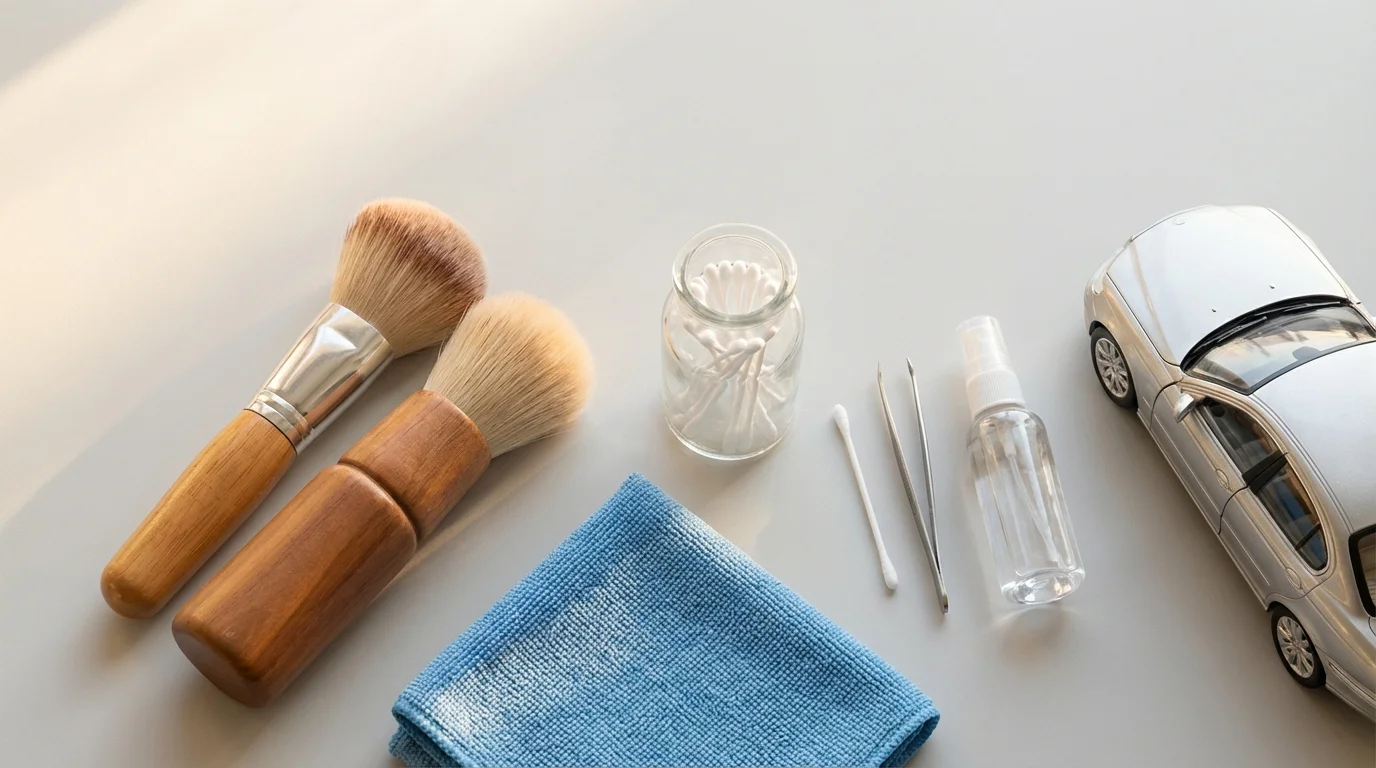
According to the Auto World Store cleaning guide, the essential tools for safe diecast cleaning are a microfibre cloth, cotton swabs, plastic toothpicks, and tweezers (Auto World Store). Notice what’s missing from that list? Paper towels. Stiff brushes. Household cleaning sprays. We can’t stress this enough: the wrong cloth does more damage than dust ever will.
Diecast Cleaning
Diecast models are the most forgiving material for cleaning. We’ve cleaned hundreds of them, and the routine is straightforward. For light dusting, a microfibre cloth dampened with a dab of lukewarm water works perfectly (Auto World Store). Don’t soak it. Just barely moist.
For heavier grime? You can briefly submerge a diecast model in lukewarm water with mild soap for roughly 30 seconds (Auto World Store). But here’s where people go wrong: they leave models sitting in water, or they use hot water, or they reach for solvents. Alcohol and chemical cleaners strip paint finishes. Full stop.
After washing, dry with a clean cloth or a blow dryer on low heat. Never leave a model to air-dry in direct sunlight (Auto World Store). We’ve seen sun spots form on windscreens from brief UV exposure during drying.
Regular weekly dustings prevent heavy grime buildup in the first place (Auto World Store). That’s the real secret, isn’t it? Prevention beats repair every time.
Resin Cleaning
Resin models need a completely different approach. These are sealed display pieces with fully painted, glossy finishes. You can’t submerge them. You shouldn’t use damp cloths on them. And you must never use any solvent or alcohol-based cleaner anywhere near them.
So what do you actually do? A soft-bristle brush (like a clean makeup brush or a dedicated model brush) is your best option. Gently sweep dust away from the surface. Handle the model by its base only, because fingerprints on sealed resin surfaces can become permanent marks over time (DiecastXchange). Cotton gloves aren’t overkill here; they’re sensible.
From our experience, collectors who display resin models in enclosed cases rarely need to clean them at all. Dust simply doesn’t accumulate the way it does on open shelves. That’s probably the most practical cleaning tip we can offer for resin: don’t let dust reach them in the first place.
Composite and Mixed-Material Cleaning
Composite models (like those from AUTOart, combining metal bodies with detailed plastic interiors) sit somewhere between diecast and resin in terms of care. The metal body panels can handle a damp microfibre wipe, but be cautious around plastic and rubber components. These parts can degrade if exposed to moisture or cleaning products.
We generally recommend treating composites like resin: dust with a brush first, and only use a barely damp cloth on the metal surfaces when truly necessary. It’s the safer path.
UV Protection: Preventing Yellowing and Fading
UV radiation is, from what we see, the single biggest threat to model collections. According to research published by ScienceDirect, yellowing in epoxy and vinyl ester resins is caused by UV-induced photodegradation of bisphenol-A groups, and UV aging is the most aggressive yellowing mechanism compared to thermal aging (ScienceDirect). That’s not something you can reverse.
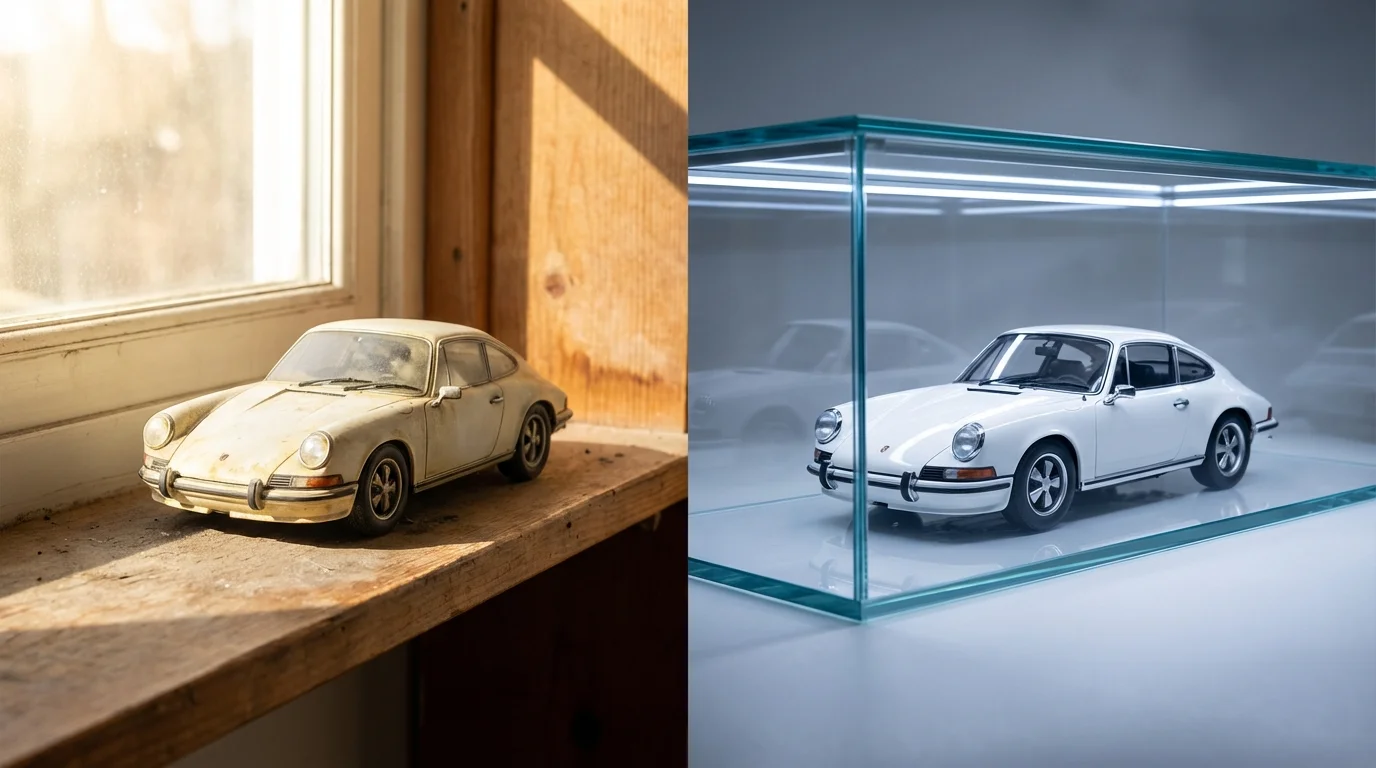
Here’s what makes this particularly frustrating: yellowing in resin is permanent. Once the chemical bonds break down, you cannot restore clarity or the original colour (Resiners). Higher-grade resins with UV stabilisers (HALS, benzotriazole compounds) last longer, but even they’ll eventually yellow under sustained exposure (Resiners).
What can you actually do about it? We believe the single best investment for any serious collector is UV-filtered glass for display cases. It doesn’t need to be expensive; even UV-filtering acrylic sheets from a local glazier work well. The key is blocking the wavelengths that cause photodegradation before they reach your models.
Does this mean you need to keep your collection in a dark room? Not at all. UV-filtered glass lets visible light through while blocking the harmful spectrum. Your models look just as good on display. You’re simply removing the invisible threat. For a deeper look at which brands use higher-grade materials, our brand ranking guide covers material quality across manufacturers.
Thermal aging above 80°C also accelerates yellowing in epoxy systems (ScienceDirect). In practice, this means keeping models away from radiators, heated display lights that run hot, and conservatories that trap heat during summer.
Humidity and Temperature Control
Keeping humidity below 60% is essential for diecast models, and we’d suggest even lower for resin (Drool Over Diecast). Why does humidity matter so much? Two words: zinc pest. And possibly warping, if we’re talking resin.
Zinc pest is caused by impurities (lead, cadmium, tin) in the zinc alloy used for diecast bodies (Wikipedia). It was first identified as a problem back in 1923, and primarily affects models manufactured between the 1920s and 1950s. But here’s the uncomfortable truth: there’s been a resurgence in models produced since the mid-1990s (Wikipedia). So it’s not just a vintage concern.
What happens when zinc pest starts? The metal swells, cracks, and eventually crumbles. It’s irreversible once it begins. Collectors on DiecastXchange have reported that dark storage, oil coatings, and humidity control are all ineffective as cures once the process has started (DiecastXchange). Your mileage may vary with prevention, but keeping humidity consistently below 60% at least avoids accelerating the reaction.
Humidity above 65% accelerates the electrochemical process that draws lead out from between alloy crystals (Wikipedia). That’s the mechanism. Is it likely to affect a modern, post-2010 model from a reputable manufacturer? Probably not. But do you want to take that chance with a limited-edition piece?
For resin, the concern is different. Resin shrinks and deforms over time, and elevated temperatures or humidity can accelerate warping (DiecastXchange). The ideal storage temperature for all model types is 18-22°C (Drool Over Diecast). A cheap hygrometer inside your display cabinet is, in our opinion, one of the smartest purchases you can make.
Display Solutions: Open Shelf vs Enclosed Case
Enclosed diecast display cases reduce dust accumulation by over 90% compared to open shelving (Drool Over Diecast). That single fact probably answers the question for most collectors. But it’s worth thinking about what type of model car display case suits your situation best.
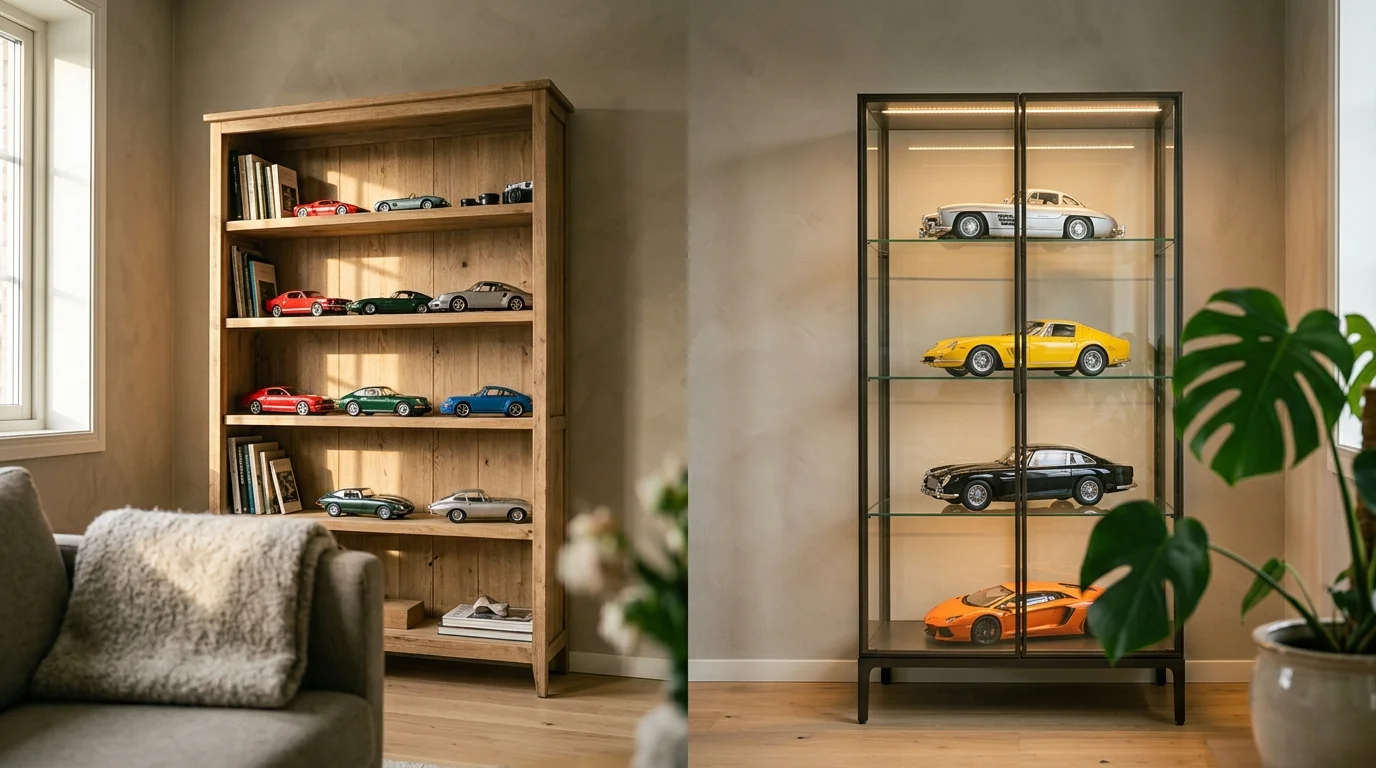
| Feature | Open Shelf | Acrylic Case | Glass Cabinet | Wall-Mounted Case |
|---|---|---|---|---|
| Dust Protection | None | Excellent | Excellent | Excellent |
| UV Protection | None | Good (with UV filter) | Good (with UV glass) | Depends on material |
| Visibility | Great | Great | Great | Good (angle-dependent) |
| Best For | Quick access, browsing | Individual high-value pieces | Larger collections | Space-saving layouts |
| Capacity (1:18) | Unlimited | 1-4 models | 8-20+ models | 2-6 models |
We stock models from brands across every price tier, and we’ve noticed that collectors who invest in decent display solutions tend to keep their collections in better condition over the long term. That said, there are exceptions. Some collectors prefer open shelving because they like to handle their models regularly. Can you blame them? There’s something satisfying about picking up a well-made 1:18 diecast and feeling the weight of it.
If you do go with open shelving, commit to weekly dusting. No excuses. And keep those shelves away from windows, radiators, and kitchen areas where grease particles circulate in the air. LED lighting is the preferred option for display illumination because standard LEDs produce virtually no UV radiation and generate minimal heat. Just check the specification, because some cheaper LED strips can run surprisingly warm.
Individual perspex or acrylic cases work brilliantly for high-value pieces. They’re affordable, stackable, and offer excellent dust prevention for a 1:18 display case setup. Wall-mounted cases save floor space and can look quite striking when arranged in a grid pattern. The investment varies widely depending on size and material, but even budget-friendly acrylic options do an excellent job.
Handling Your Models Safely
How you pick up a model matters more than most collectors realise. We’ve watched people grab a 1:18 model by an open door, only to snap the hinge. That’s not easy to fix. And with resin models, there’s the additional problem of fingerprint oils reacting with the sealed surface.
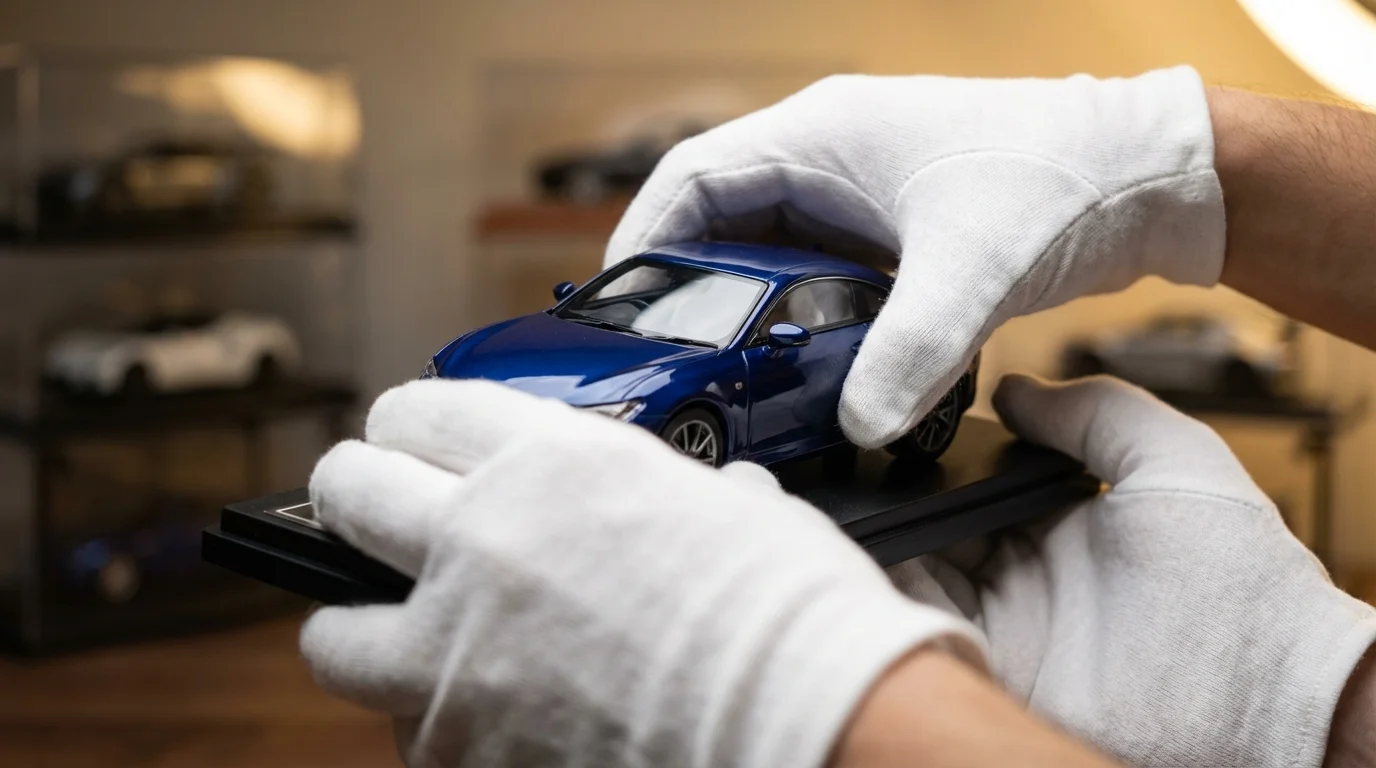
Here are the fundamentals we follow in our own warehouse:
- Always lift diecast models from the body or chassis, never by doors, bonnets, or mirrors
- Handle resin models by the base only; cotton gloves are recommended (DiecastXchange)
- Support the model from underneath when possible, distributing weight evenly
- Work over a padded surface (a folded towel works) in case of drops
- Keep fingernails trimmed to avoid scratching paint finishes
Does this sound overly cautious? Perhaps. But we’ve seen the results of careless handling often enough to know the difference it makes. A chipped door mirror on a Minichamps 1:18 isn’t the end of the world, but it’s the kind of thing that quietly bothers you every time you look at it.
Common Care Mistakes That Damage Collections
We’ve been in the collectible model business long enough to spot patterns. These are the mistakes we see again and again, and they’re all avoidable.
Using paper towels or tissue paper for dusting. They feel soft, but they’re abrasive at a micro level. Paper fibres scratch clear-coat finishes. Use microfibre only (STK Model Car).
Spraying glass cleaner near models. Even if you’re cleaning the diecast car display case glass, chemical mist drifts onto model surfaces. Remove models before cleaning case interiors, or use a damp cloth instead of spray.
Displaying near kitchen areas. Airborne grease particles settle on models and create a sticky film that’s difficult to remove without proper cleaning. Have you ever tried getting cooking oil residue off a matte-finish OttOmobile? It’s not fun.
Ignoring original packaging. Preserving original boxes and foam inserts can add over 20% to resale value (Drool Over Diecast). Even if you don’t plan to sell, those boxes are the safest way to store models during a house move. We always advise keeping them.
Using tap water for cleaning. Mineral deposits from hard tap water can leave white spots on dark-coloured models. Distilled water avoids this problem entirely (STK Model Car). It’s a small detail, but it matters.
Emergency Repairs: Fixing Common Damage
Things go wrong. A door hinge snaps. An antenna breaks off. A wing mirror gets knocked. What then? We’re not professional restorers, but we’ve fixed enough minor issues to share some practical approaches.
Broken door hinges (diecast): For clean breaks, a tiny amount of cyanoacrylate glue (superglue) applied with a toothpick can reattach a door. Use gel formula, not liquid, to prevent dripping onto paint. Let it cure fully before testing the hinge. Don’t expect it to open and close smoothly afterwards, though. Once a hinge breaks, it’s generally better to glue the door in a slightly open or closed position.
Detached mirrors and antennas: These are the most common breakages we see. A drop of clear-drying hobby glue does the job. Position the part with tweezers, hold for 30 seconds, and leave undisturbed overnight.
Paint chips: Small chips can sometimes be touched up with hobby enamel paint, but colour matching is tricky. We’d suggest leaving minor chips alone rather than making them more noticeable with a bad colour match. This is debatable, and some collectors prefer to accept the imperfection rather than risk a worse result.
Warped resin: Slight warping in resin models is, unfortunately, something that happens over time (DiecastXchange). There’s no reliable home fix. Keep the model at stable temperature and humidity to prevent further deformation, but don’t try to heat-bend it back. You’ll likely crack it.
Frequently Asked Questions
What is the safest way to remove dust from scale models?
For diecast, use a clean microfibre cloth with a small amount of lukewarm water. For resin and composite models, a soft-bristle brush is safer because resin surfaces are more sensitive to moisture and pressure. Whichever method you choose, always work gently from top to bottom. If you’re just getting started with collecting, this habit is worth building early.
Can I use glass cleaner on display case windows near models?
We’d recommend removing models before spraying any cleaning product near them. Chemical mist travels further than you’d think, and residue from ammonia-based cleaners can damage paint finishes and decals. A damp microfibre cloth is a safer alternative for cleaning case glass with models still inside.
How often should I clean my model car collection?
Models in enclosed cases need attention every few months at most. Open-shelf displays should be lightly dusted weekly to prevent grime buildup (Auto World Store). We’ve found that quarterly deep inspections, where you check for early signs of corrosion, yellowing, or dust accumulation, are a good routine for larger collections.
Do LED display lights cause UV damage to models?
Standard LED strips produce negligible UV radiation, making them the preferred lighting choice for model car display setups. However, some very inexpensive LEDs can generate more heat than expected, so it’s worth checking the operating temperature after a few hours. Warm LEDs positioned directly against an acrylic case can, in rare instances, cause localised heat buildup.
How should I store models during a move or relocation?
Original packaging is your best option. The factory foam inserts are shaped specifically for each model and provide excellent protection. If you’ve discarded the box, wrap each model individually in acid-free tissue paper, then place in a snug cardboard box with crumpled paper filling the gaps. Never stack models on top of each other without barriers between them.
Conclusion: Building a Sustainable Care Routine
You don’t need expensive equipment or specialist knowledge to keep your models looking their best. What you do need is consistency. A weekly dust, a decent display case, and an awareness of UV and humidity risks will protect your collection for years.
We’ve been saying this to customers for as long as we can remember: the difference between a collection that holds its value and one that doesn’t usually comes down to care, not luck. If you’re curious about how proper care affects resale value, that’s a topic worth exploring separately.
Start with the quick reference table at the top of this article. Print it out, stick it somewhere visible, and follow its recommendations. Your models will thank you.