{"ajaxurl":"https:\/\/models118.co.uk\/wp-admin\/admin-ajax.php","nonce":"40459cb95a","homeUrl":"https:\/\/models118.co.uk\/","shopUrl":"https:\/\/models118.co.uk\/shop\/","collectionLimit":12,"i18n":{"addedToCart":"Added to cart","addedToWishlist":"Added to wishlist","removedFromWishlist":"Removed from wishlist","error":"Something went wrong","loading":"Loading...","outOfStock":"Out of stock","viewCart":"View cart","addedToCollection":"Added to Collection","reserved":"Reserved!","invalidEmail":"Please enter a valid email address","connectionError":"Connection error. Please try again."},"stats":{"models":552,"brands":31,"makers":11,"collectors":10000}}
1950s Model Cars - Post-War Style & Motorsport Glory
More about our models
Build a collection that captures the decade of chrome, tailfins and wire wheels, from elegant British sports cars to pioneering Le Mans and early Formula 1 machines. Explore 1:18 centrepiece replicas and 1:43 classics that let you map the whole era on the shelf.
1950s Model Cars — Collector Replicas from the Era
3 models from the 1950s — diecast and resin replicas of the era's most collected cars
What 1950s model cars do you offer?
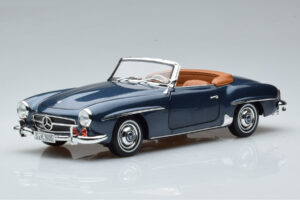
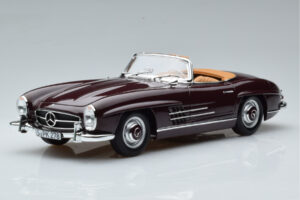
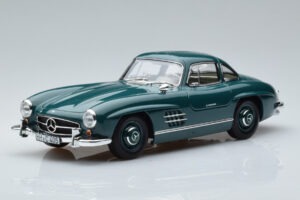
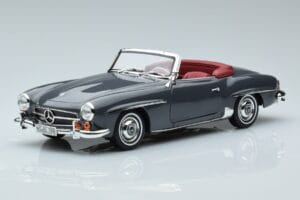
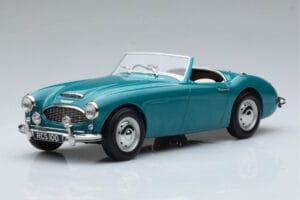
Our 1950s collection includes 3 scale replicas in diecast and resin — road cars, racing legends, and limited editions from the period. Featured marques: Austin-Healey, Mercedes.
Which car brands define the 1950s?
The 1950s produced cars from Austin-Healey, Mercedes — many now discontinued in model form and sought after by collectors. Browse by brand to find specific models from the period.
What are the most collectible 1950s car models?
The most sought-after 1950s replicas are limited-edition recreations of legendary road and race cars. Discontinued models in low production runs (under 1,000 pieces) appreciate fastest. Original packaging and certificates add value.
Which manufacturers produce 1950s model cars?
1950s car replicas are produced by Norev. Diecast brands focus on accurate road cars; resin specialists recreate rare and limited variants unavailable elsewhere.
What scales are available for 1950s models?
1950s models are available in 1:18. The 1:18 scale captures period-correct details best — chrome trim, dashboard gauges, and engine bays authentic to the era.
Why do collectors love 1950s car models?
The 1950s produced some of the most iconic cars in automotive history — and model manufacturers capture that legacy in precise detail. Limited editions of legendary road and race cars from the period are highly sought after. Period-correct details make these models time capsules of automotive design.
How are model cars shipped?
5-layer packing: original box, bubble wrap, foam inserts, reinforced carton, FRAGILE markings. All shipments tracked and insured. Damage rate under 0.1%.
Do you offer returns?
14-day returns on unused items in original packaging. Defective or damaged in transit? Free replacement — contact us with photos within 48 hours.
1950s model cars capture the moment motoring stepped out of post-war austerity and into a decade of confidence. In miniature you see the return of chrome, the rise of streamlined coachwork and the beginnings of modern motorsport culture, from Jaguar’s Le Mans dominance to the first Formula 1 World Championship seasons. This era category brings together road and race replicas in the scales collectors actually display — typically 1:18 for statement pieces and 1:43 for building a broad timeline — so you can compare makers, materials and levels of detail before committing to a theme. Whether your interest is British sports cars, continental grand touring or period competition liveries, the 1950s offers a coherent, highly collectable story.
1950s Model Cars: Chrome, Curves and New Confidence
Unlike the heavier, more formal pre-war shapes, fifties bodywork feels lighter on its feet. Bonnet lines lengthen, cabins sit lower, and subtle fins and scallops begin to appear without the excess of the 1960s. On many 1950s classic car models the appeal is in the surfaces: the way a two-tone paint line follows a shoulder crease, or how a brightwork strip frames a grille opening. Look for accurate chrome finish and crisp panel edges, because these cars often wore plenty of jewellery. Details such as external fuel fillers, knock-off wheel spinners and leather bonnet straps are period signatures that separate a good replica from a merely decorative one.
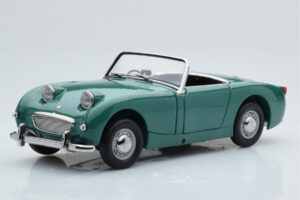
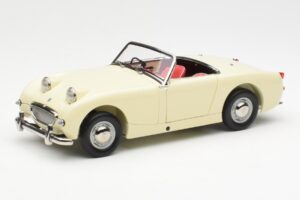
For UK collectors, the 1950s reads like a highlight reel: Jaguar’s XK120 evolving through XK140 and XK150, the purposeful Austin-Healey 100 and 100-6, and the clean-lined MG MGA and Triumph TR2/TR3 that defined affordable sporting motoring. At the top end, Bentley’s R-Type Continental and Rolls-Royce’s Silver Cloud represent the decade’s sense of occasion, particularly when finished in sober shades of green, blue or silver with neatly applied chrome. These subjects reward careful model making because their character sits in stance and proportion — the long bonnet, the tight cabin, the wire wheels tucked under the arches. A well-finished replica in British racing green looks at home alongside Goodwood-era memorabilia on a shelf.
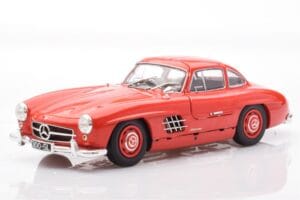
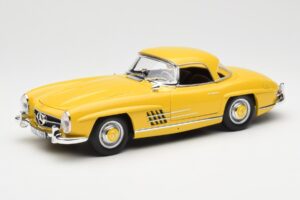
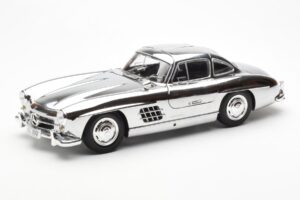
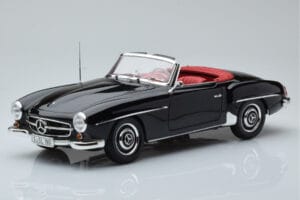
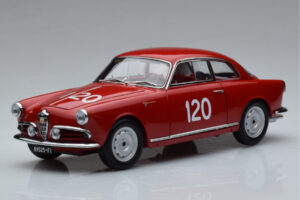
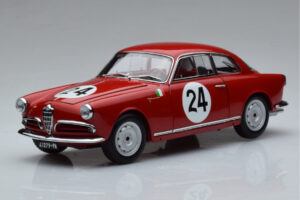
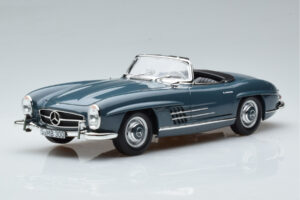
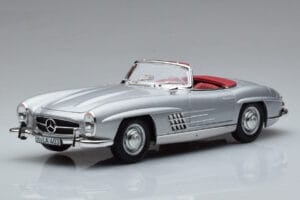
Continental Europe contributed some of the decade’s most recognisable silhouettes. Mercedes-Benz’s 300 SL Gullwing brought fuel injection and genuine racing pedigree to the road, while Porsche’s 356 made lightness and balance a defining philosophy. Italy’s influence runs from Alfa Romeo’s Giulietta Sprint to coachbuilt grand tourers from Ferrari, Maserati and Lancia, where delicate grilles and curved glass are hard to reproduce well at smaller scales. France, meanwhile, changed the conversation with the Citroën DS in 1955, its hydropneumatic stance and clean surfaces making it an ideal subject for a crisp, well-painted model. Even American classics — Corvette, Thunderbird, the finned Cadillacs — have a place if you enjoy the decade’s optimism and colour.
Motorsport of the Fifties in Miniature
The first Formula 1 World Championship season in 1950 gives the decade a clear starting gun, and the cars look purpose-built rather than promotional. The supercharged Alfa Romeo 158/159, Ferrari’s early championship machinery, and later Mercedes W196 and Maserati 250F are all about exposed mechanicals: thin tyres, delicate suspension arms, and cockpit details you can actually see. British collectors often gravitate to the home narrative as well, from Vanwall’s late-fifties breakthrough to Cooper’s rear-engined revolution that arrived just before 1960 and reshaped the sport. In model form, accurate wheel spoke patterns, period helmet colours and correctly proportioned radiator openings matter as much as printed decals, because there is nowhere for mistakes to hide.
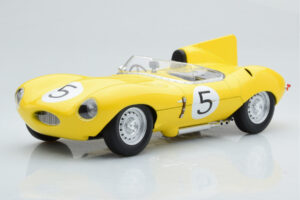
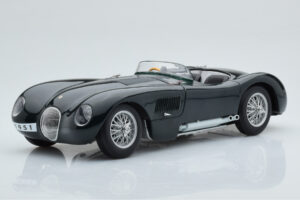
Endurance racing is equally central to the era. Jaguar’s C-Type introduced disc brakes to the Le Mans story, and the later D-Type combined aerodynamics with brutal efficiency, becoming a natural cornerstone for 1950s Le Mans model cars collections. Mercedes’ 300 SLR, with its long bonnet and side exhausts, is visually dramatic even as it carries the weight of 1955’s complex history. Ferrari’s sports racers — from early 375 Plus to the 250 Testa Rossa — bring a different flavour, all curves and red paint, while Aston Martin’s DBR1 in 1959 offers a very British counterpoint. These models often come down to livery correctness: roundels, race numbers, tiny national flashes and the right shade of aluminium or British racing green.
Beyond circuits, the fifties were still an age of long-distance bravado. The Mille Miglia and Targa Florio rewarded lightness and reliability as much as outright power, which is why so many period racers look compact and purposeful rather than flamboyant. The Carrera Panamericana, with its high-speed Mexican stages, created some of the decade’s most evocative imagery: auxiliary lamps, taped headlamps, and numbers painted directly onto doors. Rallying also begins to take on a modern shape, with the Monte Carlo Rally becoming a genuine test of preparation, tyre choice and night driving. Replicas of these events look best when small details are present — rally plaques, bonnet straps, spare wheels and the correct number plate format — because they tell the story at a glance.
Collectors often find the decade easier to curate than later periods because sponsorship is restrained and national identity is clear. A shelf can be built around driver legends such as Fangio, Moss, Hawthorn and Ascari, or around a single race with cars from different classes telling the broader picture. Pairing a road-going icon with its competition sibling also works well: a Mercedes 300 SL beside the 300 SLR, or a Jaguar XK-based road car alongside a D-Type, makes the engineering link obvious. If you enjoy British motor racing history, the late-fifties shift towards lighter, rear-engined cars provides a neat narrative bridge into the 1960s without needing to leave the era category. The point is coherence: pick a story, then let individual models earn their place.
Choosing Scale, Material and Maker
Because the 1950s includes everything from tiny city cars to long-bonneted GTs, scale choice affects the whole feel of a collection. Many UK enthusiasts grew up with 1:43 as the ‘proper’ model car scale thanks to Dinky and early Corgi, and it remains ideal for building a broad decade line-up without sacrificing an entire cabinet. Step up to 1:18 and the cars become objects in their own right: wire wheels show depth, grille texture becomes visible, and open-cockpit racers finally have room for believable steering wheels and instruments. If your aim is a timeline, 1:43 keeps things coherent; if your aim is to celebrate a few icons, larger scales deliver that sense of presence.
Material and construction matter more than people expect with fifties subjects. Diecast models suit cars where opening bonnets and boots add enjoyment, particularly on machinery with prominent engines or luggage detailing. They also tend to have that reassuring weight collectors like when handling a model. Resin replicas, by contrast, often achieve sharper shut lines and more delicate trim, which can flatter coachbuilt shapes and thin window surrounds, but they are usually sealed display pieces. Either approach can be excellent, yet the details to watch are similar: neat chrome application, realistic tyre profiles (whitewalls if appropriate), and properly finished interiors that avoid looking toy-like. With lots of curved glass and brightwork in this decade, paint quality and masking accuracy are not optional.
The maker landscape in this era tends to split by subject. For motorsport, specialists such as Spark have built a reputation for accurately researched Le Mans and sports-racing cars, while Minichamps has long been a reference point for grand prix and period road models in popular scales. For British everyday motoring and service vehicles, you will often see Corgi’s heritage ranges and Oxford Diecast’s catalogue referenced by UK collectors, especially when the goal is to recreate a believable street scene rather than a supercar line-up. Continental icons are covered by firms such as Norev for French classics (the DS is a frequent favourite) and Schuco for German saloons and sports cars, while boutique brands like Matrix or CMC sometimes tackle rarer coachbuilt subjects with higher prices and finer detailing. Availability varies by model, which is precisely why browsing an era category is useful.
When you are comparing individual replicas, the fifties demand an eye for proportion. Ride height is a common tell: too high and a Jaguar XK looks awkward; too low and a Citroën DS loses its peculiar, floating stance. Wheel and tyre detail matters as well, because wire wheels were everywhere and they look crude if the spoke pattern is simplified. On racing pieces, printing quality should be crisp enough that roundels and numbers do not bleed into the body colour, and period details such as bonnet pins, exhaust exits and taped lamps should be placed with intent. For collectors focusing on 1950s 1:18 model cars, check the metalwork and bright trim closely, as bigger scales make poor chrome or heavy shut lines obvious. The best models invite close inspection but still read correctly from across the room.
Curating a Coherent 1950s Display
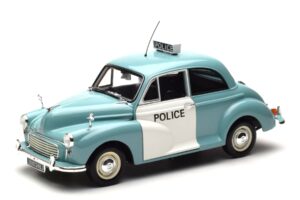
A satisfying 1950s collection usually starts with a simple organising idea. Some collectors build a distinctly British cabinet: a run of sports cars from MG, Triumph, Austin-Healey and Jaguar, balanced by a couple of more formal saloons and a period police car or taxi. Others go continental, following the decade’s shift from elegant pre-war thinking to the cleaner, more modern lines seen on cars like the DS and the early Italian GTs. Motorsport themes work especially well because the decade offers a clear progression from front-engined brutes to the first rear-engined challengers, and because the liveries are comparatively uncluttered. If you also enjoy model railways or dioramas, 1950s road cars instantly set the period without needing much additional scenery.
Display is where era collecting becomes genuinely enjoyable. Keeping a consistent scale gives a museum-like look, but mixing scales can be practical if you treat 1:18 as the hero and 1:43 as supporting cast. A Jaguar D-Type or Mercedes 300 SL in a larger format can anchor a shelf, with smaller models around it providing context — a period family saloon, a competitor’s racer, or a city car that shows how broad the decade really was. Consider colour as part of the composition: British racing green, Rosso Corsa, French greys and silvers, and the occasional bright two-tone all sit comfortably together if you group by tone rather than brand. Closed display cases are worth it for this era, as dust dulls chrome and makes clear glazing look tired.
However you approach it, the 1950s rewards collectors who enjoy both design history and mechanical honesty. The best 1950s model cars communicate the texture of the decade: thin pillars, generous chrome, purposeful racing numbers and the sense that innovation was happening in plain sight. Browsing an era page lets you compare 1950s classic car models across different makers and materials, and decide whether you prefer a single centrepiece replica or a broader cabinet that charts the whole decade. If your passion leans towards motorsport, you will find that 1950s Le Mans model cars sit naturally alongside early Formula 1 machinery, creating a coherent story of competition in its most romantic form. Explore the selection and build the chapter of motoring history that speaks to you.